
Managed network security is a service model where a third-party managed service provider (MSP) or managed security service provider (MSSP) is responsible for overseeing, operating, and protecting an organization’s network environment on an ongoing basis. It integrates technologies like managed firewalls, intrusion detection and prevention, endpoint security, SD-WAN, VPNs, and 24/7 monitoring into a centralized, proactive security framework. This ensures traffic, endpoints, user access, and critical infrastructure are continuously protected against evolving cyber threats.
Operationally, managed network security follows a continuous lifecycle, beginning with network assessment and configuration, followed by real-time monitoring, threat detection, incident response, and reporting. Security Operations Centers (SOCs) use SIEM, EDR, IDS/IPS, and access control tools to validate threats, contain attacks, and refine protections as network environments evolve.
For businesses, particularly small and medium-sized organizations, managed network security provides access to expert security teams and limits risks from ransomware, phishing, DDoS, and zero-day exploits, reduces alert fatigue, and ensures regulatory compliance. The result is a resilient, monitored network that supports operational stability and allows organizations to focus on growth rather than constant threat management.
What is Included in Managed Network Security Services?
Factors included in managed network security services are managed firewall services, intrusion detection, VPN management, managed endpoint protection, 24/7 monitoring, and secure access service edge. These services deliver managed, secure, proactive, and centralized network security management across network infrastructure, network traffic, endpoints, and access layers. For businesses, especially small and medium sized business (SMBs), this service model protects against cyber threats, maintains reliable network operations, and reduces security risks.7 key components included in managed network security services are:
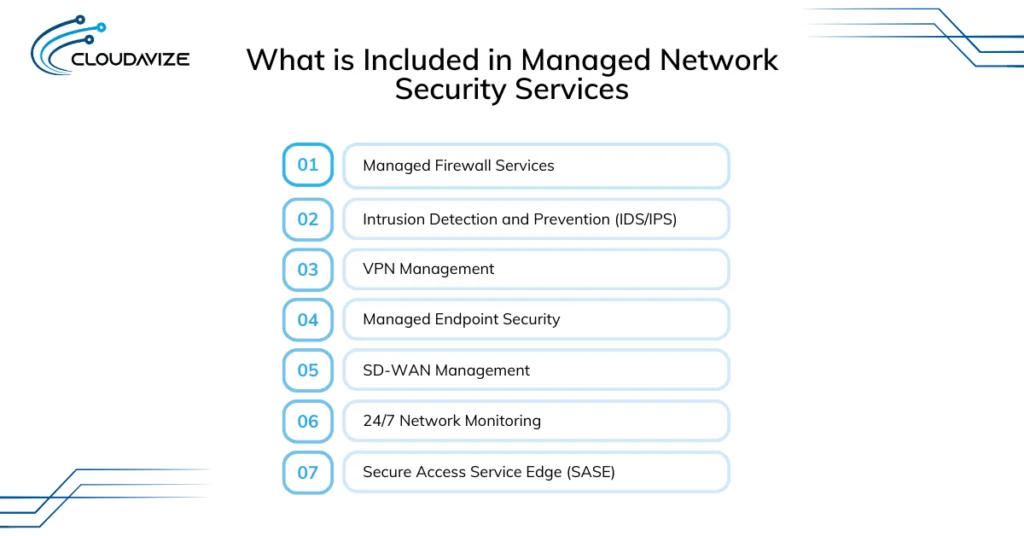
7 key components included in managed network security services are:
- Managed Firewall Services
Within managed network security services, managed firewall services include firewall configuration, policy management, rule optimization, automated patch management, and continuous monitoring across network boundaries. MSPs deploy next-generation firewalls (NGFWs) with deep packet and SSL inspection to analyze inbound and outbound network traffic and enforce policy-based prevention. Acting as an intelligent gatekeeper, this service segments traffic and blocks malicious data before it reaches core infrastructure. For businesses, this approach reduces the risk of cyberattacks, protects critical assets, and lowers the risk of costly data breaches. - Intrusion Detection and Prevention (IDS/IPS)
In managed network security, intrusion detection and prevention rely on real-time network traffic inspection, intrusion detection systems, and automated prevention systems, supported by advanced sensors that apply behavioral heuristics and signature matching. This service actively monitors network activity to identify lateral movement and in-progress attacks, then actively terminates suspicious connections and drops malicious packets targeting unpatched software vulnerabilities. By detecting and blocking threats before they spread across the infrastructure, the service minimizes attacker dwell time, prevents data exfiltration, safeguards operational uptime, and preserves brand credibility against sophisticated cyber threats. - VPN Management
Managing end-to-end encryption and MFA integration, the VPN management service secures remote connectivity through virtual private network configuration, user authentication, and performance monitoring. The service protects the encrypted tunnel between remote users and internal network resources by rotating cryptographic keys and updating protocols to prevent interception on untrusted networks. Its role is to enforce identity-based access controls that shield internal environments from external exposure. For businesses, including SMBs, VPN management enables secure, high-speed access for distributed teams while protecting sensitive data and supporting compliance requirements. - Managed Endpoint Security
Utilizing AI-driven Endpoint Detection and Response (EDR), managed endpoint security monitors laptops, desktops, and mobile devices for fileless malware and ransomware behavior. Within managed network security, this service goes beyond traditional antivirus by delivering real-time telemetry, automated threat detection, patch management, and isolation of compromised devices to stop lateral infection. Its role is to secure the network’s most vulnerable access points. To businesses, this visibility limits endpoint-based attacks and preserves business continuity by preventing single-user errors from escalating into network-wide disruption. - SD-WAN Management
SD-WAN management service functions as a core component of managed network security by combining application-aware routing, policy-based traffic control, and embedded security across distributed locations. Through centralized orchestration of security and performance policies, it ensures branch offices, data centers, and cloud environments receive consistent protection with continuous encryption across all links. Its role is to optimize traffic paths while maintaining secure connectivity. This approach improves application performance, eliminates regional blind spots, reduces operational overhead, and supports secure geographic expansion for businesses without weakening the overall security posture. - 24/7 Network Monitoring
Operating through a 24/7 Security Operations Center (SOC), the managed network security service delivers continuous network monitoring by using SIEM tools to correlate security events and detect anomalies in real time. This constant visibility enables security experts to maintain uninterrupted vigilance, allowing them to identify heartbeat failures, suspicious network traffic, and unauthorized login attempts even during off-hours. Once detected, the service validates incidents and generates immediate alerts, ensuring threats are contained before they spread across the network. For businesses, this round-the-clock defense layer reduces downtime, limits prolonged attacks, and ensures consistent protection at night, on weekends, and on holidays. - Secure Access Service Edge (SASE)
Secure Access Service Edge (SASE) is a core component of managed network security, integrating SD-WAN with cloud-native security capabilities, including Zero Trust network access (ZTNA) and secure web gateways. By enforcing security controls at the edge closest to the user, the service removes latency caused by backhauling traffic to centralized locations. Its role is to deliver dynamic, identity-centric access control through unified policy enforcement for users and applications. This cloud-first framework supports secure global access, streamlines security operations, and maintains consistent protection across SaaS, cloud, and on-premises environments.
How Does Managed Network Security Work?
Managed network security works by network assessment, security infrastructure setup, real-time network monitoring, threat detection, incident response, and continuous reporting. Each stage follows a defined operational sequence, where insights from one phase transition directly into the next to form a managed, secure, and proactive security lifecycle.
Here is how managed network security works:
- Network Assessment and Onboarding
The process begins with a comprehensive network assessment that evaluates network infrastructure, traffic flows, endpoints, access controls, and existing security risks. Security teams analyze vulnerabilities, misconfigurations, and threat exposure to establish a clear baseline. This onboarding phase defines security requirements and prepares the environment for controlled implementation, enabling a smooth transition into active security management. - Security Infrastructure Setup and Configuration
Following the network assessment, security infrastructure is deployed and configured based on identified risks and operational needs. Firewalls, intrusion detection systems, VPNs, endpoint security tools, and access policies are configured using centralized, policy-based controls. Once security infrastructure is set up, it establishes enforced security boundaries and prepares the network for continuous monitoring and threat prevention. - Real-Time Network Monitoring and Surveillance
With the infrastructure in place, real-time network monitoring begins across network traffic, endpoints, and access points, with 24/7 surveillance tools tracking every byte entering or leaving the network. This surveillance layer provides constant visibility, allowing abnormal patterns such as unusual traffic spikes or unauthorized access attempts across all endpoints to surface quickly for further analysis. - Threat Detection and Alert Generation
When an anomaly, such as a brute-force login attempt or a suspicious file transfer, is detected, managed network security uses AI-driven SIEM (Security Information and Event Management) tools to validate the threat. This step filters out false positives to ensure only legitimate risks are escalated. Once a high-probability threat is confirmed, an emergency alert is generated, triggering the incident response team to take action. - Incident Response and Threat Mitigation
After alerts are validated, incident response procedures are activated to contain and mitigate threats. Security teams isolate affected systems, block malicious traffic, and apply corrective controls to prevent further spread. This response phase restores secure operations while limiting damage to network infrastructure and data. - Reporting and Performance Review
The final stage involves generating detailed reports that document handled incidents, system uptime, and compliance status (e.g., PCI DSS or HIPAA). These reviews provide transparency into the network’s health and the effectiveness of the security measures. This data is then used to refine security policies and update the initial assessment, starting the lifecycle over to ensure the network stays ahead of evolving cyber threats.
What Are the Benefits of Managed Network Security for Businesses?
The benefits of managed network security for businesses are access to expert security teams, 24/7 monitoring, reduced operational costs, improved network performance, reduced alert fatigue, and seamless regulatory compliance. These benefits are achieved through centralized security management, continuous monitoring, and proactive threat handling that reduce risk, stabilize network operations, and align security controls with business and compliance requirements.
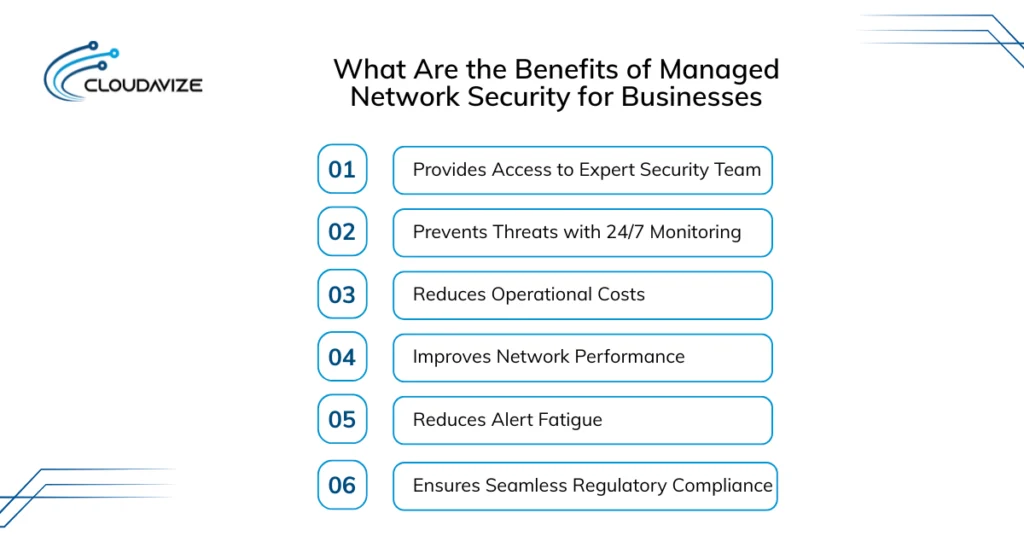
6 benefits of managed network security for businesses are:
- Provides Access to Expert Security Team
With managed network security, businesses gain direct access to dedicated security experts who are certified cybersecurity professionals, without the high cost of hiring and maintaining in-house specialists. This approach lowers operational expenses while ensuring experienced professionals continuously manage and protect the network. - Prevents Threats with 24/7 Monitoring
When managed network security is outsourced to an MSP, the MSP continuously monitors networks to identify and mitigate threats in real time, often before damage occurs. Constant oversight limits attack duration, reduces downtime, and keeps operations stable even outside standard working hours. - Reduces Operational Costs
By leveraging managed network security, operational costs are reduced by shifting security management, tooling, and expertise to a managed service model. Instead of maintaining in-house IT teams and infrastructure, organizations rely on centralized security operations, which lowers staffing expenses, minimizes unexpected incident costs, and creates predictable security spending. - Improves Network Performance
Network performance improves as managed network security continuously analyzes traffic and enforces optimized security policies. Proactive monitoring identifies congestion, misconfigurations, and inefficient routing early, resulting in reliable application access, stable connectivity, and a consistent user experience. - Reduces Alert Fatigue
Alert fatigue is minimized through intelligent event correlation and expert validation of security alerts. MSSPs filter false positives and prioritize actionable incidents before escalation. This approach ensures critical threats receive immediate attention while routine noise is suppressed, allowing for a faster response and a clearer operational focus. - Ensures Seamless Regulatory Compliance
Outsourcing managed network security to MSSPs helps organizations maintain compliance with complex industry regulations. Continuous monitoring, policy enforcement, and reporting reduce compliance gaps and lower the risk of fines or legal penalties.
What Are the Common Challenges and Threats That Arise Without Managed Network Security?
Common challenges and threats that arise without managed network security are ransomware and malware attacks, DDoS attacks, phishing and social engineering, and zero-day exploits. These threats emerge when organizations lack continuous monitoring, centralized controls, and expert response capabilities. Without managed network security, gaps often go undetected, allowing attacks to spread across the network infrastructure, disrupt operations, and cause long-term operational and financial damage.
4 common challenges and threats that arise without managed network security are:
- Ransomware and Malware Attacks
Without managed network security, malicious software commonly enters the network through unpatched vulnerabilities, infected email attachments, or malicious downloads. Once inside, ransomware and malware encrypt critical business files and spread laterally across systems, effectively holding organizational data hostage. Managed network security addresses this challenge through continuous monitoring, endpoint detection, intrusion prevention, and rapid isolation of infected systems, thereby containing the threat early and preventing widespread data loss. - DDoS (Distributed Denial of Service) Attacks
DDoS attacks occur when large volumes of malicious traffic overwhelm network resources, making applications and services unavailable. These attacks often exploit unprotected network entry points and a lack of traffic filtering. To overcome this threat, managed network security continuously monitors traffic patterns in real time, filters malicious requests, and reroutes traffic to maintain availability and protect critical services. - Phishing and Social Engineering
Without proper security filters, phishing attempts are more likely to succeed, tricking employees into revealing credentials or installing malware through deceptive emails, messages, or spoofed websites. These attacks exploit human behavior and often bypass basic defenses when centralized monitoring and access controls are missing. Managed network security mitigates this risk by detecting abnormal login patterns, enforcing identity-based access controls, and identifying credential misuse early, thereby preventing unauthorized access to internal systems and limiting the spread of compromise. - Zero-Day Vulnerabilities
Zero-day vulnerabilities occur when attackers exploit previously unknown software flaws before patches are available. Organizations without managed security often lack the visibility and response capability to detect these exploits in time. To overcome this issue, managed network security uses behavior-based threat detection, intrusion prevention systems, and rapid policy updates to block suspicious activity, even when vulnerabilities are newly discovered.
What Are the Top Tools Used in Managed Network Security?
Top tools used in managed network security include firewall management tools (like Fortinet FortiGate), security information and event management (SIEM) tools (e.g., IBM QRadar), endpoint detection and response (EDR) tools (e.g., CrowdStrike Falcon), VPN and secure access management tools (e.g, Cisco AnyConnect), and intrusion detection and prevention tools (e.g., Suricata). These tools work together to provide centralized visibility, real-time threat detection, policy enforcement, and rapid response across the network environment.
Firewall Management Tools
Firewall management tools serve as the first line of defense in managed network security, controlling, inspecting, and filtering network traffic at critical entry and exit points. These tools enforce security policies, block unauthorized access, and prevent malicious traffic from reaching internal systems. When managed centrally, firewall tools improve visibility, strengthen perimeter security, and reduce the likelihood of network-based attacks affecting business operations.
- Cisco Adaptive Security Appliance (ASA)
As a robust, multi-functional security device, the Cisco ASA combines firewall, antivirus, and VPN capabilities into a single integrated appliance. Its role in security management is to control inbound and outbound traffic according to predefined policies, ensuring only authorized connections are permitted. For businesses, Cisco ASA helps protect core network infrastructure, reduce unauthorized access attempts, and support secure remote connectivity. - Fortinet FortiGate
The Fortinet FortiGate is a next-generation firewall that integrates firewalling, intrusion prevention, and application control. It manages security by inspecting network traffic in real time and blocking known and emerging threats at high speed. FortiGate strengthens threat prevention while maintaining network performance, which helps reduce security incidents without disrupting business operations. - Palo Alto Networks Next-Gen Firewall
Palo Alto Networks Next-Gen Firewall is a market-leading, ML-powered NGFW that identifies and controls traffic based on applications, users, and content rather than port numbers. Using single-pass parallel processing, it performs deep packet inspection without degrading performance. This delivers superior visibility and automated threat prevention, enabling strong Zero Trust enforcement across cloud and on-premise environments. - Sophos XG Firewall
An innovative solution in the managed network security space, the Sophos XG Firewall offers synchronized security by sharing real-time threat intelligence with protected endpoints. It automatically identifies and isolates compromised hosts to stop ransomware and malware from spreading laterally. This approach improves visibility, simplifies management through a centralized dashboard, and enables faster, automated incident response with minimal manual intervention.
Security Information and Event Management Tools
Acting as the central intelligence layer in managed network security, Security Information and Event Management tools collect, correlate, and analyze security data from across the network. These tools turn raw logs and events into actionable insights, enabling real-time threat detection, faster incident response, and continuous visibility into the security posture. When managed centrally, SIEM tools reduce blind spots, improve detection accuracy, and support compliance and audit readiness.
- IBM QRadar
IBM QRadar is an enterprise-grade SIEM platform that uses AI and behavioral analytics to automatically prioritize and investigate high-risk security incidents. By correlating data from thousands of network sources, it detects anomalies such as internal data leaks or compromised user credentials. The primary business benefit is a dramatic reduction in alert fatigue, allowing security teams to focus their energy on the most critical threats that could impact business continuity. - Splunk Enterprise Security
As a data-centric SIEM platform, Splunk Enterprise Security provides real-time visibility and advanced search analytics for both security and general IT operations. It enables proactive threat hunting by allowing analysts to search through petabytes of historical data to uncover hidden or dormant breaches. This offers businesses unparalleled flexibility, allowing them to tailor security monitoring to their specific operational needs while gaining deep insights into overall network health. - LogRhythm
LogRhythm is a comprehensive SIEM platform designed for speed, specifically focused on reducing the time to detect and respond to threats (MTTD and MTTR). It automates log collection across disparate systems and applies machine learning to identify suspicious lateral movement within the network. For businesses, this provides a highly efficient workflow for security analysts and ensures they can meet strict compliance requirements with automated, audit-ready reporting. - Exabeam
Exabeam is a next-gen SIEM that focuses heavily on User and Entity Behavior Analytics (UEBA) to detect modern, credential-based attacks and insider threats. It manages security by identifying abnormal behavior patterns that indicate compromised accounts or insider threats. This effectively identifies silent cyberattackers who use stolen legitimate credentials, safeguarding sensitive corporate data from sophisticated breaches that often bypass traditional firewalls.
Endpoint Detection and Response Tools
Endpoint Detection and Response tools secure end-user devices, such as laptops, desktops, and servers, by continuously monitoring endpoint activity and responding to suspicious behavior in real time. In managed network security, EDR tools provide deep visibility into endpoint threats, enable rapid attack containment, and prevent lateral movement across the network. These tools strengthen endpoint protection while supporting centralized security operations and faster incident resolution.
- CrowdStrike Falcon
CrowdStrike Falcon is a cloud-based EDR platform that monitors endpoint behavior using threat intelligence and behavioral analytics. Its role in network security management is to detect advanced malware, ransomware, and fileless attacks, and to isolate compromised devices instantly. For businesses, Falcon reduces endpoint-based breaches, limits lateral movement, and improves response speed without requiring on-premise infrastructure. - Symantec Endpoint Protection
As an endpoint security solution that combines antivirus, behavioral detection, and device control, Symantec Endpoint Protection delivers a layered defense against both common malware and advanced persistent threats. It supports managed network security by protecting endpoints through centralized policy enforcement and continuous threat prevention. The business impact includes trusted enterprise-wide management, strong compliance reporting, and reliable protection for modern and legacy. - Carbon Black
Carbon Black is a cloud native endpoint security platform that provides next-generation antivirus, endpoint detection and response, and workload protection. This tool manages network security through a centralized SaaS console that enables real-time threat hunting, behavioral analytics, and vulnerability management across Windows, Mac, and Linux environments. For organizations, this delivers broad endpoint visibility, faster threat investigation, and reduced impact from advanced and persistent attacks.
VPN and Secure Access Management Tools
By encrypting network traffic and enforcing identity-based controls, VPN and secure access management tools provide a critical layer of managed network security. These tools secure access to internal systems, cloud applications, and sensitive data by verifying user identity and protecting data in transit. They support remote and hybrid work environments, enforce consistent access policies, and reduce the risk of unauthorized access across distributed network locations.
- Cisco AnyConnect
Cisco AnyConnect is a unified security agent that provides highly secure VPN access while simultaneously performing endpoint posture checks and roaming protection. It manages network security by ensuring that only healthy and compliant devices, those with updated patches and active security software, are allowed to connect to the internal corporate core. For the business, this enables a flexible, mobile work environment that significantly reduces the risk of data leaks or unauthorized access from remote devices connected to public or untrusted Wi-Fi. - Palo Alto Networks GlobalProtect
GlobalProtect extends the advanced protection of the Palo Alto Networks Next-Gen Firewall to users across all devices and locations. It combines secure VPN connectivity with endpoint security integration to enforce consistent, identity-based access policies regardless of where users connect. By applying the same traffic inspection and threat prevention controls to remote and on-site users, GlobalProtect eliminates remote access blind spots, improves visibility into user activity, and delivers a seamless, secure experience that scales with a growing, distributed workforce. - Fortinet FortiVPN
Designed to integrate seamlessly with Fortinet’s security ecosystem, Fortinet FortiVPN works in tandem with the FortiGate firewall to deliver encrypted SSL or IPsec connectivity for remote users and branch offices. It manages network security by continuously inspecting traffic within the VPN tunnel, preventing remote access from becoming a backdoor for malware. This integration provides centralized access control, consistent policy enforcement, and a cost-effective, high-performance approach to securing remote and hybrid network environments.
Intrusion Detection and Prevention Tools
Intrusion detection and prevention tools monitor network traffic in real time to identify malicious activity, policy violations, and attack patterns before they compromise systems. Within managed network security, these tools inspect packets, analyze behavior, and either alert security teams or automatically block threats. They provide deep visibility into network activity, strengthen threat prevention, and help organizations respond quickly to attacks that bypass perimeter defenses.
- Snort
Snort is an open source intrusion detection and prevention system that analyzes network traffic using rule-based and signature-matching techniques. This tool’s role in managing network security is to detect known attack patterns, suspicious behavior, and protocol violations as traffic moves across the network. For businesses, Snort delivers cost-effective intrusion detection, early threat visibility, and greater control over network-level attacks. - Suricata
Created for modern, high-speed networks, Suricata is a multi-threaded IDS/IPS that performs deep packet inspection at scale. It manages network security by analyzing application-layer protocols and detecting hidden threats using packet metadata and TLS certificate inspection. This allows organizations to secure high-bandwidth environments without introducing latency, ensuring strong protection that keeps pace with data-intensive network operations. - Zeek
Focused on deep visibility rather than simple alerts, Zeek is a passive network traffic analysis platform that records detailed logs and metadata for every network interaction. It manages security by analyzing communications, sessions, and behavioral anomalies to uncover long-term and low-and-slow attack campaigns. This detailed activity history supports advanced threat hunting, forensic investigations, and post-incident analysis, providing organizations with reliable ground-truth data and ensuring that no malicious behavior goes undocumented.
How Much Does Managed Network Security Cost?
Managed network security costs typically range from $100 to $25,000 per user per month, while organizations seeking comprehensive Managed Security Service Provider (MSSP) coverage with advanced 24/7 SOC monitoring incur higher costs. For smaller organizations, this typically results in a monthly investment of $2,000 to $6,000, whereas mid-sized businesses with more complex environments often incur costs of $10,000 to $25,000 per month.
These pricing levels are shaped by several interrelated factors, including the total number of users and endpoints, the complexity of the network architecture, such as multiple locations or cloud-hybrid integrations, and industry-specific regulatory requirements like HIPAA, PCI DSS, or GDPR. The final investment is also influenced by the depth of the service level agreement, the selected security technologies (e.g., advanced EDR versus basic antivirus), and one-time onboarding fees.
What Are the Best Practices for Managed Network Security?
Best practices for managed network security include conducting regular network audits, implementing MFA, updating all systems, monitoring network traffic, segmenting the network, and training employees. Together, these practices create a structured and proactive security approach that helps organizations reduce risk, maintain continuous visibility, and respond to threats before they disrupt operations.
8 best practices for managed network security include:
- Conduct Regular Network Audits
Regular network audits systematically assess network infrastructure, configurations, access controls, and traffic flows to uncover misconfigurations, unused services, and emerging vulnerabilities. For businesses, this provides continuous visibility into network security, reduces hidden security gaps, and supports proactive risk management. - Implement Multi-Factor Authentication (MFA)
MFA works by requiring multiple verification factors, such as passwords, tokens, or biometric checks, before granting access. Its role is to prevent unauthorized access even if credentials are compromised. For businesses, MFA significantly lowers the risk of account takeover, protects sensitive systems, and strengthens identity-based security across users and applications. - Keep All Systems and Software Updated
System and software updates are managed through continuous patching and version control across servers, endpoints, and network devices. This practice closes known security gaps that attackers commonly exploit. Its role is to reduce vulnerability exposure. The impact for businesses is fewer successful exploits, stronger system stability, and lower incident response costs. - Monitor Network Traffic in Real-Time
Real-time monitoring continuously analyzes network traffic, security events, and behavioral patterns to detect anomalies, intrusions, and policy violations as they occur. For businesses, this results in faster threat detection, reduced dwell time, and improved ability to contain incidents before they escalate. - Segment Your Network Effectively
Network segmentation runs by dividing the network into controlled zones based on function, sensitivity, or user role. Its role is to limit lateral movement during a breach. The business impact is reduced blast radius during incidents and stronger protection for critical systems and sensitive data. - Train Employees on Cybersecurity Awareness
Cybersecurity training focuses on ongoing education on phishing, social engineering, and safe system use, helping reduce human error, which remains a common entry point for attacks. For businesses, this leads to fewer successful phishing attempts, lower incident frequency, and a stronger overall security culture. - Enforce Least Privilege Access Policy
Least privilege enforcement is achieved by granting users only the access required to perform their roles, and nothing more. Its role is to minimize unauthorized access and reduce potential damage from compromised accounts. The business impact includes tighter access control, reduced insider risk, and improved alignment with compliance requirements. - Have a Solid Incident Response Plan
An incident response plan operates through predefined procedures for detection, containment, eradication, and recovery. Its role is to ensure a coordinated and timely response during security events. For businesses, this reduces downtime, limits operational disruption, and improves incident recovery speed.
How to Choose the Right Managed Network Security Service Provider for Your Business?
Choosing the right managed network security service provider (MSSP) requires evaluating technical expertise, proactive monitoring capabilities, and industry experience to ensure the provider can protect your network as your business grows. A trusted provider delivers continuous threat monitoring, rapid incident response, and clear accountability through well-defined service agreements, reducing long-term security and operational risk.
Key steps for choosing an MSSP include:
- Define Your Security and Compliance Needs
Start by identifying your existing security gaps, risk exposure, and regulatory requirements such as HIPAA, PCI DSS, or GDPR. Clear requirements help ensure the managed network security service provider aligns services with your compliance and operational needs. - Ensure Proactive 24/7 Security Monitoring
Select a managed network security service provider that offers round-the-clock monitoring through a staffed SOC. Proactive monitoring helps detect and mitigate threats in real time rather than responding only after incidents occur. - Verify Expertise and Certifications
Confirm the managed network security service provider employs certified security professionals and has experience with modern security technologies relevant to your industry. Proven expertise improves threat detection accuracy and response effectiveness. - Evaluate Scalability and Service Flexibility
The managed network security service provider should be able to scale services as your network expands, whether through additional users, endpoints, cloud adoption, or new locations. Flexible service models ensure long-term alignment with business growth. - Review Incident Response and SLAs
Assess how quickly the managed network security service provider responds to security incidents and how responsibilities are defined in Service Level Agreements. Documented response times and escalation processes are critical during security emergencies. - Choose a Reputable and Established Partner
Working with experienced managed network security providers helps ensure consistent protection, reduced downtime, and predictable security outcomes. Trusted managed network security providers operate as long-term security partners, offering proven processes, reliable response capabilities, and ongoing guidance rather than short-term, reactive services.