
Article summary: SMBs often approve “small” software add-ons based on reassuring security language. The risk is that these tools can gain ongoing access to sensitive data and quietly expand vendor risk. A vendor risk checklist that demands proof replaces vague promises with verifiable answers about controls, data handling, access, and incident readiness.
The riskiest software decision most small businesses make isn’t the big platform rollout. It’s the “small” add-on that someone wants to connect in 30 seconds.
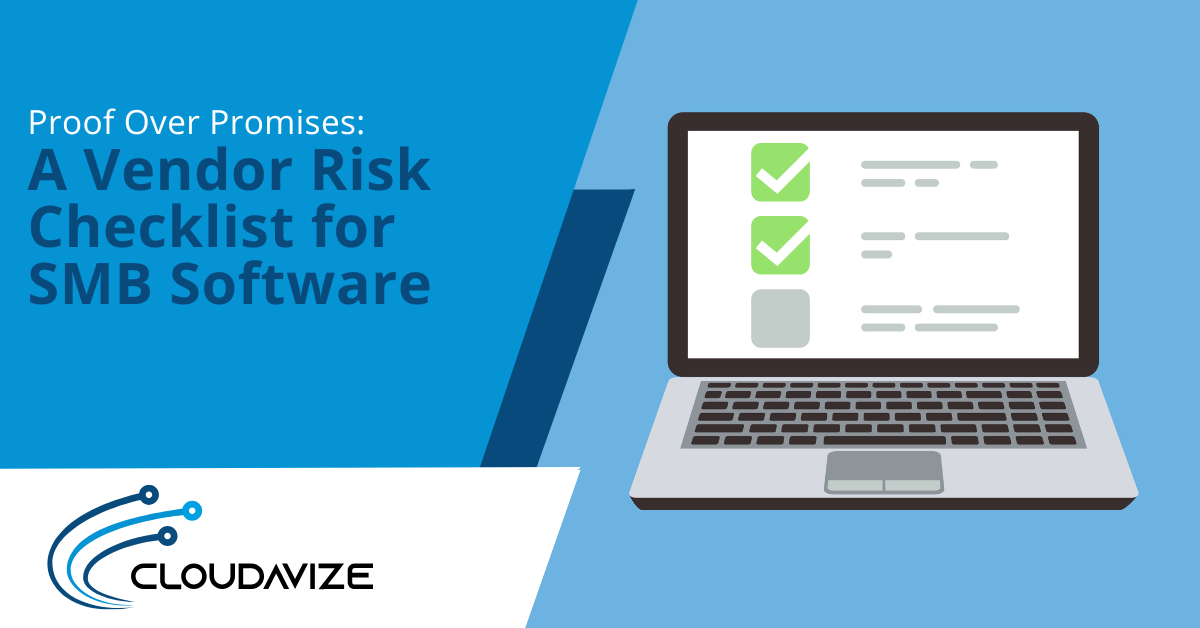
That’s why a vendor risk checklist matters.
Most vendors will tell you they “take security seriously.” Some will show badges. Some will publish polished trust pages. But promises don’t reduce risk. Proof does.
Why “We Take Security Seriously” Isn’t Enough
Most vendors will tell you they “take security seriously.”
The problem is that the phrase doesn’t tell you anything measurable. It also doesn’t help you compare one add-on to another when both sound equally confident.
That’s why a vendor risk checklist needs to be built around evidence you can verify, not reassurance you can’t.
NIST’s supply chain guidance notes that modern environments involve multiple suppliers and components, which can reduce an organization’s direct visibility into how products and services are developed, assembled, and secured.
This matters for SMBs because every SaaS add-on and integration is now part of your supply chain, even if it’s “just” a plugin.
So, what counts as real proof?
Independent assurance is one of the strongest signals. The AICPA explains that “a SOC 2 examination is a report on controls” relevant to areas like security, availability, confidentiality, and privacy. In other words, it’s structured evidence about controls, not a marketing claim.
The other piece is asking the same meaningful questions every time.
Bottom line: “we take security seriously” is easy to say.
A vendor risk checklist helps make the review process faster, clearer, and more defensible.
What Counts as Proof and What Doesn’t
“Non-proof” is anything that sounds reassuring but can’t be verified. A good vendor risk checklist helps you separate the two quickly.
One of the clearest forms of proof is independent, standards-based validation.
The Cloud Security Alliance recommends asking vendors which security frameworks, certifications, or regulatory requirements they align with, such as ISO 27001 certification, SOC 2 reporting, or GDPR compliance.
Standards help vendors demonstrate compliance and operationalize security rather than leaving it as vague intent.
Proof also includes operational readiness.
It’s easy for a vendor to promise they respond quickly. It’s more meaningful when they can describe an incident response process and the communication expectations around it.
Incident response planning is a core question area, because you’re not only buying a product. You’re buying the vendor’s ability to detect, contain, remediate, and communicate when the unexpected happens.
Finally, proof is consistency.
So, what doesn’t count as proof? If it can’t be verified, treat it as marketing and rely on your vendor risk checklist to turn claims into documented evidence.
The Vendor Risk Checklist SMBs Can Actually Use
Use this vendor risk checklist any time a tool will store sensitive data, connect to core systems, or keep ongoing access after setup.
Independent Assurance
Don’t settle for “we’re compliant.” Ask what the vendor can provide that shows security is real and repeatable.
If you’re trying to keep control of your environment long-term, this is part of protecting your “digital destiny,” not just checking a box.
Data Handling “Receipt Check”
Vendor risk becomes your problem the moment you can’t explain where your data goes, how long it’s kept, and what happens to it after you leave.
Strong compliance is built on everyday habits like controlling access, protecting data properly, and being able to recover consistently.
What to document in writing:
- What data is collected
- Where it’s stored/processed
- Retention period by default, and whether you can change it
- How deletion works and what happens to backups/archives
Access Controls and Admin Reality
Most vendor risk isn’t the tool itself. It’s the access you gave it.
If you want predictable governance, you need clarity on who can access what, and what happens when roles change.
What to verify:
- Support for SSO/MFA where applicable
- Role-based access and least-privilege options
- Admin activity logging details
- How vendor staff access customer environments and how that access is approved
Incident Response and Notification
When something goes wrong, the difference between a minor disruption and a painful week is whether there’s a plan.
A strong risk program should include incident response readiness as part of how you manage threats and reduce exposure.
What to ask for:
- Their incident response process in plain language
- How and when customers are notified
- Who your escalation contact is during an incident
Vulnerability Management and Testing
Good vendors don’t rely on “security by reputation.” They show ongoing discipline: finding weaknesses, prioritizing fixes, and reducing known exposure over time.
What to confirm:
- Do they run regular vulnerability assessments
- How are fixes prioritized
- How quickly are high-risk issues patched
Third-Party and Supply Chain Risk
Your vendor has vendors. If you don’t understand who else touches your data, you don’t have real oversight.
What to request:
- A list of third parties/subprocessors that may touch your data
- How third parties are assessed and reviewed
- How you’ll be informed when third parties change
Business Continuity and Exit Options
Even the “best” vendor can have outages, policy changes, or pricing shifts.
A mature approach assumes change and keeps options open.
What to document:
- Where your critical data lives and how you export it
- Offboarding steps
- What happens to your data after termination
- Minimum recovery expectations
Make Proof the Price of Entry
A vendor risk checklist is how you stop relying on assumptions.
Want a vendor review process that’s fast, consistent, and easier to stand behind? Cloudavize can support your team as you apply a proof-first checklist to the tools you already use, decide where deeper review makes sense, and put a simple review rhythm in place going forward.
Contact the team now to learn more.
Article FAQs
What is a vendor risk checklist?
A vendor risk checklist is a short set of questions you use to verify how a vendor handles security, access, and data before you approve a tool or add-on. It helps you compare vendors using evidence, not marketing language.
Is SOC 2 enough to trust a vendor?
SOC 2 is a strong signal, but it’s not a guarantee. You still need to confirm scope, recency, and whether it covers the product and data flows you’ll actually use.
What’s the biggest red flag when evaluating software add-ons?
When the add-on wants broad, ongoing access to email, files, or admin functions. As well as when the vendor can’t clearly explain why, how it’s protected, and how access is removed.