What is IT Service Management (ITSM)?

IT Service Management (ITSM) is a structured, governance-driven discipline for managing the full lifecycle of IT services to ensure they consistently align with business objectives and deliver measurable value. Rather than operating IT as a reactive support function, ITSM standardizes processes such as incident management, problem management, change management, service-level management, and knowledge management to ensure predictable, reliable, and performance-based service delivery.
Through recognized frameworks like ITIL, ISO/IEC 20000, COBIT, and VeriSM, organizations formalize roles, workflows, and service performance metrics within a unified service management system. Supporting tools such as ServiceNow and Jira Service Management enable automation, centralized service desks, SLA monitoring, and configuration visibility, which strengthen governance and operational control.
By combining structured processes, automation, and continuous improvement, ITSM reduces operational costs, improves service reliability, enhances customer and employee experience, and ensures regulatory compliance. Across industries, ITSM transforms IT operations into a scalable, business-aligned, and measurable service management capability that supports long-term digital transformation.
Why is ITSM Important?
IT Service Management is important for aligning IT services with business goals, improving operational efficiency by standardizing ITSM processes, reducing downtime, lowering costs, and enhancing user satisfaction through faster, more reliable, and consistent IT service delivery. Information Technology Service Management transforms IT operations into a structured, business-aligned, and measurable service management system.
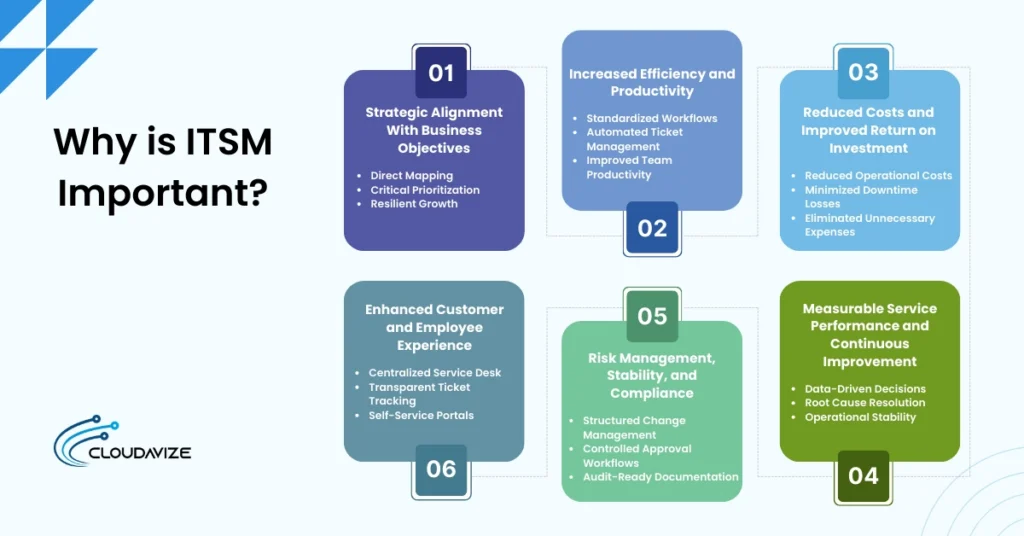
Here is why ITSM is essential for modern organizations and the measurable impact it produces:
- Strategic Alignment With Business Objectives
IT Service Management aligns IT service delivery with business objectives through a governance-based service management framework that maps IT services directly to revenue and operational goals. By prioritizing business-critical systems such as payment platforms and customer portals, ITSM ensures that technology investments support measurable outcomes. This structured alignment improves coordination, strengthens return on investment through optimized resource allocation, and supports digital transformation initiatives while maintaining business continuity during service disruptions. - Increases Efficiency and Productivity
ITSM improves operational efficiency by standardizing workflows and automating processes within ITSM tools and software. Documented incident management, problem management, and change management processes reduce variability and shorten resolution times. Automation enables faster ticket categorization and escalation, allowing IT teams to focus on high-value optimization activities rather than repetitive administrative tasks, thereby improving overall productivity. - Reduces Costs and Improves Return on Investment
By improving asset management, minimizing downtime, and optimizing infrastructure utilization, ITSM reduces operational costs and strengthens financial control. Configuration management databases increase visibility into IT dependencies, which helps prevent downtime-related losses. By implementing structured asset tracking and identifying unused licenses or redundant cloud resources, organizations eliminate unnecessary expenses and improve overall return on investment. - Enhances Customer and Employee Experience
ITSM improves user experience through centralized service desks, structured service request management, and integrated knowledge management systems. Transparent ticket tracking and automated communication updates provide clarity and reduce uncertainty for users. Self-service portals enable faster issue resolution, while standardized workflows ensure consistent and reliable support across the organization, ultimately increasing satisfaction and service fulfillment rates. - Risk Management, Stability, and Compliance
With structured change management and monitored IT operations, ITSM strengthens governance and reduces operational risk. Controlled approval workflows prevent unauthorized system modifications and improve infrastructure stability. By maintaining audit-ready documentation and enforcing compliance standards such as ISO/IEC 20000, organizations reduce service disruptions and maintain SLA compliance in regulated environments. - Measurable Service Performance and Continuous Improvement
IT Service Management measures service performance metrics, including SLA compliance, resolution rates, incident trends, and service availability, to guide improvement initiatives. Structured performance reporting supports process refinement, while problem management removes root causes of recurring disruptions. This data-driven approach improves service reliability, strengthens governance controls, and ensures long-term operational stability.
What is an ITSM Framework?
An ITSM framework is a structured set of best practices, standardized processes, and governance-based principles designed to help organizations manage the full lifecycle of their IT services. Instead of handling IT operations through ad hoc methods, an ITSM framework’s primary purpose is to establish proven, process-oriented structures that ensure consistency, service quality, accountability, and measurable control throughout the IT department.
This framework includes defined components, including incident management, problem management, change management, service-level management, configuration management, and knowledge management. It also formalizes roles and responsibilities, service value system logic, policy frameworks, performance metrics, and a governance model. These elements work together to standardize how a service provider manages service requests, resolves incidents, controls changes, and measures service performance.
What are the Popular Frameworks for ITSM?
Popular frameworks for ITSM include ITIL, TOGAF, ISO/IEC 20000, VeriSM, and COBIT, which provide governance models, standardized processes, and best-practice guidance for managing IT services. Each framework defines how organizations structure IT service delivery, control risk, measure service performance, and align IT services with business objectives.
8 most popular ITSM frameworks are:
- ITIL
Recognized as one of the most widely adopted ITSM frameworks, ITIL (Information Technology Infrastructure Library) provides structured guidance for managing the IT service lifecycle through a defined service value system. It outlines standardized practices, including incident, problem, change, and service-level management. Organizations that implement this framework improve service quality, strengthen SLA compliance, reduce resolution times, and establish a measurable governance-driven IT service management model. - TOGAF
Designed as an enterprise architecture framework, TOGAF (The Open Group Architecture Framework) aligns IT and business strategies through a structured method for architecture development. Although not exclusively focused on ITSM, it strengthens IT Service Management by ensuring that services integrate with long-term enterprise architecture goals. Adoption improves strategic alignment, reinforces governance structures, and standardizes technology planning across business units. - ISO/IEC 20000
As an internationally recognized service management standard, ISO/IEC 20000 defines formal requirements for establishing and continually improving a service management system. Unlike guidance-based frameworks, it enables organizations to achieve certification against defined compliance criteria. Implementation strengthens audit readiness, improves risk management practices, and demonstrates structured and compliant IT service management capabilities. - VeriSM
VeriSM is a service management model that integrates governance principles with modern delivery methods such as Agile, DevOps, and cloud-based environments. VeriSM focuses on flexibility and value-driven service management rather than rigid process enforcement. Organizations that implement VeriSM improve adaptability, align service delivery with digital transformation initiatives, and integrate multiple management practices into a unified governance model. - COBIT
Developed to support enterprise IT governance, COBIT defines control objectives, risk management principles, and measurable performance metrics for IT operations. The framework focuses on compliance, accountability, and governance-driven performance management. Organizations adopting COBIT strengthen regulatory alignment, improve oversight of IT infrastructure, and establish structured control mechanisms across service delivery functions. - FitSM
FitSM is a lightweight, structured IT service management standard designed for organizations that require simplified, scalable ITSM processes. It provides minimal yet formalized process requirements aligned with service management best practices. Organizations that implement FitSM improve process standardization, achieve cost-effective governance, and maintain service quality without the complexity of extensive implementation. - CMMI
Structured as a process maturity model, CMMI (Capability Maturity Model Integration) evaluates and improves organizational capability across defined maturity levels. Although broader than ITSM alone, it reinforces IT Service Management by formalizing process optimization and performance measurement. Organizations implementing CMMI increase operational consistency, elevate process maturity, and establish measurable mechanisms for continuous improvement. - ASL’s
ASL, or Application Services Library, is a framework focused specifically on application management within IT Service Management. ASL defines processes for maintaining, improving, and governing application services across their lifecycle. Organizations that implement ASL improve application stability, strengthen service support for business-critical systems, and integrate application management into a broader service management framework.
What is the Difference between ITSM and ITIL?
ITSM is the overall philosophy, strategy, and processes for managing IT services to meet business needs, while ITIL (Information Technology Infrastructure Library) is a specific, widely adopted best-practice framework for implementing ITSM. In simple terms, ITSM defines the discipline of managing IT service delivery, and ITIL provides structured guidance for executing that discipline through standardized practices and a service value system.
Below is the table highlighting the major differences between ITSM and ITIL:
| Key factors | ITSM (IT Service Management) | ITIL (Information Technology Infrastructure Library) |
| Scope | Broad discipline that covers the full lifecycle of IT service delivery | Specific best-practice framework within the ITSM domain |
| Purpose | Align IT services with business objectives and improve service quality | Provide structured guidance and standardized practices to implement ITSM |
| Core Focus | Managing people, processes, technology, and governance for IT services | Defining detailed practices such as incident management, change management, and service-level management |
| Nature | Management philosophy and operational discipline | Governance-based framework and structured methodology |
| Flexibility | Implemented using multiple frameworks such as ITIL, ISO/IEC 20000, or COBIT | Provides a predefined service value system and structured lifecycle model |
| How They Work Together | Defines what an organization manages in IT service delivery | Defines how to structure and standardize those management activities |
What Are ITSM Processes?
ITSM process includes incident management, problem management, configuration management, service request management, service-level management, and knowledge management. When these processes operate in coordination, organizations improve service quality, strengthen SLA compliance, reduce operational risk, and increase service reliability.
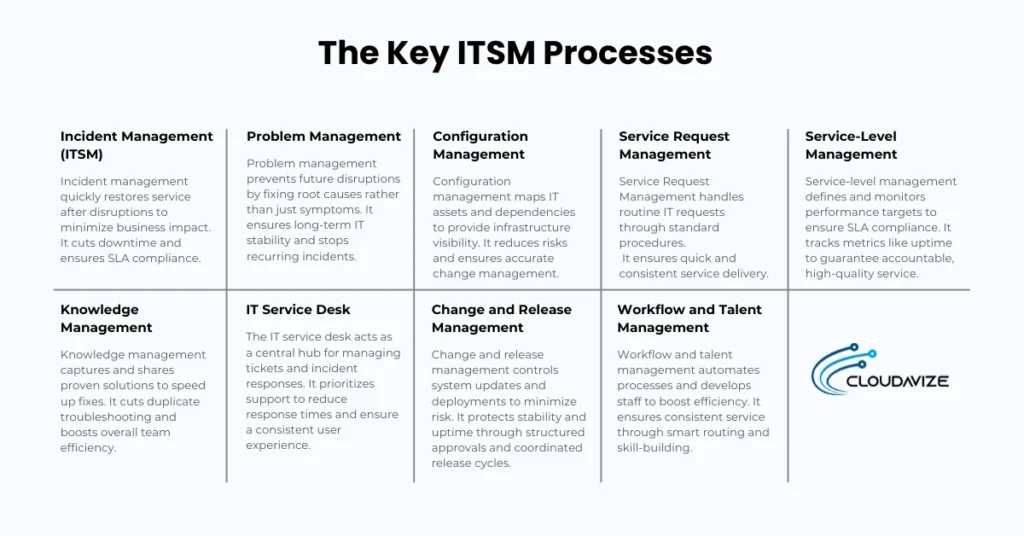
Below are the 9 key ITSM processes:
- Incident Management
Under incident management, ITSM manages and resolves unplanned service interruptions or performance degradations, such as server outages, application crashes, or network failures, as quickly as possible. This process restores normal service operation with minimal business impact. It reduces incident resolution time, improves service availability, increases customer satisfaction, and supports SLA compliance. - Problem Management
While incident management restores service quickly, problem management focuses on preventing future disruptions through root cause analysis and documented corrective actions. Problem management identifies, analyzes, and eliminates the underlying causes of recurring incidents. This structured approach improves long-term service stability, reduces repeat incidents, and strengthens operational efficiency across the IT infrastructure. - Configuration Management
Configuration management maintains accurate records of configuration items, such as servers, applications, databases, and network components, in a configuration management database. It maps relationships and dependencies across the IT infrastructure to provide clear visibility into system architecture. This visibility supports change-management decisions, reduces deployment risk, and improves asset-management accuracy. - Service Request Management
Within service request management, routine service requests such as password resets, software installations, and access provisioning are handled through standardized workflows. These requests differ from incidents because they are planned and procedural rather than unexpected disruptions. The process improves response times, ensures consistent request fulfillment, and increases user satisfaction through structured and repeatable execution. - Service-Level Management
In service-level management, the organization defines, monitors, and enforces service-level agreements between the service provider and service consumers. This ITSM process establishes measurable performance targets, such as response time, resolution time, and system availability, and tracks service performance metrics to ensure SLA compliance. Structured monitoring and reporting strengthen accountability, improve service quality, and support predictable IT service delivery. - Knowledge Management
Within knowledge management, the IT organization captures, organizes, and distributes documented solutions, technical documentation, and process guidelines across the service management system. It enables faster incident resolution and consistent service execution by allowing teams to reuse validated solutions. Documented known errors and corrective actions reduce duplicate troubleshooting efforts and improve service desk efficiency. - IT Service Desk
Under the IT service desk function, the organization operates a centralized communication point that manages support tickets, coordinates incident response, and tracks service requests. The service desk classifies, prioritizes, and escalates issues while providing transparent status updates. This structured interaction improves user experience, reduces response time, and ensures consistent support across the IT infrastructure. - Change and Release Management
Change management controls and approves modifications to IT systems to minimize risk and protect service stability, while release management coordinates deployments into production through controlled release cycles. Together, these processes reduce failed changes, protect critical systems, improve system uptime, and strengthen governance through structured risk assessment and approval workflows. - Workflow and Talent Management
Within workflow and talent management, the organization standardizes and automates ITSM processes while ensuring skilled personnel operate and refine those workflows. Automation routes tickets, enforces escalation paths, and tracks performance metrics, while talent development strengthens service capabilities. This structured combination improves operational efficiency, supports process consistency, and increases productivity across the IT service management system.
What Are the Popular ITSM Tools?
Popular ITSM tools are ServiceNow ITSM, Zluri, SolarWinds Service Desk, Freshservice, and Jira Service Management. These IT service management tools centralize workflows, integrate with existing IT infrastructure, and provide reporting dashboards to measure service performance metrics. While many tools offer similar features, they cater to different organizational sizes, technical maturity levels, and industry needs.
5 popular ITSM tools are:
- ServiceNow ITSM
ServiceNow ITSM is a cloud-based and enterprise-grade IT service management platform that delivers comprehensive ITIL support, AI-driven capabilities, and scalable workflow automation. The platform centralizes incident, change, asset, and configuration management within a unified service management system. It also provides integration capabilities, reporting dashboards, and a configuration management database, enabling organizations to improve service visibility, strengthen governance controls, and scale IT service delivery efficiently. - Zluri
As a SaaS management and IT asset management platform, Zluri strengthens ITSM processes through detailed visibility into software usage, license management, and application access control. It integrates with service management workflows to automate onboarding, offboarding, and access provisioning. This integration helps organizations control software costs, reduce compliance risks, and improve asset tracking within their broader IT service management system. - SolarWinds Service Desk
SolarWinds Service Desk is a cloud-based IT service management software designed to manage incident tracking, service request management, change management, and asset management from a centralized interface. The tool includes workflow automation, knowledge management, and reporting features that monitor SLA compliance and service performance metrics. These capabilities improve operational efficiency, reduce resolution times, and enhance overall service reliability. - Freshservice
Known for its user-friendly interface, fast deployment, and robust automation, Freshservice is a SaaS-based ITSM platform that provides incident, problem, and change management, along with service catalog capabilities, within an intuitive interface. In addition, it integrates asset management and knowledge management features to streamline service delivery and improve response consistency across IT operations. - Jira Service Management by Atlassian
Jira Service Management by Atlassian is an ITSM platform that integrates service management workflows with development and DevOps environments. It supports incident management, change management, service request tracking, and SLA monitoring within a collaborative interface. By connecting IT operations and development teams, the platform improves change control, increases transparency, and accelerates service delivery in Agile-driven environments.
What Are Essential Considerations When Choosing ITSM Tools & Software?
Selecting ITSM software requires a structured evaluation of business requirements, technical capabilities, scalability needs, and integration compatibility with existing IT infrastructure. Organizations should assess automation features, reporting capability, security controls, compliance requirements, total cost of ownership, and deployment model, such as cloud-based or on-premises. Careful evaluation of these factors ensures that the selected IT service management tool enhances service quality, supports governance objectives, and delivers a measurable return on investment.
What Are the Benefits of IT Service Management?
The benefits of IT service management include cost reduction, faster incident resolution, improved service quality, enhanced security, and better risk management. IT Service Management achieves these outcomes by standardizing ITSM processes, aligning IT service delivery with business goals, and enforcing measurable governance controls across the IT service lifecycle. As a result, organizations improve operational efficiency, maintain SLA compliance, strengthen service reliability, and deliver consistent value to business stakeholders and end users.
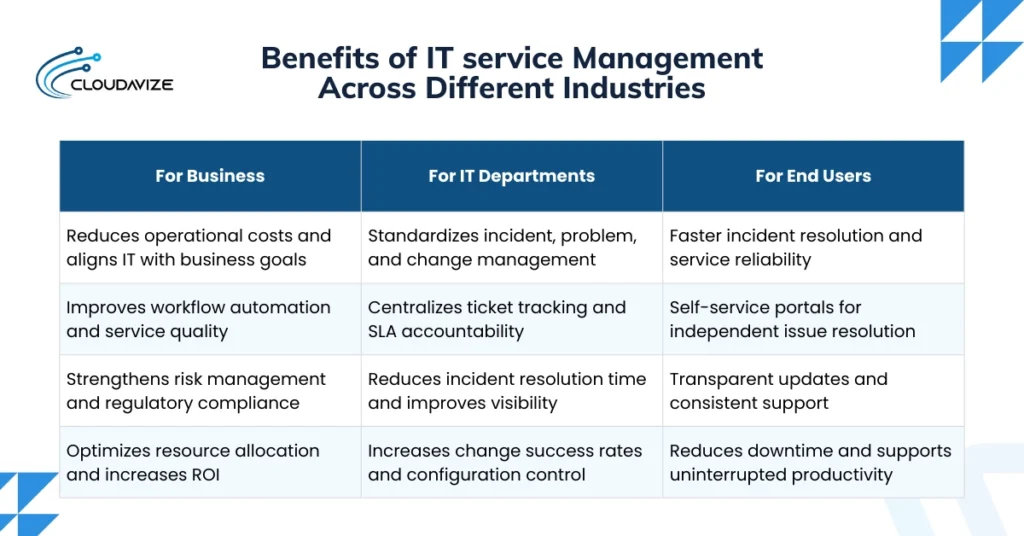
Benefits of IT service management across different industries include:
For Business
ITSM improves business efficiency, reduces operational costs, and aligns IT services with strategic goals, resulting in faster incident resolution and improved employee productivity. Through standardized ITSM processes and workflow automation, organizations improve service quality, strengthen risk management, and scale IT operations in a structured and controlled manner. This alignment supports regulatory compliance, optimizes resource allocation, and increases return on investment. When IT Service Management improves service availability and reduces downtime, the organization protects revenue streams and strengthens competitive positioning.
For IT Departments
For IT departments, ITSM provides a process-driven and structured operating model that standardizes incident management, problem management, configuration management, and workflow automation. ITSM tools centralize ticket tracking, measure service performance metrics, and enforce SLA-driven accountability across IT operations. This structured approach reduces incident resolution time, improves change success rates, increases operational visibility, and strengthens configuration control. As a result, IT teams improve productivity, manage workloads more effectively, and operate within a governance-based framework that supports continuous improvement.
For End Users
IT Service Management directly benefits end users by delivering faster incident resolution, improved service reliability, and accessible self-service options. Structured ITSM processes, such as incident and service request management, reduce downtime and restore services quickly, supporting uninterrupted productivity. Centralized communication through the IT service desk ensures transparent updates and consistent support. Self-service portals and knowledge management systems provide rapid, accurate solutions, enabling users to resolve common issues independently within a reliable service management framework.
What Are the Key Considerations When Implementing ITSM?
Key considerations when implementing ITSM include understanding objectives, assessing current capabilities, fostering stakeholders’ buy-in, training your team, selecting the right tools, and focusing on continuous improvement. These considerations establish a structured foundation for aligning IT Service Management with business goals and operational requirements.
Below are the key considerations for effective ITSM implementation:
- Understand Your Objectives: Clearly define business objectives, service delivery goals, and expected outcomes before implementing ITSM. This ensures that ITSM processes align with organizational strategy and measurable performance targets.
- Assess Current Capabilities: Evaluate existing IT infrastructure, process maturity, resource allocation, and service performance metrics. A capability assessment identifies gaps that ITSM implementation must address.
- Choose the Right Framework: Select an ITSM framework such as ITIL, ISO/IEC 20000, or COBIT based on governance requirements, compliance needs, and organizational scale. The framework should support structured and scalable service management.
- Get Buy-in from Stakeholders: Secure executive sponsorship and stakeholder alignment across business units. Leadership support strengthens governance adoption and reduces resistance to process standardization.
- Train Your Team: Develop ITSM framework knowledge and proficiency with ITSM tools among service teams. Structured training ensures consistent execution of incident, change, and service-level management processes.
- Select the Right Tools: Choose ITSM software that integrates with existing IT infrastructure, supports automation, and provides reporting dashboards for service performance monitoring.
- Implement in Phases: Deploy ITSM processes in controlled phases rather than organization-wide rollout. Phased implementation reduces risk and allows measurable process refinement.
- Focus on Continuous Improvement: Adopt a continuous improvement model that regularly reviews incident trends, SLA compliance, and service performance metrics. Ongoing optimization strengthens service reliability.
- Measure and Report: Establish measurable KPIs and reporting frameworks to monitor service delivery, change success rate, and incident resolution time. Performance reporting ensures accountability and governance control.
- Prepare for Cultural Change: Promote a service-oriented mindset and clearly communicate the benefits of the process. Cultural readiness improves the adoption of standardized workflows and governance structures.
- Leverage Expertise: Engage ITSM consultants or subject-matter experts as needed. External expertise supports framework selection, the design of an implementation roadmap, and improving process maturity.
How Is IT Service Management Used Across Industries?
IT Service Management supports hospital information systems, core banking platforms, learning management systems, point-of-sale networks, smart manufacturing environments, and citizen service portals across industries. Organizations apply ITSM processes such as incident management, problem management, change management, asset management, and SLA monitoring to maintain high-availability infrastructure, protect sensitive data, and ensure regulatory compliance.
- Healthcare
In healthcare, IT Service Management supports hospital information systems, electronic health records systems such as Epic or Cerner, and medical device integration platforms. ITSM processes manage incidents affecting clinical applications, control system changes to protect patient data, and enforce service-level agreements for high-availability infrastructure. This structured governance model increases system uptime, safeguards patient safety, strengthens HIPAA compliance, and ensures uninterrupted access to mission-critical healthcare systems. - Finance
For the Banking, Financial Services, and Insurance (BFSI) sector, ITSM manages core banking systems, payment processing platforms, and trading applications that require secure and high-availability environments. Organizations apply problem management to investigate root causes of transaction failures and automate SLA monitoring to maintain the industry benchmark of 99.9% uptime for consumer-facing applications. This structured approach improves regulatory compliance, reduces operational risk, strengthens audit readiness, and ensures reliable transaction processing across financial systems. - Education
Educational institutions leverage ITSM to manage large-scale, decentralized IT environments that support thousands of students and faculty across campuses. Institutions implement service portals for student self-service, including automated password resets and Wi-Fi provisioning, while managing the lifecycle of digital learning platforms such as learning management systems. This structured approach increases student engagement, reduces administrative overhead, and enables IT teams to shift focus from routine queries to research support and infrastructure modernization. - Retail
In the retail industry, ITSM manages point-of-sale systems, e-commerce platforms, inventory management systems, and payment gateways that support transaction-heavy environments. Incident management restores transaction systems rapidly, configuration management tracks infrastructure dependencies across store networks, and change management protects production systems during updates. This governance-driven model improves transaction reliability, minimizes revenue-impacting downtime, strengthens cybersecurity controls, and supports seamless omnichannel retail operations. - Manufacturing
Modern manufacturing, or Industry 4.0, relies on ITSM to bridge the gap between traditional Information Technology (IT) and Operational Technology (OT) on the factory floor. Manufacturers use asset management to track smart machinery and integrate ITSM platforms with IoT sensors to enable predictive maintenance. By correlating incident data with equipment performance, organizations prevent assembly line disruptions, minimize production delays, and improve cost control across operational environments. - Public Sector
Government agencies use ITSM to deliver transparent, efficient, and secure digital services to citizens while operating within strict regulatory and budgetary frameworks. Agencies automate citizen application workflows, implement audit-ready reporting, and strengthen compliance with national data protection laws. The shift from legacy systems to cloud-based ITSM platforms enables faster implementation timelines, reduces administrative delays, and improves the overall quality and reliability of public service delivery.
What Are the Best ITSM Practices for Better Efficiency?
Best ITSM practices for better efficiency include adopting a service-oriented mindset, implementing improvement, leveraging automation, developing knowledge management, prioritizing security, and aligning with business goals. These practices ensure that Information Technology Service Management remains measurable, scalable, and performance-driven across the IT service lifecycle.
The 9 best ITSM practices for better efficiency are:
- Adopting a Service-Oriented Mindset: Treat IT as a value-driven service provider rather than a technical support function. Prioritize incidents by business impact, restoring revenue-generating systems before low-risk issues. This shift strengthens business alignment, improves customer satisfaction, and ensures IT service delivery directly supports operational continuity.
- Implementing Continuous Improvement: Regularly review incident trends, SLA compliance, and service performance metrics to identify areas for improvement. Conduct root-cause analysis and refine workflows to prevent recurring disruptions. Consistent optimization increases service reliability and strengthens long-term operational stability.
- Streamlining Processes with Automation: Automate repetitive tasks such as ticket routing, escalation paths, change approvals, and reporting within your ITSM tools. Replace manual steps with workflow automation to reduce delays and errors. Structured automation improves response time and increases overall service delivery efficiency.
- Focusing on Knowledge Management: Maintain a centralized knowledge base with documented solutions and known error records. Encourage teams to reuse validated resolutions rather than repeatedly troubleshooting. A structured knowledge management system improves consistency and accelerates incident resolution.
- Enhancing Service with a Robust IT Service Desk: Establish a centralized IT service desk with clear escalation paths and transparent communication updates. Ensure structured workflows guide incident and service request handling. A strong service desk reduces response time and improves user experience.
- Prioritizing Security Within ITSM: Integrate access control, structured change management, and audit documentation into daily ITSM workflows. Review and approve system modifications through controlled processes. Security-focused governance reduces operational risk and strengthens compliance.
- Aligning ITSM with Business Goals: Map ITSM processes to strategic objectives such as revenue protection, cost control, and compliance requirements. Use service-level management to link IT metrics with measurable business outcomes. This alignment strengthens decision-making and improves return on investment.
- Adopting a User-Centric Approach: Design ITSM processes around user experience. Provide self-service portals, transparent communication, and fast resolution pathways. A user-centric approach increases satisfaction and improves workforce productivity.
- Leveraging ITSM for Digital Transformation: Use ITSM to standardize governance, automate workflows, and manage change securely during modernization efforts. Structured controls allow safe adoption of cloud platforms and emerging technologies. This approach improves scalability and supports controlled digital transformation.
What Are the Career Opportunities in IT Service Management?
Career Opportunities in IT service management range from service desk manager to IT support specialist, IT asset management, ITSM analyst, and IT service delivery manager. As Information Technology Service Management becomes more structured and governance-driven, demand for skilled ITSM professionals continues to grow across enterprise IT environments.
Major career roles available in ITSM include:
- Service Desk Manager
A Service Desk Manager leads the IT service desk function, oversees incident management and service request workflows, and ensures SLA compliance. This role manages support teams, monitors service performance metrics, and maintains structured communication between IT and users to ensure consistent service delivery. Required skills include leadership, SLA management, incident escalation management, stakeholder communication, and proficiency with ITSM tools. Certifications such as ITIL 4 Foundation, ITIL Managing Professional, and HDI Support Center Manager strengthen professional credibility. The salary for an ITSM Service Desk Manager ranges from $56,835 to $160,186, making it an appealing career option. - IT Support Specialist
Acting as frontline technical support, IT Support Specialists diagnose hardware, software, and network issues while managing support tickets and documenting solutions within knowledge management systems. Their work ensures timely service restoration and maintains user productivity across the organization. Success in this role requires strong troubleshooting ability, effective customer communication, and solid knowledge of operating systems and ticketing platforms. Certifications such as CompTIA A+, CompTIA Network+, and ITIL 4 Foundation strengthen credibility. Professionals in this role earn between $57,000 and $89,000 annually, depending on experience and industry. - IT Asset Management
IT Asset Management professionals oversee the full lifecycle of IT assets, from procurement and deployment to maintenance and retirement. They ensure license compliance, maintain accurate records within configuration management databases, and monitor vendor relationships to control costs. This role demands expertise in asset lifecycle management, CMDB administration, and compliance oversight. Certifications such as Certified IT Asset Manager (CITAM) and ITIL 4 Foundation enhance career progression. Compensation varies widely based on scope and responsibility, with salaries ranging from $41,000 to $172,500. - ITSM Analyst
Unlike IT asset management professionals who manages overall lifecycle of IT assets, an ITSM Analyst evaluates ITSM processes, analyzes service performance metrics, and identifies improvement opportunities. This role supports SLA monitoring, root cause analysis, and reporting frameworks to strengthen service quality. Skills required for this position include process analysis, SLA monitoring, data interpretation, root cause analysis, and knowledge of ITSM frameworks. Required certifications include ITIL 4 Foundation, ITIL Specialist certifications, and COBIT Foundation. Salaries range from $56,920 to $151,271, reflecting differences in experience and organizational complexity. - Incident Manager
An Incident Manager leads the response to major incidents, coordinating cross-functional teams to restore services quickly while minimizing business disruption. This role requires strong crisis management, structured communication, risk assessment, and SLA enforcement capabilities. In addition to technical knowledge, the ability to manage high-pressure situations is critical. Certifications such as ITIL 4 Foundation, ITIL Managing Professional, and CISSP are often valued, particularly in security-sensitive environments. Compensation ranges from $52,934 to $169,905, depending on responsibility level and industry. - ITSM Administrator
Responsible for configuring and maintaining ITSM platforms such as ServiceNow or Jira Service Management, an ITSM Administrator manages workflow automation, integrations, user access control, and reporting dashboards. Basic skills required to become an ITSM administrator include configuration of ITSM platforms, workflow automation, scripting fundamentals, integration management, database knowledge, and reporting tools. Certifications such as ServiceNow Certified System Administrator and Atlassian Certified Professional support advancement. Salaries range from $26,500 to $142,000, influenced by platform expertise and organizational scale. - IT Service Delivery Manager
An IT Service Delivery Manager oversees end-to-end IT service delivery and ensures compliance with service-level agreements. This role aligns IT performance metrics with business objectives, manages vendor relationships, and drives continuous improvement. Skills for this role include service governance, vendor management, SLA negotiation, leadership, performance reporting, and strategic alignment. Certifications: ITIL 4 Managing Professional, PMP (Project Management Professional), COBIT Foundation. Compensation ranges from $35,000 to $171,000, depending on industry, scale, and executive responsibility.
What Are the Necessary Skills and Certifications in IT Service Management?
The necessary skills in IT Service Management include knowledge of the ITSM framework, proficiency with tools, incident management, and stakeholder communication. To validate these skills, certifications such as ITIL 4 Foundation and COBIT Foundation are recommended. These skills and credentials strengthen career progression, enhance service delivery capabilities, and increase professional credibility in Information Technology Service Management environments.
Skills to Acquire For a Successful IT Service Management Career
- ITSM Framework Knowledge: Understand ITIL, COBIT, and ISO/IEC 20000 to design and manage structured ITSM processes. This knowledge strengthens governance capability and improves career advancement opportunities.
- ITSM Tool Proficiency: Develop the ability to configure and manage ITSM platforms like ServiceNow or Jira Service Management. Tool expertise improves workflow automation and operational efficiency.
- SLA Design and Monitoring: Learn to define, track, and report service-level agreements using measurable performance metrics. This skill ensures service reliability and strengthens accountability.
- Incident and Problem Management: Gain expertise in resolving incidents quickly and conducting root cause analysis to prevent recurrence. This improves service stability and reduces operational risk.
- Communication and Stakeholder Management: Build strong communication skills to coordinate with business units and leadership. Effective stakeholder management improves collaboration and transparency in service delivery.
- Analytical Thinking and Data Interpretation: Develop the ability to analyze service performance metrics and identify opportunities for improvement. Data-driven decisions strengthen ITSM process optimization.
- Continuous Improvement Mindset: Adopt a structured improvement approach to refine workflows and enhance service quality. This mindset supports long-term governance maturity and leadership growth.
Certifications to Earn
- ITIL 4 Foundation: Entry-level certification that validates knowledge of ITIL best practices and the service value system. It strengthens employability and builds a foundation for advanced ITSM roles.
- COBIT Foundation: A governance-focused certification that validates knowledge of IT risk management and compliance frameworks. It supports careers in IT governance and strategic IT alignment.
- ISO/IEC 20000 Foundation: Certification based on the international service management standard. It strengthens knowledge of compliance and supports roles in regulated industries.
- Certified ScrumMaster (For Agile ITSM Environment): An Agile-focused certification that validates Scrum methodology knowledge. It supports ITSM professionals working in iterative and DevOps-driven environments.