15 Types of Managed IT Services for Every Business
Managed IT services include technical support, cybersecurity management, cloud computing support, network monitoring, disaster recovery, infrastructure management, compliance oversight, communication systems, software management, and strategic technology consulting, helping businesses maintain secure and scalable IT operations. These services support daily technology functions through proactive monitoring, cloud administration, infrastructure maintenance, data protection, and centralized system management. Organizations use managed IT solutions to improve operational efficiency, strengthen cybersecurity defenses, maintain business continuity, and support evolving technology environments across on-site and remote operations.
Different managed IT services serve distinct operational and infrastructure requirements across industries. Helpdesk support improves user productivity by resolving issues rapidly, while managed security services reduce cyber risks through continuous threat monitoring and compliance oversight. Cloud management enhances scalability and accessibility, and backup solutions protect critical business data during outages or cyber incidents. Infrastructure management, vendor coordination, communication support, and strategic consulting help businesses maintain reliable technology performance, optimize long-term IT planning, and support sustainable operational growth.
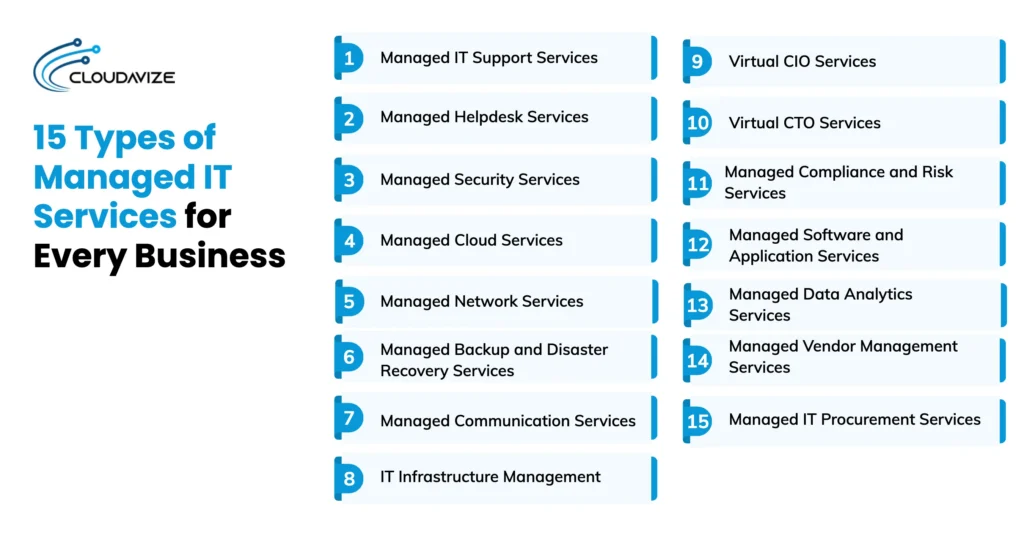
15 types of managed IT services for every business are:
- Managed IT Support Services
- Managed Helpdesk Services
- Managed Security Services
- Managed Cloud Services
- Managed Network Services
- Managed Backup and Disaster Recovery Services
- Managed Communication Services
- IT Infrastructure Management
- Virtual CIO Services
- Virtual CTO Services
- Managed Compliance and Risk Services
- Managed Software and Application Services
- Managed Data Analytics Services
- Managed Vendor Management Services
- Managed IT Procurement Services
Managed IT Support Services
Managed IT support services provide businesses with technical support, infrastructure monitoring, troubleshooting, and ongoing maintenance for daily technology operations. These services cover servers, software, cloud systems, devices, and network infrastructure through continuous monitoring and preventive maintenance. MSPs commonly provide patch management, software updates, remote troubleshooting, hardware maintenance, helpdesk support, and user assistance as part of their managed IT solutions.
Businesses such as healthcare providers, manufacturers, engineering firms, and small companies rely on managed IT support services to maintain stable and secure technology environments. The main advantage of these services is proactive monitoring that helps detect issues before they disrupt operations. Outsourcing managed IT support can reduce downtime, improve infrastructure performance, strengthen security, and support long-term operational continuity.
Managed Helpdesk Services
Managed helpdesk services deliver centralized technical support, enabling businesses to quickly respond to software issues, connectivity problems, login errors, and device-related disruptions through responsive troubleshooting and rapid resolution. MSPs manage support tickets, remote troubleshooting, communication systems, and response coordination to maintain consistent user assistance and faster technical response times across cloud and on-site IT environments. Common services include password resets, onboarding support, software setup, issue tracking, end-user troubleshooting, and real-time technical assistance for daily operations.
Unlike broader managed IT support services, managed helpdesk solutions primarily focus on user-facing technical assistance and fast issue resolution. Small businesses, healthcare organizations, financial institutions, and remote-work environments often rely on these services to maintain productivity without expanding their internal IT teams. Outsourced helpdesk support can improve response times, reduce downtime, and provide dependable 24/7 technical assistance.
Managed Security Services
Managed security services protect business networks, systems, applications, and cloud environments through continuous cybersecurity monitoring and centralized threat management. MSPs manage firewalls, endpoint protection, threat detection systems, and access controls to reduce security risks across business infrastructure. Services commonly include vulnerability assessments, patch management, incident response, email security, compliance monitoring, and data protection support.
Organizations handling sensitive data, such as healthcare providers, financial institutions, manufacturers, and legal firms, commonly rely on managed security services to maintain secure technology environments. The primary advantage of these services is proactive threat detection and rapid incident response that help prevent operational disruptions. Businesses that use outsourced cybersecurity support often reduce ransomware risk, strengthen compliance, and improve protection against phishing attacks and unauthorized access.
Managed Cloud Services
Managed cloud services support cloud infrastructure, storage systems, applications, and cloud computing environments through centralized monitoring and operational management. Managed Service Providers manage platforms such as Microsoft Azure, AWS, and hybrid cloud environments to maintain scalable and reliable digital operations. Services commonly include cloud migration, storage optimization, backup integration, workload monitoring, cloud security, and infrastructure performance management.
SMBs requiring flexible and scalable infrastructure, including software companies, healthcare organizations, remote work environments, and growing enterprises, commonly rely on managed cloud services to reduce hardware dependency. The primary advantage of these services is centralized cloud management that improves operational continuity and scalability. Businesses outsourcing cloud operations often reduce maintenance costs, strengthen cloud security, and improve accessibility across cloud-based systems.
Managed Network Services
Managed network services, monitor, maintain, and optimize business network infrastructure that supports communication, connectivity, operational performance, and secure data transmission across connected environments. IT service providers oversee routers, wireless networks, switches, VPN environments, firewall systems, and data encryption protocols through continuous monitoring and preventive maintenance. These services commonly include network configuration, connectivity troubleshooting, traffic monitoring, firewall management, wireless optimization, encrypted data protection, and network performance assessments.
Manufacturers, engineering firms, healthcare organizations, and businesses with multiple office locations commonly rely on managed network services to maintain reliable communication across operational systems. The primary benefit of these services is proactive network visibility that helps identify connectivity and security issues before they affect business operations. Businesses outsourcing network management often reduce downtime, strengthen network security, improve communication reliability, and maintain scalable connectivity across cloud and on-site environments.
Managed Backup and Disaster Recovery Services
Managed backup and disaster recovery services protect business data, applications, and infrastructure systems from operational disruptions, cyberattacks, accidental deletion, and hardware failures. MSPs use automated backup systems, cloud-based recovery environments, monitored storage platforms, and structured disaster recovery protocols to ensure business data remains recoverable during cyberattacks, hardware failures, accidental deletions, and operational disruptions. These managed services commonly include scheduled backups, cloud replication, recovery testing, server restoration, disaster recovery planning, and business continuity management.
The primary value of managed backup and disaster recovery services lies in their rapid recovery capabilities, which reduce downtime following operational disruptions. Financial services companies, healthcare organizations, manufacturers, and businesses with sensitive operational systems commonly use these managed IT services to maintain resilient infrastructure environments. Businesses that outsource supervised recovery operations commonly minimize data loss risks, maintain operational continuity, improve disaster preparedness, and strengthen compliance support across business-critical systems.
Managed Communication Services
Managed communication services support voice systems, collaboration platforms, messaging tools, and cloud-based communication infrastructure used in daily business operations. MSPs manage VoIP systems, email platforms, video conferencing software, and digital collaboration tools through centralized monitoring and communication management. Services commonly include platform integration, account management, connectivity troubleshooting, communication monitoring, and performance optimization.
Small and medium businesses with hybrid workforces, customer service teams, healthcare operations, and distributed business environments commonly rely on managed communication services to maintain reliable communication systems. The primary advantage of these services is centralized communication management that improves workforce coordination and operational continuity. Businesses outsourcing communication support often reduce service disruptions, improve collaboration efficiency, and maintain scalable cloud-based communication environments.
IT Infrastructure Management
IT infrastructure management oversees business technology systems, including servers, storage platforms, hardware environments, virtualization systems, and software infrastructure. MSPs monitor infrastructure performance, maintain operating systems, manage hardware lifecycles, and optimize system reliability through preventive maintenance and continuous monitoring. Services commonly include server monitoring, storage management, virtualization support, operating system updates, hardware troubleshooting, and infrastructure optimization.
Enterprises, engineering firms, healthcare organizations, and manufacturers with complex operational environments commonly rely on IT infrastructure management services to maintain stable technology systems. The primary benefit of these services is centralized infrastructure oversight that improves operational visibility and long-term scalability. Businesses that outsource infrastructure management often reduce downtime, improve system performance, enhance operational efficiency, and ensure reliable support for critical business infrastructure.
Virtual CIO Services
Virtual CIO services provide outsourced executive-level technology leadership that helps align business operations with long-term IT strategy and planning. Outsourced IT providers and technology consultants evaluate infrastructure roadmaps, cybersecurity priorities, operational risks, vendor relationships, and budgeting requirements to support informed technology decisions. Services commonly include technology planning, infrastructure assessments, compliance guidance, budgeting support, vendor coordination, and digital transformation planning.
Small and mid-sized businesses, healthcare organizations, and growing enterprises without internal CIO leadership commonly use virtual CIO services to improve operational scalability and technology planning. The primary benefit of these services is strategic guidance that aligns technology investments with business objectives. Businesses that outsource virtual CIO support often improve infrastructure planning, strengthen risk management, and maintain structured, long-term technology development.
Virtual CTO Services
Virtual CTO services provide outsourced technical leadership that supports software infrastructure, cloud computing systems, digital architecture, and operational technology planning. MSPs and technical consultants evaluate infrastructure environments, software systems, cybersecurity frameworks, and development operations to maintain scalable technology environments. These managed services commonly include software planning, infrastructure modernization, technical assessments, integration support, and digital system strategy development.
Technology-focused organizations such as startups, software companies, engineering firms, and businesses with cloud-based operational environments commonly use virtual CTO services to maintain structured technical planning. The unique value of virtual CTO services comes from advanced technical oversight that supports scalable software and infrastructure development. Businesses that outsource monitored CTO functions commonly improve infrastructure reliability, strengthen cloud computing strategies, reduce operational inefficiencies, and maintain aligned technical planning across digital business systems.
Managed Compliance and Risk Services
Managed compliance and risk services provide centralized oversight for regulatory requirements, cybersecurity policies, and operational risk management across business technology environments. Managed IT providers monitor compliance standards, assess infrastructure vulnerabilities, and manage security frameworks to support protected and compliant operations. Common services include audit support, policy implementation, compliance tracking, access control management, security documentation, and risk assessments.
Organizations operating in highly regulated industries, including healthcare, legal services, and finance, frequently use managed compliance and risk services to maintain secure handling of sensitive information. Unlike general IT management, these services focus heavily on regulatory preparedness and proactive risk reduction. Businesses using outsourced compliance support often improve operational resilience, reduce cybersecurity exposure, and maintain stronger compliance with standards such as HIPAA and PCI DSS.
Managed Software and Application Services
Managed software and application services help businesses maintain operational software systems, cloud applications, and digital platforms through continuous monitoring and technical support. MSPs supervise application environments, software integrations, licensing operations, and user access systems to improve workflow reliability and system performance. These managed services commonly include software patching, application troubleshooting, integration management, cloud monitoring, and user support.
Businesses that depend on software-driven operations, including healthcare organizations, financial service providers, and growing enterprises, commonly rely on managed software and application services to maintain stable business systems. A major benefit of these services is proactive software management that minimizes application-related disruptions before they impact productivity. Businesses outsourcing application support often improve operational efficiency, strengthen application security, and maintain reliable access to business-critical software systems.
Managed Data Analytics Services
Managed data analytics services involve organizing, processing, monitoring, and analyzing operational data to support reporting accuracy and strategic decision-making. Managed analytics providers use centralized analytics tools, cloud-based reporting systems, dashboard environments, and monitored data management workflows to maintain structured business intelligence operations. These managed services commonly include reporting automation, dashboard management, analytics monitoring, storage optimization, data integration, and operational reporting support.
With large volumes of operational data, manufacturers, enterprises, financial institutions, and healthcare organizations often rely on managed data analytics services to better understand business performance. The unique value of this managed service comes from continuous analytics oversight that improves reporting consistency and operational planning. Businesses that outsource supervised analytics operations commonly reduce manual data processing workloads, strengthen strategic decision-making, improve reporting accuracy, and maintain scalable access to operational insights.
Managed Vendor Management Services
Managed vendor management services coordinate relationships among businesses, software providers, hardware suppliers, cloud vendors, and third-party technology partners that support operational infrastructure. Managed service providers supervise vendor communication, contract oversight, procurement coordination, licensing management, and operational issue resolution across integrated technology systems. These managed IT services commonly include vendor assessments, escalation management, contract reviews, procurement tracking, and service coordination.
Businesses with multiple technology providers, such as enterprises, healthcare organizations, manufacturers, and engineering firms, commonly use managed vendor management services to maintain organized infrastructure operations. The unique value of these managed services comes from centralized vendor oversight that improves accountability across technology relationships. Businesses that outsource monitored vendor coordination commonly reduce communication delays, strengthen procurement efficiency, improve service reliability, and maintain streamlined operational support across multiple service providers.
Managed IT Procurement Services
Managed IT procurement services evaluate, source, purchase, configure, and maintain technology products that support operational infrastructure and long-term business growth. Managed service providers assess infrastructure requirements, compare hardware and software solutions, coordinate vendor purchases, and supervise deployment workflows across business systems. These managed services commonly include procurement planning, hardware sourcing, lifecycle management, licensing coordination, deployment support, and infrastructure budgeting.
Growing enterprises, engineering firms, healthcare organizations, and businesses modernizing their operational infrastructure commonly use managed IT procurement services to maintain cost-effective technology investments. The key value of these services comes from strategic purchasing guidance and structured infrastructure planning that aligns technology decisions with operational requirements. Businesses that outsource procurement management commonly reduce purchasing risks, improve infrastructure scalability, ensure system compatibility, and strengthen long-term operational efficiency through organized procurement processes.
What Are the Types of Managed IT Services Based on Scope?
Managed IT services include lower-, intermediate-, and high-level service models, ranging from remote technical support to fully outsourced IT management, covering cybersecurity, cloud computing, infrastructure operations, and strategic planning. These service levels help businesses choose the right degree of IT outsourcing based on their operational needs and internal capabilities.
Lower-Level Managed IT Services
Lower-level managed IT services include remote support and project-based IT assistance such as monitoring, troubleshooting, software support, and short-term infrastructure projects. These managed services provide focused technical support for organizations that maintain internal control over most operational systems.
- Remote Managed IT Services
Remote managed IT services provide off-site monitoring, troubleshooting, software support, and infrastructure maintenance through cloud-based management tools. Businesses using remote managed IT services commonly improve system visibility and maintain cost-effective infrastructure support through centralized monitoring. - Project-Based Managed IT Services
Project-based managed IT services handle temporary infrastructure projects, such as cloud migrations, software deployments, cybersecurity upgrades, and hardware implementations. Organizations commonly use project-based managed IT services to complete specialized infrastructure upgrades with structured technical expertise and controlled implementation timelines.
Intermediate/Standard Managed IT Services
Intermediate/Standard Managed IT Services include co-managed IT support, where internal IT teams work with MSPs for infrastructure and cybersecurity management, and on-site IT services that provide in-person maintenance, troubleshooting, and operational support. Businesses commonly use intermediate managed IT services to strengthen infrastructure support while maintaining partial internal oversight of operational technology systems.
- Co-Managed IT Services
Co-managed IT services combine internal IT departments with external MSP support for infrastructure management, cybersecurity monitoring, and technical operations. Businesses commonly use co-managed IT services to improve infrastructure oversight while maintaining internal control over business-critical technology systems. - On-Site Managed IT Services
On-site managed IT services provide in-person technical support, hardware maintenance, infrastructure troubleshooting, and operational monitoring within business environments. Organizations with complex operational infrastructure commonly use on-site managed IT services to maintain direct technical support and faster issue resolution.
High-Level Managed IT Services
High-level managed IT services include fully outsourced IT management, covering infrastructure, cybersecurity, cloud support, helpdesk services, and strategic planning. They help enterprises achieve centralized control, continuous monitoring, and scalable operations while reducing internal IT workload and ensuring strong business continuity.
- Fully Managed IT Services
Fully managed IT services outsource complete infrastructure management, cybersecurity operations, cloud support, helpdesk services, and strategic technology planning to MSPs. Businesses commonly use fully managed IT services to centralize infrastructure operations, reduce internal IT responsibilities, and maintain scalable technology management.
Who Needs Different Types of Managed IT Services?
Small businesses, medium-sized businesses, large enterprises, manufacturing companies, engineering firms, healthcare organizations, and financial services companies use different types of managed IT services to manage cybersecurity, cloud infrastructure, compliance, operational continuity, and scalable technology environments. The level of managed IT support depends on infrastructure complexity, compliance requirements, cybersecurity risks, and available internal IT resources, helping organizations maintain secure systems, stable operations, and reliable long-term technology performance.
The following businesses need managed IT services based on their operational and infrastructure requirements:
- Small Businesses
Limited internal IT staff and growing cybersecurity demands often make managed IT services necessary for small businesses seeking reliable technology support without expanding their internal IT departments. These organizations commonly use managed helpdesk services, remote monitoring, and managed security support to maintain stable daily operations. Outsourced IT management helps reduce operational costs, improve productivity, and support scalable business growth. - Medium-Sized Businesses
As operational environments expand, medium-sized businesses often require stronger oversight of infrastructure, cloud support, and compliance management. These organizations commonly rely on managed network services, backup solutions, and cybersecurity monitoring to maintain operational continuity as they grow. Centralized monitoring and stronger infrastructure oversight help medium-sized businesses support operational growth with fewer technology disruptions. - Large Enterprises
Managing enterprise-level infrastructure across multiple business locations often requires centralized monitoring, compliance oversight, and advanced cybersecurity management. Large enterprises commonly implement fully managed IT services, infrastructure management, and strategic technology support to maintain operational control. These managed services support long-term operational stability, infrastructure visibility, and scalable technology operations. - Manufacturing Companies
Manufacturing companies often require managed IT services to maintain connected production systems, operational networks, and secure industrial infrastructure environments through continuous monitoring and centralized technology management. These companies commonly use managed network services, disaster recovery solutions, and cybersecurity support to reduce operational disruptions. Proactive infrastructure monitoring and stable network management help manufacturing companies reduce production downtime and maintain reliable operational performance. - Engineering Firms
Cloud collaboration, technical software systems, and infrastructure-intensive project environments often create complex operational demands, making managed IT services necessary for engineering firms. Many engineering companies rely on managed cloud services, infrastructure monitoring, and communication support to maintain efficient coordination across distributed operational teams. Scalable cloud environments and monitored infrastructure systems support efficient collaboration, secure project coordination, and infrastructure-intensive operations. - Healthcare Organizations
Healthcare organizations often need managed IT services to protect patient data systems, maintain HIPAA compliance, support operational continuity, and secure their healthcare infrastructure. These organizations commonly rely on managed security services, compliance management, backup solutions, and help desk support to maintain secure healthcare operations. Secure infrastructure oversight and compliance-focused monitoring help healthcare organizations maintain protected patient systems and reduce cybersecurity exposure. - Financial Services Companies
Strict regulatory requirements, transaction-based operations, and sensitive financial data make managed IT services essential for financial services companies that require secure and continuously monitored technology environments. Many financial institutions rely on managed cybersecurity services, infrastructure monitoring, and vendor management support to maintain protected operational systems and secure financial transactions. Managed IT services help improve regulatory compliance, strengthen operational resilience, and maintain secure access to critical financial environments.
Why Do Businesses Use Different Types of Managed IT Services?
Businesses use different types of managed IT services to reduce IT costs, improve budgeting, strengthen cybersecurity and compliance, scale infrastructure, reduce downtime, support cloud integration, and maintain reliable long-term technology operations. The long-term benefits of managed IT services include improved operational efficiency, secure infrastructure management, workforce flexibility, and centralized oversight that supports scalable business growth and stable day-to-day performance.
10 reasons businesses use managed IT services are:
Reduces IT Costs
Enables Predictable IT Budgeting
Scales IT infrastructure as needed
Enhances Security and Compliance
Strategic IT Planning and Consulting
Reduces Network Downtime
Enhances Scalability and Flexibility
Provides 24/7 Support and Rapid Response
Security Awareness Training
Offers Enhanced Cloud Integration
- Reduces IT Costs
Many businesses use managed IT services to lower the cost of maintaining internal IT departments, infrastructure upgrades, and emergency technical repairs. Outsourced support models provide access to experienced technical teams, centralized monitoring, and ongoing infrastructure management without the expense of hiring large in-house IT staff. - Enables Predictable IT Budgeting
Managed IT services help businesses maintain more predictable technology spending through fixed monthly service plans and structured support agreements. This approach reduces unexpected infrastructure expenses and allows organizations to plan long-term operational and technology budgets more efficiently. - Scales IT Infrastructure as Needed
As businesses expand, technology requirements often grow alongside workforce demands and operational complexity. Managed IT services provide flexible infrastructure support and cloud-based scalability, enabling organizations to increase operational capacity without major disruptions or complete system replacements. - Enhances Security and Compliance
Businesses handling sensitive data often rely on managed IT services to strengthen cybersecurity protection and maintain regulatory compliance. Continuous monitoring, threat detection, access management, and compliance oversight help reduce cybersecurity risks while maintaining secure operational environments. - Strategic IT Planning and Consulting
Technology growth and infrastructure planning often require specialized expertise that many organizations do not maintain internally. Managed IT consulting services provide strategic guidance, infrastructure assessments, and operational planning that support informed technology decisions and long-term business growth. - Reduces Network Downtime
Operational disruptions caused by unstable networks often lead businesses to use managed IT services for continuous monitoring and proactive troubleshooting. Faster issue detection and centralized oversight help maintain reliable communication systems and stable operational performance. - Enhances Scalability and Flexibility
Organizations with changing operational demands commonly use managed IT services to maintain adaptable infrastructure environments. Flexible cloud support and scalable technology management help businesses allocate infrastructure resources more efficiently as they grow operationally. - Provides 24/7 Support and Rapid Response
Businesses that require uninterrupted operations often depend on managed IT services for around-the-clock technical support and faster response times. Continuous monitoring and responsive troubleshooting help maintain operational continuity during infrastructure failures and system disruptions. - Security Awareness Training
Employee-related cybersecurity risks remain one of the most common causes of operational security incidents. Managed IT services often include cybersecurity awareness training to help employees identify phishing attempts, suspicious activity, and other common security threats in the workplace. - Offers Enhanced Cloud Integration
Businesses use managed IT services to improve cloud integration across applications, infrastructure, and operational platforms through centralized cloud management and infrastructure coordination. Improved cloud connectivity supports better application access, operational efficiency, and infrastructure performance.
How to Choose the Right Types of Managed IT Services for Your Business?
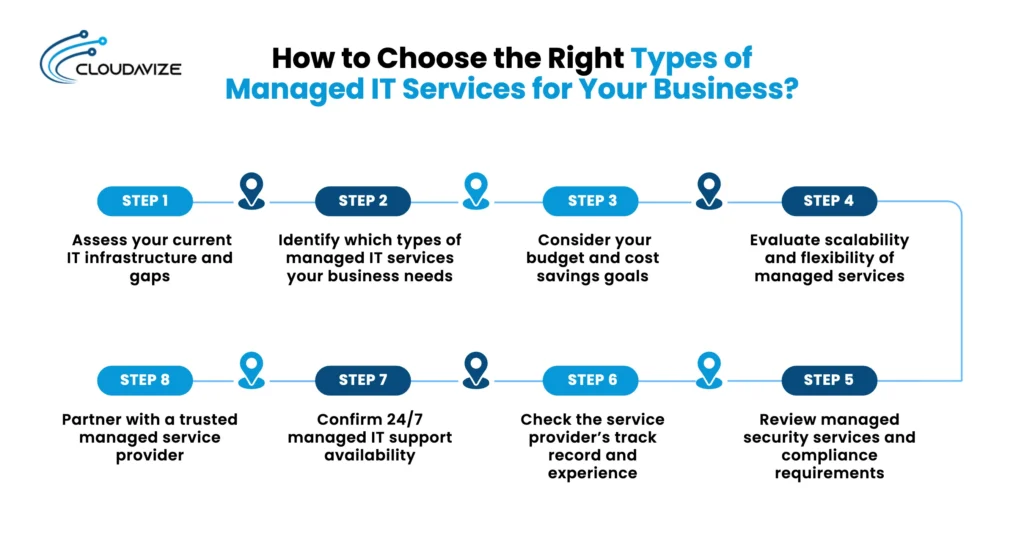
Choosing the right managed IT services involves assessing your infrastructure requirements, cybersecurity priorities, operational goals, compliance needs, budget expectations, and long-term growth plans before selecting a support model. Following the right evaluation steps helps businesses improve operational efficiency, reduce downtime risks, strengthen infrastructure performance, and maintain scalable long-term technology operations across business-critical environments.
Steps to follow while choosing the right type of managed IT services for your business are:
Step 1: Assess your current IT infrastructure and gaps
Step 2: Identify which types of managed IT services your business needs
Step 3: Consider your budget and cost savings goals
Step 4: Evaluate the scalability and flexibility of managed services
Step 5: Review managed security services and compliance requirements
Step 6: Check the service provider’s track record and experience
Step 7: Confirm 24/7 managed IT support availability
Step 8: Partner with a trusted managed service provider
- Assess your current IT infrastructure and gaps
Review servers, cloud systems, network performance, cybersecurity risks, operational inefficiencies, and existing IT limitations before selecting managed IT services. This assessment helps identify infrastructure weaknesses, improve operational planning, and prioritize the most important technology support requirements. - Identify which types of managed IT services your business needs
Evaluate cybersecurity support, cloud management, helpdesk operations, backup solutions, infrastructure monitoring, and compliance requirements based on business operational demands, organizational goals, and technology dependencies. Select managed IT services that align with business priorities and infrastructure requirements. - Consider your budget and cost savings goals
Compare monthly service costs, maintenance expenses, operational risks, and long-term technology investments before choosing a managed IT service model. Focus on services that support predictable IT spending and reduce unexpected infrastructure costs. - Evaluate the scalability and flexibility of managed services
Assess cloud computing support, infrastructure expansion capabilities, workforce flexibility, and future growth requirements before selecting managed services. Choose scalable technology environments that can support operational expansion more efficiently. - Review managed security services and compliance requirements
Examine cybersecurity monitoring, compliance standards, access controls, threat detection systems, and data protection strategies before finalizing service agreements. Prioritize services that strengthen infrastructure security and support regulatory compliance. - Check the service provider’s track record and experience
Review technical expertise, operational experience, industry knowledge, client support quality, and infrastructure management capabilities before selecting a managed IT partner. This evaluation helps businesses choose reliable providers for long-term operational support. - Confirm 24/7 managed IT support availability
Verify response times, emergency technical assistance, infrastructure monitoring capabilities, and helpdesk availability before onboarding a managed services partner. Ensure continuous support availability for faster issue resolution during operational disruptions. - Partner with a trusted managed service provider
Select a managed IT service partner that provides infrastructure management, cybersecurity support, cloud services, strategic consulting, and operational monitoring aligned with business requirements. Experienced managed service providers help businesses maintain reliable technology operations, scalable infrastructure management, and long-term operational stability.