What Is IT Compliance? Requirements, Standards, Management and Services
IT compliance is the process of aligning an organization’s technology systems, data practices, policies, and controls with applicable laws, regulations, industry standards, contractual obligations, and internal requirements. For small and mid-sized businesses, applicable compliance requirements vary by industry, location, business activities, and the types of data they process. Major regulations include HIPAA, GDPR, SOX, GLBA, and FISMA, while SOC 2, PCI DSS, ISO/IEC 27001, NIST CSF, CIS Controls, CMMC, and FedRAMP provide standards, frameworks, or assessment requirements that support different compliance needs.
Managing IT compliance involves identifying applicable requirements, assessing gaps, mapping and implementing controls, maintaining documentation, monitoring compliance, and remediating identified issues. Regular assessments and audits evaluate whether systems, controls, access practices, policies, and evidence meet defined requirements. Businesses can maintain compliance by monitoring regulatory changes, reviewing policies, conducting risk assessments, training employees, and maintaining audit-ready evidence. Managed IT compliance services can further support organizations through assessments, gap analysis, policy management, control implementation, compliance monitoring, audit preparation, reporting, and ongoing compliance management.
What Is IT Compliance?
IT compliance is the process of making sure a business’s technology systems, data handling, and operations follow applicable laws, industry standards, and internal rules. For small and mid-sized businesses, these requirements depend on their industry, systems, data, and operations. It aligns IT systems, processes, access controls, security measures, documentation, and IT policies with applicable compliance requirements. Verizon’s 2025 DBIR analyzed 12,195 confirmed breaches and found credential abuse accounted for 22% of breaches, while vulnerability exploitation reached 20%, showing why access and security controls require consistent oversight.
A structured IT compliance framework connects data protection, governance, access management, monitoring, risk assessment, and documentation with regulatory requirements. Organizations regularly assess applicable obligations, implement required controls, document compliance activities, and review policies as regulations and technology change. These practices help demonstrate regulatory alignment, address compliance gaps, reduce compliance risk, and maintain consistent oversight of IT infrastructure and protected information.
What Does IT Compliance Include?
IT compliance for SMBs includes documented policies, security controls, data protection practices, infrastructure and access management, and applicable regulatory requirements. Together, these elements define how an organization governs its IT environment and maintains alignment with established compliance obligations.
5 key components of IT compliance include:
- IT policies and procedures
Documented guidelines outline permissible technology usage, employee obligations, and governance practices across small and mid-sized businesses. Standardized protocols ensure all team members handle sensitive systems consistently, establishing accountability and providing an auditable trail that demonstrates adherence to legal frameworks.
- Security controls
Technical and administrative safeguards actively shield networks and sensitive applications from unauthorized access or malicious threats. Continuous monitoring, automated threat detection, and encrypted authentication routines help businesses reduce operational risk while meeting mandated cybersecurity benchmarks.
- Data protection
Safeguarding sensitive assets throughout their lifecycle requires robust classification schemes, strict confidentiality measures, and privacy controls. Implementing end-to-end encryption alongside restricted storage protocols prevents unauthorized disclosures and helps meet strict legal requirements for handling customer and enterprise information.
- Infrastructure and access management
Managing system architecture, network boundaries, and user privileges maintains absolute oversight of critical digital environments. Regular identity verification, access reviews, and role-based permissions ensure only authorized personnel touch sensitive systems, containing operational risk and preserving system integrity.
- Regulatory requirements
Legal frameworks and industry-specific mandates set mandatory standards based on an organization’s sector, geographic footprint, and the data it processes. Meeting these requirements demands ongoing oversight, meticulous record-keeping, and structured audits to ensure long-term legal alignment and avoid financial penalties.
Why Is IT Compliance Important?
IT compliance is important because it helps small and mid-sized businesses reduce legal and regulatory risks, protect sensitive data, strengthen security governance, maintain audit readiness, support business continuity, and build customer trust. These benefits connect compliance requirements with stronger oversight, responsible data handling, risk reduction, and consistent management of IT systems and information.
Here are 6 key reasons why IT compliance is important:
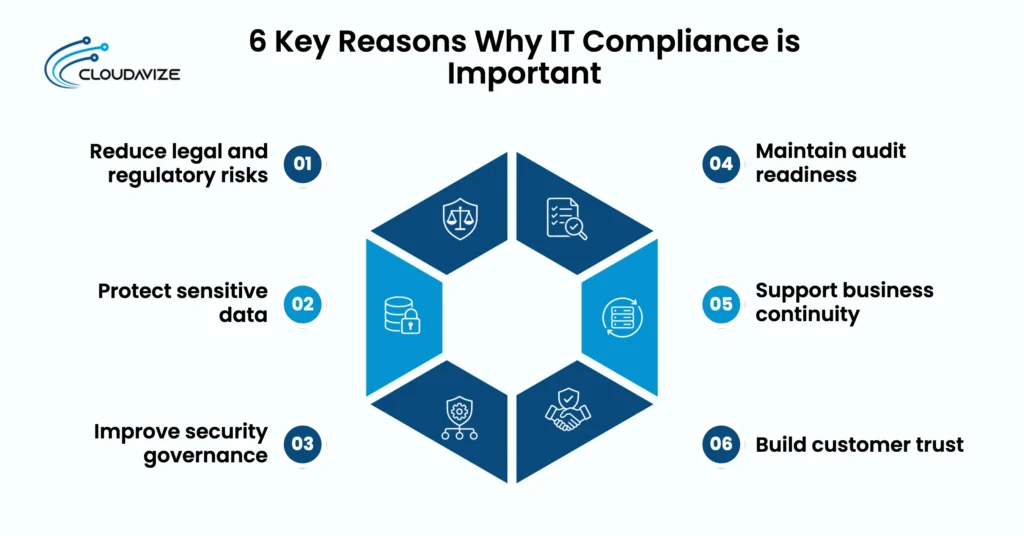
- Reduce legal and regulatory risks
Following applicable legal, regulatory, and contractual requirements helps SMBs reduce compliance risk associated with violations, penalties, enforcement actions, and unmet business obligations. Regular compliance assessments and gap analysis can identify weaknesses in policies, controls, processes, and documentation before they become larger issues. Addressing identified gaps through structured remediation also helps small and mid-sized businesses maintain alignment with applicable requirements and prepare for regulatory or contractual reviews.
- Protect sensitive data
Compliance controls help SMBs protect sensitive data, including PII, PHI, and ePHI, customer information, financial data, and cardholder data. Data classification and identity and access management practices define how information is handled and who can access it, while access controls, MFA, authentication, encryption, and monitoring help reduce unauthorized access and improper use. Verizon’s 2025 DBIR found credential abuse accounted for 22% of known initial access vectors in qualifying breaches, reinforcing the importance of effective identity and access controls.
- Improve security governance
Structured compliance frameworks support stronger security governance by defining policies, roles and responsibilities, leadership oversight, accountability, and internal controls for managing technology risks. Regular risk assessments and vendor risk management also help SMBs identify and address supplier and third-party cybersecurity risk. NIST CSF 2.0 reinforces this approach through its Govern function, which addresses cybersecurity risk management, organizational responsibilities, policies, legal and regulatory requirements, and supply chain risk management.
- Maintain audit readiness
Ongoing documentation, compliance evidence, and continuous monitoring help small businesses stay audit-ready throughout regular operations. Policies, audit logs, access records, risk assessments, control-testing results, and periodic reviews provide evidence that required controls are operating as intended. Continuous evidence collection helps teams identify findings and compliance gaps earlier, while remediation tracking documents corrective actions and progress. These practices support preparation for internal audits, external assessments, and regulatory reviews without relying on last-minute evidence collection.
- Support business continuity
Compliance practices can support business continuity and operational resilience by connecting risk management with incident response, recovery planning, system availability, and critical operations. Documented recovery procedures, data backups, backup testing, restore testing, and disaster recovery planning help small and mid-sized businesses prepare for cyber incidents and technology disruptions. This planning is increasingly relevant as ransomware appeared in 44% of breaches reviewed in Verizon’s 2025 DBIR, highlighting the need to maintain tested recovery capabilities and restore critical operations following an incident.
- Build customer trust
Responsible data handling and compliance practices can help SMBs build customer trust by demonstrating accountability for sensitive information and customer requirements. During procurement, due diligence, and partner assessments, businesses may be asked to provide compliance evidence through security assessments, vendor questionnaires, attestations, certifications, or supporting documentation. Meeting applicable compliance requirements and standards can help customers and business partners evaluate how an organization manages contractual requirements, data protection, compliance risk, and its broader reputation.
What Determines IT Compliance Requirements?
IT compliance requirements for small and mid-sized businesses are determined by their industry, location, data types, business activities, and contractual obligations. Applicable federal, state, and international laws establish regulatory duties, while industry standards, customer contracts, vendor relationships, and cyber insurance requirements can add specific controls. Organization type and data sensitivity further influence requirements for access management, monitoring, documentation, reporting, assessments, and data protection.
How Do IT Compliance Requirements Vary by Industry and Organization Type?
IT compliance requirements for SMBs vary by industry and organization type based on the data handled, services provided, regulatory environment, and contractual obligations. Healthcare organizations may address HIPAA, financial institutions GLBA, retailers PCI DSS, and government organizations FISMA requirements. Technology providers, government contractors, and nonprofits may face additional standards involving data protection, access controls, assessments, documentation, reporting, and risk management.
These requirements differ across industries in the following ways:
- Healthcare
Healthcare entities enforce administrative, physical, and technical safeguards under the HIPAA Security Rule (45 CFR § 164.308/312) to shield electronic protected health information. These strict measures ensure total confidentiality, integrity, and availability of patient records while preventing unauthorized disclosures across clinical systems.
- Financial Services
Financial institutions deploy robust access controls, continuous transaction logging, and strong encryption under regulations like GLBA and SOX. These rules secure customer financial records, mitigate fraud, maintain verifiable accounting integrity, and protect systems that support critical banking and payment operations.
- Retail and E-commerce
Retailers processing payment transactions follow PCI DSS standards to safeguard cardholder data environments. Additionally, these businesses navigate applicable consumer privacy laws governing personal customer data collection, storage, and retention to prevent unauthorized leaks and maintain secure online checkout pipelines.
- Technology and Cloud Services
Small and mid-sized technology and cloud service providers may face compliance and contractual requirements related to customer data, access controls, monitoring, availability, and third-party assessments. Obligations include protecting managed customer datasets and delivering contractual security proof through recognized third-party frameworks like SOC 2 trust criteria and ISO/IEC 27001 certifications.
- Government Organizations
Public-sector agencies operate under statutory standards like FISMA, requiring baseline risk management programs and continuous assessments. They enforce comprehensive information protection practices, maintain rigorous audit documentation, and implement strict technical security controls following standardized frameworks like NIST SP 800-53.
- Government Contractors
Defense and civilian contractors handling government data implement contractually enforced cybersecurity baselines. When processing Controlled Unclassified Information (CUI), contractors follow rigorous frameworks such as CMMC and NIST SP 800-171, meeting strict assessment, incident reporting, and system protection requirements.
- Nonprofit Organizations
Nonprofits safeguard donor financial logs, maintain grant funding compliance, and secure sensitive beneficiary data. Their overall compliance scope depends on the specific personal, medical, or financial information handled, requiring appropriate access controls, data protection policies, and operational transparency under regional privacy statutes.
How Do Location, Data, and Business Obligations Affect IT Compliance Requirements?
Location, data, and business obligations affect IT compliance requirements by determining which laws, standards, controls, and contractual duties an organization must follow. Operating jurisdictions establish federal, state, or international requirements, while sensitive data can require additional safeguards. Customer contracts, vendor relationships, and cyber insurance policies may also require access controls, assessments, monitoring, documentation, reporting, and incident response.
The following factors determine how these IT compliance requirements apply in practice:
- Federal Laws and Regulations
National statutes establish mandatory cybersecurity and privacy standards across specific industries, enforcing nationwide baseline protections. Mandates like HIPAA for healthcare, GLBA for financial services, and FISMA for federal systems regulate digital operations, access controls, system auditing, and data security within their defined scope.
- State Privacy and Cybersecurity Laws
Regional statutes like CCPA/CPRA create jurisdictional duties based on resident locations, granting consumers explicit data rights. These state-level mandates enforce strict data collection rules, consumer opt-outs, mandatory encryption baselines, and defined breach notification timelines that organizations operating across state lines actively manage.
- International Data Protection Requirements
Cross-border data regulations like the EU GDPR impose strict processing limits, individual consent rules, and data transfer safeguards regardless of company headquarters. Organizations serving international users maintain lawful processing bases, uphold data subject rights, and enforce technical protections across global digital footprints.
- Type and Sensitivity of Data
Handling high-risk data, including financial details, medical records, biometrics, or proprietary information, directly increases required security controls. Higher sensitivity levels trigger mandatory multi-factor authentication, end-to-end encryption, strict role-based access limits, comprehensive activity logging, and defined lifecycle retention rules across storage networks.
- Customer and Contract Requirements
Business agreements establish binding compliance duties beyond direct statutory requirements. B2B contracts frequently require vendor partners to maintain specific security postures, complete annual independent assessments, deliver SOC 2 Type II audit reports, and adhere to strict security SLAs before accessing client systems.
- Third-Party and Vendor Requirements
Interconnected supply chains extend compliance duties to external service providers that access corporate networks or handle sensitive files. Organizations manage vendor risks by conducting regular security reviews, enforcing Data Processing Agreements, monitoring third-party access, and verifying that outsourced software satisfies applicable data protection standards.
- Cyber Insurance Requirements
Insurance underwriters set mandatory security controls as prerequisites for issuing policy coverage. To obtain or maintain policy eligibility, organizations implement foundational safeguards, including universal multi-factor authentication, air-gapped immutable backups, endpoint detection tools, regular vulnerability scanning, and formal incident response plans.
What Are the Main IT Compliance Regulations, Standards, and Frameworks?
The main IT compliance regulations, standards, and frameworks that may apply to small and mid-sized businesses include HIPAA, GDPR, SOX, GLBA, FISMA, SOC 2, PCI DSS, ISO/IEC 27001, NIST CSF, CIS Controls, CMMC, and FedRAMP. Regulations establish legally binding obligations within their scope, while standards and frameworks provide requirements, control models, assessment criteria, or guidance organizations can use to manage technology risks and meet compliance obligations.
Which Regulations Apply to IT Compliance?
HIPAA, GDPR, SOX, GLBA, and FISMA are major regulations and laws that can apply to IT compliance. They establish requirements involving health information, personal data, financial reporting, customer information, and federal information systems. Which requirements apply depends on an organization’s industry, jurisdiction, business activities, systems, and the types of information it handles.
The following regulations address different areas of IT compliance:
- HIPAA (Health Insurance Portability and Accountability Act)
The HIPAA Security Rule establishes federal requirements for protecting electronic protected health information (ePHI). The HIPAA Security Rule requires covered entities and business associates to implement reasonable and appropriate administrative, physical, and technical safeguards for electronic protected health information (ePHI) and maintain its confidentiality, integrity, and availability. It primarily applies to covered healthcare providers, health plans, healthcare clearinghouses, and their business associates.
- GDPR (General Data Protection Regulation)
GDPR regulates the processing of personal data and establishes rights for individuals within its territorial scope, including data subjects in the EU and, through the EEA framework, the wider European Economic Area. It applies to organizations established in the EU and can apply to organizations outside the EU when they offer goods or services to individuals in the EU or monitor their behavior. Requirements cover lawful processing, transparency, individual rights, accountability, and international data transfers.
- SOX (Sarbanes-Oxley Act)
SOX establishes corporate governance, financial reporting, recordkeeping, and internal-control requirements for public companies and other issuers subject to applicable SEC reporting requirements. Section 404 requires management to assess the effectiveness of internal control over financial reporting. IT compliance becomes relevant when technology systems and IT general controls, such as access and change controls, affect financial reporting. SOX itself does not specifically mandate tamper-evident IT logging, as the original version suggested.
- GLBA (Gramm-Leach-Bliley Act)
GLBA establishes privacy and information-protection obligations for financial institutions within its scope. The FTC Safeguards Rule, 16 CFR Part 314, requires financial institutions under FTC jurisdiction to develop, implement, and maintain an information security program with administrative, technical, and physical safeguards for customer information. The requirements can apply to various businesses significantly engaged in qualifying financial activities.
- FISMA (Federal Information Security Modernization Act)
FISMA requires federal agencies to maintain agency-wide information security programs for systems supporting their operations, including applicable systems operated by contractors or other organizations on their behalf. It works with NIST standards and guidance to manage information security risk. FISMA primarily applies to federal agencies and federal information systems, while other organizations may face related requirements when handling federal information or operating federal systems.
Which Standards Support IT Compliance?
SOC 2, PCI DSS, ISO/IEC 27001, NIST CSF, CIS Controls, CMMC, and FedRAMP support IT compliance. These standards, frameworks, controls, and federal programs provide requirements, cybersecurity practices, risk-management guidance, and assessment approaches that help organizations address applicable regulatory, contractual, industry, and information security obligations.
Key standards and frameworks used to support IT compliance include:
- SOC 2
SOC 2 is an AICPA examination and reporting framework that evaluates controls at service organizations based on the Trust Services Criteria. Security is the common criterion, while Availability, Processing Integrity, Confidentiality, and Privacy may be included based on the services and engagement scope. SOC 2 examinations can produce Type I or Type II reports rather than a universal certification covering all five criteria.
- PCI DSS
PCI DSS is an industry standard for entities that store, process, or transmit cardholder data or sensitive authentication data and for certain entities that can affect the security of the cardholder data environment. PCI DSS v4.0.1 contains 12 principal requirements covering areas such as network controls, account data protection, vulnerability management, access control, authentication, monitoring, testing, and security policies. Network segmentation is not universally required, but it can reduce PCI DSS scope.
- ISO 27001
ISO/IEC 27001 is an international standard specifying requirements for establishing, implementing, maintaining, and continually improving an Information Security Management System (ISMS). It uses a risk-based approach that helps organizations identify information security risks, determine appropriate treatments and controls, establish governance processes, monitor performance, and continually improve information security management.
- NIST Framework
The NIST Cybersecurity Framework 2.0 provides a flexible, risk-based approach for managing cybersecurity risk across organizations of different sizes and sectors. Its Core contains six concurrent functions: Govern, Identify, Protect, Detect, Respond, and Recover. NIST describes the framework outcomes as non-prescriptive, allowing organizations to determine how to accomplish those outcomes within their environments.
- CIS Controls
CIS Controls v8.1 consists of 18 prioritized cybersecurity controls designed to strengthen an organization’s cybersecurity posture. Individual safeguards cover areas such as asset management, data protection, vulnerability management, access management, logging, incident response, and penetration testing. CIS also provides three Implementation Groups, IG1, IG2, and IG3, to help organizations prioritize safeguards according to factors such as risk profile and available resources.
- CMMC and FedRAMP
CMMC and FedRAMP address different federal cybersecurity needs. CMMC establishes cybersecurity assessment requirements for applicable Department of Defense contractors, with requirements depending on the information and contract involved, including Federal Contract Information and Controlled Unclassified Information. FedRAMP provides a standardized approach to security assessment and authorization for cloud products and services that process unclassified federal information within its defined scope.
What Is the Difference Between IT Compliance and IT Security?
IT compliance focuses on meeting applicable laws, regulations, standards, contractual requirements, and internal policies, while IT security focuses on protecting systems, networks, applications, and sensitive data from security threats and unauthorized access. IT compliance defines which requirements an organization must satisfy and demonstrate through controls, documentation, and evidence. IT security implements many of the technical and operational protections that help satisfy those compliance requirements.
The key differences between IT compliance and IT security are:
| Area | IT Compliance | IT Security |
| Purpose | Demonstrates adherence to applicable regulatory, contractual, and internal requirements. | Protects systems, networks, applications, and information from security threats. |
| Focus | Requirements, policies, controls, assessments, documentation, and audit evidence. | Access protection, vulnerability management, monitoring, threat detection, and incident response. |
| Primary Driver | Laws, regulations, standards, contracts, and internal policies. | Cyber risks, vulnerabilities, threats, and organizational security needs. |
| Relationship | Uses relevant security controls to meet and demonstrate applicable requirements. | Provides technical and operational controls that support compliance obligations. |
How Does IT Security Support IT Compliance?
IT security supports IT compliance by implementing protection mechanisms required by applicable compliance obligations. Security practices such as access control, multi-factor authentication, encryption, vulnerability management, monitoring, data backup, and incident response help protect regulated systems and sensitive information. Organizations can map these security controls to relevant compliance requirements, assess how they operate, document evidence, and address identified control gaps.
What Are the Risks and Challenges of IT Compliance?
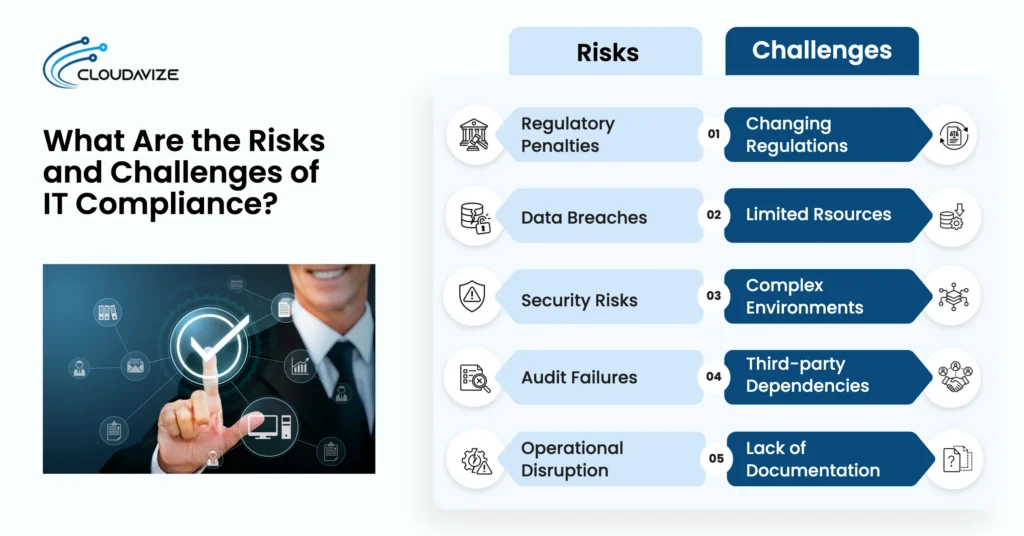
Poor IT compliance can expose small and mid-sized businesses to regulatory penalties, data breaches, security risks, audit failures, and operational disruption. Key challenges include changing regulations, limited resources, complex IT environments, third-party dependencies, and incomplete documentation. Organizations must track regulatory changes, allocate compliance expertise, manage controls across diverse systems and vendors, maintain accurate evidence, and conduct regular assessments to identify and address compliance gaps.
What Risks Can Poor IT Compliance Create?
Failure to maintain IT compliance can create regulatory penalties, data breaches, security risks, audit failures, and operational disruption. Missing or ineffective controls can expose sensitive information, leave security vulnerabilities unresolved, and prevent organizations from demonstrating compliance during audits. Regulatory violations may also trigger enforcement or remediation, while resulting security incidents and corrective activities can affect system availability, business continuity, and normal operations.
The main risks of poor IT compliance include:
- Regulatory penalties
Regulatory noncompliance can expose organizations to financial penalties, enforcement actions, corrective measures, and legal consequences. The severity depends on the applicable regulation, violation, jurisdiction, and regulatory authority. Compliance gaps involving required controls, policies, or documentation can also increase regulatory exposure and require organizations to complete specific remediation activities.
- Data breaches
Compliance gaps can expose sensitive information when required safeguards are missing, ineffective, or inconsistently maintained. Weak access controls, authentication, encryption, monitoring, or data-handling practices can increase exposure to unauthorized access and improper disclosure involving personal data, financial records, health information, customer data, or proprietary information.
- Security risks
Weak compliance controls can increase security risks by leaving vulnerabilities, excessive permissions, insecure configurations, or inadequate monitoring unresolved. These weaknesses can expose IT systems and sensitive data to unauthorized access or cyberattacks while reducing an organization’s ability to identify, contain, respond to, and correct security incidents consistently.
- Audit failures
Insufficient controls and compliance evidence can create audit failures when organizations cannot demonstrate that applicable requirements are being met. Missing documentation, unresolved findings, or ineffective controls may require remediation and further assessment. Depending on the requirement involved, an unsuccessful review can also affect certifications, customer commitments, contracts, or regulatory obligations.
- Operational disruption
Compliance failures can disrupt operations when security incidents, enforcement actions, or remediation requirements affect critical IT systems and business processes. Organizations may need to restrict access, investigate incidents, correct configurations, restore information, or implement missing controls, which can consume resources and affect service availability, productivity, and business continuity.
What Challenges Make IT Compliance Difficult to Maintain?
Changing regulations, limited resources, complex IT environments, third-party dependencies, and incomplete documentation make IT compliance difficult to maintain. Organizations must track evolving requirements while managing controls across systems, vendors, and data. Staffing and expertise constraints can delay assessments and remediation, while limited third-party visibility and missing compliance evidence can create gaps in continuous monitoring, documentation, and audit readiness.
The 5 challenges of maintaining IT compliance include:
- Changing regulations
Changing regulations create ongoing compliance challenges because organizations must monitor applicable requirements and determine how regulatory changes affect existing policies, controls, and processes. New or revised obligations can require updated risk assessments, documentation, security practices, employee responsibilities, and technical controls while organizations continue maintaining compliance with existing requirements.
- Limited resources
Small businesses with limited staffing, budgets, and compliance resources may find it difficult to manage assessments, monitoring, documentation, remediation, training, and audit preparation consistently. IT and security teams may need to manage assessments, monitoring, documentation, remediation, employee training, and audit preparation alongside regular technology operations, creating resource constraints that can delay required work or leave identified compliance gaps unresolved.
- Complex environments
As SMBs adopt cloud services, applications, remote endpoints, and hybrid infrastructure, maintaining consistent compliance oversight across different systems can become increasingly difficult. Different systems can use separate configurations, permissions, security controls, and monitoring processes, making consistent oversight, evidence collection, vulnerability management, and configuration management harder across the organization’s regulated IT infrastructure.
- Third-party dependencies
Third-party dependencies create compliance challenges when vendors and service providers access IT systems, process sensitive information, or perform regulated functions. Organizations may have limited visibility into external controls while retaining relevant compliance responsibilities, requiring vendor risk assessments, contractual security requirements, access reviews, evidence collection, and ongoing monitoring of third-party security practices.
- Lack of documentation
Incomplete documentation makes compliance difficult to demonstrate during assessments and audits. Missing policies, access records, risk assessments, system configurations, control evidence, incident records, or remediation documentation can prevent organizations from verifying completed compliance activities. Maintaining current, accurate, and auditable records supports evidence collection, identifies compliance gaps, and improves preparation for formal compliance reviews.
How Does IT Compliance Management Work?
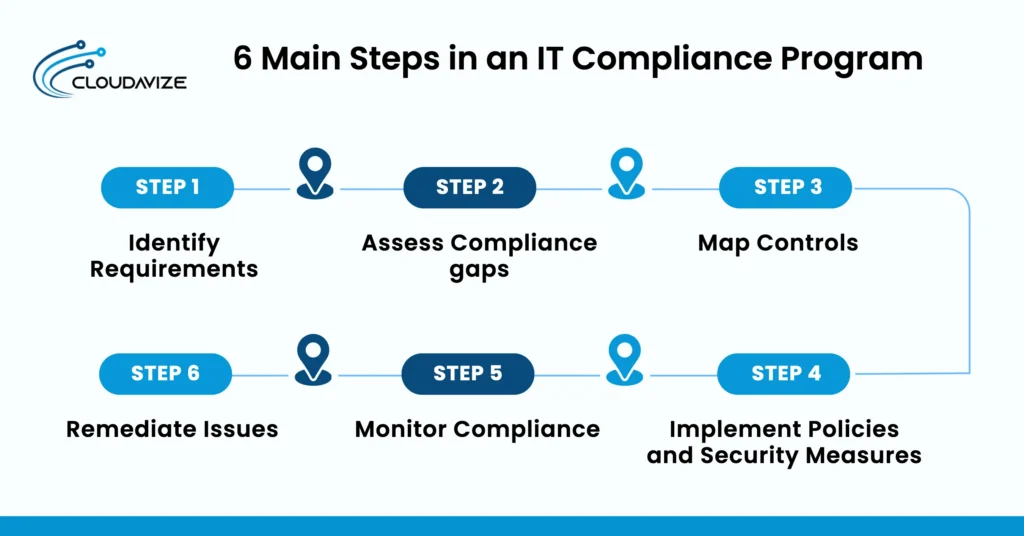
IT compliance management works through a structured process of identifying requirements, assessing compliance gaps, mapping controls, implementing security measures, monitoring compliance, and remediating issues. Organizations use compliance policies to establish responsibilities, data protection rules, access controls, and security procedures. Regular monitoring, assessments, documentation reviews, and corrective actions help maintain alignment with applicable regulations, standards, contractual obligations, and internal policies over time.
What Are the Steps in an IT Compliance Program?
An IT compliance program follows six connected steps including identify requirements, assess compliance gaps, map controls, implement policies and security measures, monitor compliance, and remediate issues. Each step builds on the previous stage to establish controls, evaluate performance, correct deficiencies, and support continuous compliance.
6 main steps in an IT compliance program are:
- Identify requirements
An IT compliance program identifies applicable legal and operational requirements shaped by industry, location, data type, and contracts. Organizations evaluate relevant regulations, standards, customer agreements, and internal policies to define the exact security, privacy, and documentation obligations governing their systems.
- Assess compliance gaps
Comparing current IT practices against identified requirements reveals missing controls, administrative weaknesses, and inconsistent processes. This gap assessment evaluates existing policies, technical configurations, and documentation, establishing an operational baseline to highlight specific areas needing corrective action or security control development.
- Map controls
Control mapping links individual compliance requirements directly to specific policies, procedures, and technical controls. By mapping requirements across multiple regulations and frameworks, organizations identify shared controls that satisfy overlapping obligations, eliminating redundant efforts while pinpointing precise control gaps needing creation.
- Implement policies and security measures
Organizations deploy the required policies, procedures, and security controls to close identified compliance gaps. Key measures include access controls, encryption, data protection, network monitoring, and incident response, turning documented regulatory rules into operational safeguards across all managed IT systems.
- Monitor compliance
Continuous monitoring tracks control performance and ensures ongoing adherence to changing regulatory rules. Compliance teams review access logs, system configurations, security events, and policy compliance using automated tools and periodic audits to detect configuration drift and control failures early.
- Remediate issues
Remediation resolves compliance gaps, control weaknesses, and audit findings through prioritized corrective action plans. Technical teams execute required fixes, update policy documentation, refine security controls, and verify completed improvements to ensure full, continuous alignment with all applicable regulatory standards.
What Should an IT Compliance Policy Include?
An IT compliance policy should define scope and responsibilities, data protection requirements, access controls, security procedures, and review and enforcement processes. These components establish how employees, IT teams, management, and relevant third parties must protect information and follow applicable requirements.
The five main components of an IT compliance policy include:
- Scope and responsibilities
Scope and responsibilities defines the employees, departments, third-party contractors, systems, and data covered by the compliance policy. Clear ownership assigns explicit oversight duties to management, IT personnel, and end users, ensuring every party understands and executes their required security and governance obligations.
- Data protection requirements
Data protection rules govern how personal, financial, medical, and proprietary information is classified, accessed, transmitted, stored, retained, and destroyed. Setting clear handling protocols across the data lifecycle ensures continuous privacy compliance and prevents accidental exposure, unauthorized leaks, or data misuse.
- Access controls
Access controls restrict system entry using role-based permissions, least-privilege principles, multi-factor authentication, and privileged account management. Enforcing strict identity verification and conducting regular account access reviews prevents unauthorized system access, limits internal security risks, and keeps sensitive business databases fully protected.
- Security procedures
Documented security procedures establish daily operational practices for system maintenance, vulnerability patching, network monitoring, malware protection, routine data backups, and incident response. Clear workflows ensure technical teams execute defensive controls consistently, maintain operational stability, and protect digital infrastructure against cyber threats.
- Review and enforcement process
Review and enforcement mechanisms keep policies current while managing rule violations. Regular reviews adapt compliance practices to changing legal standards and new technologies, while defined enforcement protocols document non-compliance, assign corrective actions, track remediation progress, and apply progressive disciplinary measures when safety rules are broken.
How Do IT Compliance Assessments and Audits Work?
IT compliance assessments and audits work by reviewing IT systems, security controls, access practices, policies, documentation, and compliance evidence against defined requirements. Assessments identify current compliance gaps and areas requiring remediation, while audits formally verify whether specified requirements are satisfied. Both processes examine control effectiveness, document findings, collect evidence, and help organizations determine whether their IT environment aligns with applicable compliance standards.
What Does an IT Compliance Assessment Review?
An IT compliance assessment reviews systems and infrastructure, security controls, user access, policies and documentation, and compliance evidence. These areas show whether required safeguards are implemented, documented, and operating consistently across the organization’s IT environment.
The 5 main areas an IT compliance assessment reviews include:
- Systems and infrastructure
Assessments examine hardware, software, networks, cloud environments, and system configurations against applicable compliance requirements. Reviews identify unsupported systems, configuration weaknesses, missing safeguards, and infrastructure gaps that could affect security or prevent the organization from meeting defined technical requirements.
- Security controls
Assessments evaluate technical and administrative controls used to protect systems and sensitive information. Reviews cover access management, authentication, encryption, vulnerability management, security monitoring, and incident response to determine whether required safeguards are implemented and operating according to applicable compliance requirements.
- User access
User access reviews examine accounts, permissions, authentication methods, privileged access, and authorization practices. Assessors verify whether users have appropriate access based on their responsibilities and identify excessive privileges, inactive accounts, weak authentication, or other access conditions that conflict with compliance requirements.
- Policies and documentation
Assessments examine policies, procedures, risk assessments, security records, and operational documentation for evidence of compliance. Reviewers determine whether documentation is current, accurate, and consistent with actual practices while identifying missing records or policies that could create compliance and audit-readiness gaps.
- Compliance evidence
Compliance evidence demonstrates whether required controls and processes operate as intended. Assessors review system logs, access records, security reports, control documentation, assessment results, training records, and remediation evidence to verify compliance activities and identify areas where supporting records are incomplete or unavailable.
What Is the Difference Between an IT Compliance Assessment and an Audit?
An IT compliance assessment identifies an organization’s current compliance status, control weaknesses, and gaps requiring remediation, while an IT compliance audit formally verifies controls and evidence against defined requirements. Assessments primarily support readiness and improvement, whereas audits follow a defined scope and produce formal findings or conclusions regarding whether specified compliance criteria are satisfied.
The key differences between an IT compliance assessment and an audit are:
| Area | IT Compliance Assessment | IT Compliance Audit |
| Purpose | Identifies gaps and weaknesses | Verifies compliance |
| Process | Reviews controls and practices | Tests controls and evidence |
| Scope | Flexible based on compliance needs | Follows a defined audit scope |
| Evaluator | Internal or external specialists | Qualified or independent auditor |
| Outcome | Findings and remediation priorities | Formal findings or audit report |
What Should an IT Compliance Checklist Include?
An IT compliance checklist helps small and mid-sized businesses systematically verify applicable regulations and standards, IT assets and data, security controls, documentation, risks, remediation, assessments, and audits. These verification steps help organizations identify compliance gaps, confirm required controls, maintain audit-ready evidence, and prepare IT systems and processes for compliance reviews.
An IT compliance checklist should include these six items:
- Identify regulations and standards
Determine which laws, regulations, industry standards, frameworks, customer requirements, and contractual obligations apply to the organization. Review requirements based on business activities, operating locations, systems, customers, and data types. Document applicable requirements and their scope so compliance teams can map obligations to relevant controls, policies, processes, responsible owners, and evidence before conducting an assessment or audit.
- Review IT assets and data
Inventory hardware, software, applications, endpoints, networks, databases, cloud services, and other technology resources within the compliance scope. Identify the personal, financial, health, customer, or other regulated data these assets process, store, or transmit. Verify system and data owners, classifications, locations, dependencies, and applicable requirements, so teams understand exactly which technology and information require compliance review.
- Verify security controls
Evaluate administrative, technical, and physical controls against the specific compliance requirements that apply to the organization. Review user access, authentication, system configurations, monitoring, vulnerability management, backups, encryption, and other relevant safeguards. Test or inspect available evidence to confirm required controls are implemented, operating as intended, and appropriately documented rather than relying only on written policies or stated procedures.
- Maintain compliance documentation
Keep compliance policies, procedures, risk assessments, access reviews, training records, incident records, audit reports, system documentation, and other required evidence current and organized. Verify that documents have appropriate approvals, owners, review dates, and version histories where applicable. Store evidence where authorized teams can retrieve it efficiently when auditors, assessors, customers, or internal compliance personnel request supporting documentation.
- Track risks and remediation
Record identified compliance gaps, control deficiencies, vulnerabilities, documentation issues, and other relevant risks in a centralized tracking process. Assign each issue an accountable owner, priority, corrective action, and target completion date. Monitor remediation progress and retain evidence of completed fixes, updated controls, or formally accepted risks so teams can demonstrate how assessment and audit findings were addressed.
- Schedule assessments and audits
Plan recurring compliance assessments, control reviews, internal audits, and required independent audits according to applicable requirements and organizational risk. Review compliance when regulations, contracts, technology, data practices, or business operations change. A defined assessment schedule helps teams identify new gaps, evaluate control performance, update documentation, collect evidence, and prepare systematically for upcoming certification, regulatory, customer, or audit reviews.
What Are the Best Practices for Maintaining IT Compliance?
Best practices for maintaining IT compliance include monitoring regulatory changes, reviewing policies regularly, continuously monitoring controls, conducting risk assessments, maintaining audit-ready evidence, training employees, and automating appropriate compliance monitoring activities. These practices help organizations maintain compliance as regulations, technology, business operations, systems, and risks change over time.
7 key practices for maintaining continuous IT compliance include:
- Monitor regulatory changes
Track changes to applicable laws, regulations, industry standards, frameworks, and contractual requirements so compliance practices remain current. Assign responsibility for monitoring relevant regulatory sources and industry updates, then evaluate how each change affects existing systems, controls, policies, and reporting obligations. A documented change-management process helps teams identify required updates and reduce the risk of operating under outdated compliance requirements.
- Review policies regularly
Review IT compliance policies on a defined schedule and whenever significant regulatory, technology, operational, or organizational changes occur. Compare current policies with actual business practices and applicable requirements, then update outdated responsibilities, procedures, controls, and data-handling rules. Regular policy reviews keep documented requirements aligned with day-to-day operations and provide employees and responsible teams with current guidance.
- Continuously monitor controls
Monitor applicable compliance and security controls to determine whether they continue to operate as intended. Use automated monitoring where appropriate alongside periodic control testing, access reviews, configuration checks, log reviews, and other verification activities. Ongoing oversight can identify control failures, unauthorized changes, or compliance gaps earlier and support corrective action before issues remain unresolved for extended periods.
- Conduct risk assessments
Conduct periodic risk assessments to identify compliance gaps, vulnerabilities, control weaknesses, and changes that could affect regulated systems or information. Evaluate identified risks based on applicable requirements, likelihood, potential impact, and existing controls. Document findings, assign responsible owners, and prioritize appropriate treatment so compliance teams can address higher-priority issues and track risk-related decisions over time.
- Maintain audit-ready evidence
Maintain current policies, reports, system logs, access reviews, risk assessments, training records, control-testing results, remediation records, and other evidence required by applicable compliance obligations. Organize records using consistent ownership, retention, approval, and version-control practices. Keeping evidence readily available supports internal assessments, external audits, certification reviews, and customer requests while reducing last-minute documentation gaps.
- Train employees
Provide employees with compliance training relevant to their roles, system access, data responsibilities, and applicable policies. Cover topics such as acceptable technology use, data handling, access procedures, incident reporting, and specific regulatory responsibilities where applicable. Refresh training when requirements or procedures change and maintain completion records to support policy adoption, reduce avoidable violations, and demonstrate required training activities.
- Automate compliance monitoring
For SMBs with limited internal resources, automated tools can reduce repetitive compliance monitoring, evidence collection, configuration checking, reporting, and issue-tracking work. This allows internal teams to spend more time reviewing compliance gaps, prioritizing remediation, and managing required controls. Organizations should maintain human oversight to validate automated findings and ensure monitoring rules remain aligned with current compliance requirements.
How Can Managed IT Compliance Services Help Businesses?
Managed IT compliance services help small and mid-sized businesses address regulatory and industry requirements through compliance assessments, control implementation, monitoring, documentation, audit preparation, and ongoing management. These services can supplement internal resources, identify compliance gaps, coordinate required activities, and help organizations maintain compliance as technology, operations, and applicable requirements change.
What Do Managed IT Compliance Services Include?
Managed IT compliance services commonly include compliance assessments, gap analysis, policy management, security control implementation, compliance monitoring, audit preparation, and ongoing compliance support.
Below are the managed IT compliance services:
- Compliance assessments
Providers evaluate IT systems, policies, processes, controls, and documentation against applicable compliance requirements. Assessments establish the organization’s current compliance status, identify areas requiring attention, and provide findings that teams can use to prioritize improvements.
- Gap analysis
Gap analysis compares existing IT controls, practices, and documentation with applicable regulatory, contractual, or framework requirements. Providers identify missing or insufficient controls, document deficiencies, and recommend corrective actions based on the organization’s compliance priorities.
- Policy management
Providers help businesses create, review, organize, and update IT compliance policies based on applicable requirements and operational needs. This support keeps documented responsibilities, procedures, control expectations, and data-handling practices aligned with current business activities.
- Security control implementation
Providers help implement technical, administrative, and physical controls required by applicable compliance obligations. Support may include access management, system configuration, encryption, logging, monitoring, data handling, and other controls appropriate to the organization’s specific requirements.
- Compliance monitoring
Compliance monitoring tracks relevant controls, compliance activities, findings, and regulatory changes through automated tools and periodic reviews where appropriate. Providers can identify changes or deficiencies, produce status reports, and support timely corrective action when issues arise.
- Audit preparation
Providers help organize policies, reports, logs, assessments, control documentation, and other evidence needed for compliance audits or reviews. They can also identify documentation gaps, review control readiness, and coordinate remediation before the formal examination begins.
- Ongoing compliance support
Ongoing support helps businesses maintain compliance as systems, operations, regulations, and contractual obligations change. Providers can review controls, update documentation, track remediation, support recurring assessments, and advise internal teams on emerging or changing compliance requirements.
When Should Businesses Use IT Compliance Services?
Small and mid-sized businesses should consider IT compliance services when internal resources or capabilities are insufficient to manage applicable requirements, particularly as compliance obligations increase or audits approach. External compliance support can provide the specialized expertise, structured processes, and ongoing oversight needed to identify gaps, manage controls, prepare documentation, and maintain audit readiness.
Common situations where external IT compliance support can help include:
- Limited internal expertise
usinesses with limited compliance knowledge or technical resources can use external services to supplement internal teams. Providers contribute specialized compliance capabilities, assessment processes, control guidance, documentation support, and ongoing assistance without requiring a dedicated internal compliance function.
- Increasing compliance requirements
Growing SMBs may encounter additional compliance obligations when entering new markets, serving regulated customers, adopting new technologies, or handling additional types of sensitive data. External services help businesses identify changing requirements and adjust controls, policies, documentation, and compliance activities accordingly.
- Preparing for audits
Small and mid-sized businesses preparing for an audit, assessment, or certification review may need additional support evaluating controls, organizing evidence, identifying gaps, and coordinating remediation. Compliance providers can perform readiness reviews, identify unresolved gaps, assemble required documentation, and coordinate remediation before the formal review.
- Managing multiple frameworks
Organizations subject to several regulations, standards, or contractual requirements may face overlapping controls and documentation obligations. Compliance services can map common requirements, coordinate control activities, reduce duplicated work, and provide clearer visibility across multiple compliance programs.
How Do Businesses Choose an IT Compliance Provider?
Businesses should choose an IT compliance provider based on compliance knowledge, relevant industry experience, assessment capability, security knowledge, and monitoring and reporting support. The provider’s capabilities should align with the organization’s applicable requirements, technology environment, and compliance objectives.
Evaluate potential providers using the following criteria:
- Compliance expertise
Evaluate whether the provider understands the regulations, standards, contractual requirements, and compliance processes relevant to the business. Review its capabilities in control mapping, documentation, remediation, audit preparation, and maintaining compliance as requirements change.
- Industry experience
Choose a provider familiar with the organization’s industry, operating environment, systems, and data. Relevant experience can help the provider understand sector-specific obligations, common compliance challenges, customer expectations, and practical control requirements affecting business operations.
- Assessment capability
Determine whether the provider can systematically evaluate systems, processes, controls, documentation, and compliance risks. A capable assessment process should identify gaps, document findings, prioritize remediation needs, and provide actionable information for improving the organization’s compliance program.
- Security knowledge
Review the provider’s ability to connect compliance requirements with appropriate technical and administrative controls. Strong cybersecurity knowledge supports practical implementation of access management, configuration, monitoring, vulnerability management, data protection, and other controls required by applicable obligations.
- Monitoring and reporting support
Evaluate how the provider tracks compliance status, control performance, remediation activities, and relevant requirement changes. Useful reporting should give responsible teams clear visibility into outstanding issues, completed actions, evidence, and areas requiring additional compliance attention.