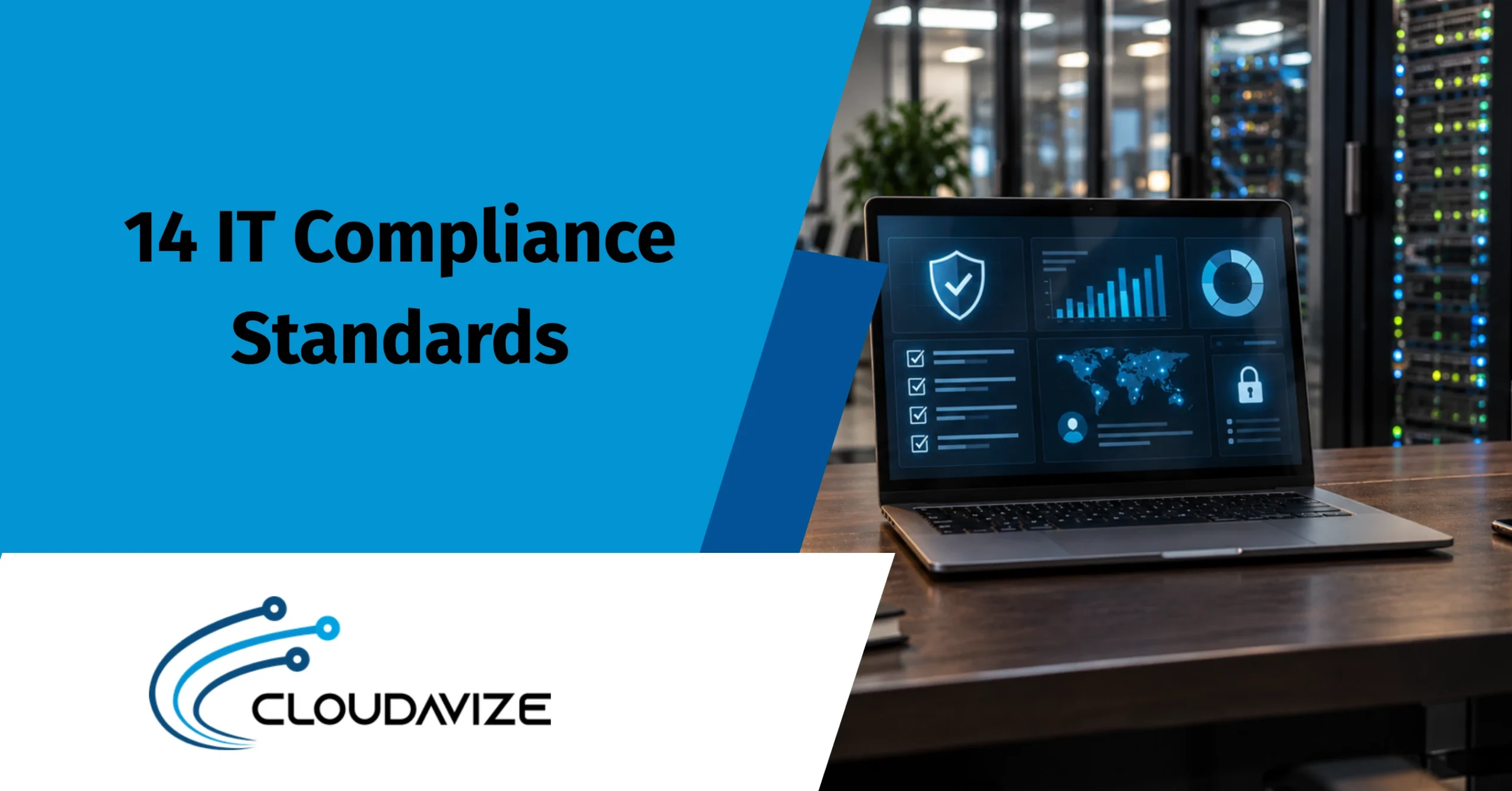
14 IT Compliance Standards
Organizations can face overlapping IT compliance requirements as they collect sensitive data, serve regulated industries, work with government agencies, or expand into new markets. Determining which requirements apply can become complex because obligations vary based on industry, data type, jurisdiction, customer contracts, and the systems within scope. This can be particularly challenging for small and medium-sized businesses (SMBs) with limited internal IT, cybersecurity, or compliance resources.
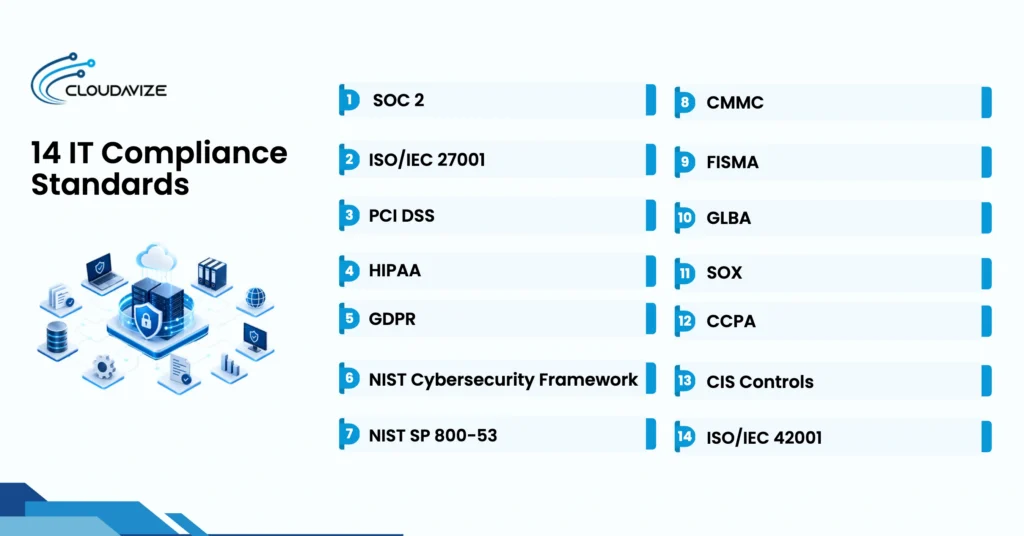
To address these requirements, organizations may need to follow SOC 2, ISO/IEC 27001, PCI DSS, HIPAA, GDPR, NIST CSF, NIST SP 800-53, CMMC, FISMA, GLBA, SOX, CCPA, CIS Controls, and ISO/IEC 42001. These standards, laws, regulations, and frameworks address information security, data privacy, payment card data, healthcare information, financial information, federal systems, defense contractors, internal controls, and AI management. Many also cover related areas such as access control, risk assessment, incident response, system monitoring, and data management.
Not every organization is subject to all 14 requirements. Applicability depends on its industry, data, customers, contracts, jurisdiction, and technology environment. Organizations should identify applicable requirements and reassess their compliance scope as operations and technology change. For SMBs, frameworks such as NIST CSF can provide a structured starting point for managing cybersecurity risk.
The 14 IT compliance standards are:
- SOC 2
SOC 2 is an AICPA attestation framework that evaluates controls at a service organization against the Trust Services Criteria. Security, also called the Common Criteria, applies to every SOC 2 examination, while availability, processing integrity, confidentiality, and privacy are included when relevant. SaaS providers, managed service providers, and cloud companies commonly pursue SOC 2 to meet customer assurance requirements.
A service auditor performs the examination and issues an attestation report, so organizations are not simply “SOC 2 certified.” A Type 1 report evaluates control design at a specified point in time, while a Type 2 report evaluates control design and operating effectiveness over a defined audit period. The report includes a system description and may address control exceptions, complementary user entity controls (CUECs), and subservice organizations. Technology-focused SMBs often pursue SOC 2 to support enterprise customer and vendor assurance requirements.
- ISO/IEC 27001
ISO/IEC 27001:2022 is an international information security management standard that defines requirements for establishing, implementing, maintaining, and continually improving an Information Security Management System (ISMS). Organizations define the ISMS scope, conduct a risk assessment, establish a risk treatment plan, and document selected Annex A controls in a Statement of Applicability (SoA). The SoA connects identified risks with applicable security controls and records whether relevant controls are implemented or excluded.
Organizations seeking certification undergo an independent certification audit by an accredited certification body, followed by surveillance audits during the certification cycle. Internal audits, management reviews, corrective actions, and continual improvement help maintain the ISMS as risks and business conditions change. ISO/IEC 27001 can apply to organizations of different sizes and sectors. For SMBs, its risk-based structure can support structured IT compliance while allowing security priorities to reflect business risks and available resources.
- PCI DSS
PCI DSS v4.0.1 is a payment card industry security standard maintained by the PCI Security Standards Council to protect account data, including cardholder data (CHD) and sensitive authentication data (SAD). It applies to entities that store, process, or transmit this data and entities that can affect the security of the Cardholder Data Environment (CDE). When properly implemented, network segmentation can support scope reduction by isolating systems from the CDE.
PCI DSS validation depends on factors such as entity type, merchant level, payment brand, and acquiring-bank requirements. Applicable entities may complete a Self-Assessment Questionnaire (SAQ) or a Report on Compliance (ROC), with an Attestation of Compliance (AOC) documenting results. Qualified Security Assessors (QSAs) and Approved Scanning Vendors (ASVs) perform specific assessment activities where required. Service providers can affect compliance scope, and outsourcing payment processing does not automatically eliminate a merchant’s PCI DSS responsibilities.
- HIPAA
HIPAA is a U.S. federal law that establishes requirements for protecting health information through the Privacy Rule, Security Rule, and Breach Notification Rule. Covered entities and business associates that handle electronic protected health information (ePHI) must address applicable administrative, physical, and technical safeguards. The Security Rule includes Security Risk Analysis, workforce access controls, incident procedures, and contingency planning to protect ePHI against security risks.
Covered entities must establish applicable Business Associate Agreements (BAAs) with business associates, while relevant obligations can extend to subcontractor business associates handling protected information. HIPAA requirements are legally enforceable and depend on an organization’s role and regulated activities, not its size. HHS reported 663 large health data breaches affecting roughly 242.9 million individuals in 2024, highlighting significant healthcare data security risks. Health-tech startups and SMBs should therefore determine whether their activities make them covered entities or business associates.
- GDPR
GDPR is European Union legislation governing how data controllers and data processors handle personal data relating to individuals. It establishes principles for lawful processing, transparency, purpose limitation, data minimization, storage limitation, integrity and confidentiality, data protection by design and default, and individual rights such as erasure and data portability. Processing requires an appropriate lawful basis, with consent being one option. Special category data receives additional protection, while certain processing activities may require a Data Protection Officer (DPO) or Data Protection Impact Assessment (DPIA).
Organizations must also address applicable data breach notification requirements and safeguards for international data transfers, including Standard Contractual Clauses where appropriate. Non-compliance can result in administrative fines of up to €20 million or 4% of worldwide annual turnover, depending on the infringement. SMEs are not generally exempt from GDPR, although some obligations may vary based on the nature of the processing, associated risks, and specific regulatory conditions.
- NIST Cybersecurity Framework
The NIST Cybersecurity Framework (CSF) 2.0 is a risk management framework that organizes cybersecurity outcomes across six Functions: Govern, Identify, Protect, Detect, Respond, and Recover. The Govern function addresses cybersecurity strategy, roles, policies, oversight, and supply-chain risk management. Organizations can use CSF Tiers and Informative References to understand cybersecurity practices and connect CSF outcomes with other standards, controls, and guidance.
Comparing current cybersecurity practices with desired outcomes helps organizations identify gaps and set risk-based priorities. A Current Profile documents existing outcomes, while a Target Profile defines intended outcomes and guides security controls, investments, and improvement plans. NIST CSF is voluntary for most private-sector organizations and does not establish regulatory compliance on its own. For SMBs, Organizational Profiles provide a practical way to align cybersecurity risk management with business risks, customer requirements, available resources, and existing IT infrastructure.
- NIST SP 800-53
NIST Special Publication 800-53 Revision 5 provides a catalogue of security and privacy controls organized into 20 control families, including Access Control, Incident Response, Risk Assessment, Configuration Management, and Supply Chain Risk Management. Within the NIST Risk Management Framework (RMF), FIPS 199 supports system categorization, while FIPS 200 establishes minimum security requirements. Organizations then select and tailor control baselines, including applicable control enhancements, using SP 800-53.
After implementation, assessment procedures in NIST SP 800-53A help determine whether controls operate as intended and support system authorization and continuous monitoring. NIST SP 800-37 defines the broader RMF process connecting categorization, control selection, implementation, assessment, authorization, and monitoring. These publications support FISMA implementation within federal environments. Private organizations are not automatically required to follow SP 800-53, although federal contracts and customer requirements can make specified controls relevant to contractors and service providers.
- CMMC
CMMC is a U.S. Department of Defence program for assessing cybersecurity requirements across the Defense Industrial Base. Its three levels address different requirements for protecting Federal Contract Information (FCI) and Controlled Unclassified Information (CUI). Level 1 uses self-assessment, Level 2 can require self-assessment or a certification assessment by a CMMC Third-Party Assessment Organization (C3PAO), and Level 3 involves government assessment by DCMA DIBCAC. Level 2 requirements align with NIST SP 800-171 Rev. 2 safeguards for CUI.
Applicability comes from DoD solicitation and contract requirements, not simply from operating within a defence-related industry. Contractors may also face affirmation requirements and flow-down obligations that extend applicable requirements to subcontractors. Businesses should review each DoD contract to determine the required CMMC level, assessment type, information scope, and subcontractor obligations. For SMBs in defence supply chains, early scope assessment can clarify which CMMC requirements apply before contract performance begins.
- FISMA
The Federal Information Security Modernization Act (FISMA) is a U.S. statutory requirement directing federal agencies to establish information security programs for federal information and systems. Agencies implement these obligations through the NIST Risk Management Framework, using FIPS 199 for system categorization, FIPS 200 for minimum security requirements, and NIST SP 800-53 to select and tailor security controls. Control assessment supports system authorization and an Authority to Operate (ATO).
Unlike FISMA, which establishes statutory obligations, NIST SP 800-53 is a control catalogue used within the federal risk-management ecosystem. Continuous monitoring, risk assessment, remediation, and incident response support security after authorization. OMB provides government-wide oversight and policy direction, while CISA supports federal cybersecurity operations and guidance. Contractors and service providers may encounter applicable FISMA-related security requirements through agency agreements and federal contracts when operating systems or handling federal information.
- GLBA
The Gramm-Leach-Bliley Act (GLBA) is a U.S. federal law governing how covered financial institutions protect nonpublic personal information (NPI). Its Privacy Rule addresses the handling and disclosure of consumer financial information, while the FTC Safeguards Rule requires covered institutions under FTC jurisdiction to maintain a written information security program for customer information. A designated Qualified Individual oversees the program, including risk assessment and applicable safeguards such as encryption, multi-factor authentication, and incident response.
Service-provider oversight is also required to address risks involving third parties that access customer information, while covered institutions must comply with applicable FTC breach notification requirements. GLBA can apply beyond traditional banks to covered businesses providing qualifying financial products or services, including certain mortgage brokers and other financial institutions. SMBs should therefore assess their activities and customer information practices to determine whether GLBA and specific Safeguards Rule requirements apply.
- SOX
The Sarbanes-Oxley Act (SOX) is a U.S. federal law governing corporate accountability and financial reporting for public companies. Section 302 addresses executive responsibility for financial disclosures, while Section 404 requires management to assess internal control over financial reporting (ICFR). IT systems become relevant when applications, databases, access permissions, or automated processes affect financial data used in financial statements. IT General Controls (ITGCs) and application controls therefore support reliable ICFR.
Public companies commonly address access management, segregation of duties, change management, and computer operations as part of their SOX control environment. External auditors assess applicable ICFR requirements, with PCAOB standards governing audits of issuers. SOX is primarily a financial-reporting law rather than a general cybersecurity framework, but weaknesses in financial reporting systems can affect the SOX assessment. Private companies are generally outside Section 404 requirements unless specific circumstances create related obligations or expectations.
- CCPA
The California Consumer Privacy Act (CCPA), as amended by the California Privacy Rights Act (CPRA), gives California consumers rights over personal information and sensitive personal information. Covered businesses must address applicable rights to know, delete, correct, and opt out of the sale or sharing of personal information. Businesses must also recognize applicable opt-out preference signals, including Global Privacy Control (GPC). The California Privacy Protection Agency (CPPA) implements and enforces the CCPA alongside the California Attorney General.
Applicability depends on statutory criteria, not business size alone. The CCPA distinguishes businesses, service providers, and contractors, each with specific obligations. Current thresholds include $26.625 million in annual gross revenue or buying, selling, or sharing personal information of 100,000 or more California residents or households, among other criteria. SMBs should assess these thresholds and their data practices before determining whether CCPA requirements apply.
- CIS Controls
CIS Controls v8.1 is a prioritized set of 18 cybersecurity Controls maintained by the Center for Internet Security, with individual Safeguards covering asset inventory, data protection, access control, vulnerability management, malware defences, logging, and application security. The Controls support essential cyber hygiene and map to NIST CSF, NIST SP 800-53, PCI DSS, and other security standards. CIS Benchmarks provide separate configuration guidance that can complement applicable Safeguards.
Implementation Groups prioritize Safeguards according to organizational risk, resources, and complexity. IG1 provides foundational protections for smaller or lower-complexity organizations, IG2 addresses greater operational complexity and risk, and IG3 addresses sophisticated threats and higher-impact risks. CIS reports that IG1 Safeguards mitigate up to 74% of MITRE ATT&CK techniques, while the CIS Controls have recorded over 500,000 international downloads. These voluntary controls give SMBs and resource-constrained IT teams a prioritized approach to cybersecurity implementation.
- ISO/IEC 42001
ISO/IEC 42001:2023 is an international management system standard that specifies requirements for establishing, implementing, maintaining, and continually improving an Artificial Intelligence Management System (AIMS). Its management structure covers leadership, planning, support, operation, performance evaluation, and continual improvement. Organizations establish an AI policy, define roles and responsibilities, set objectives, conduct AI risk assessments and AI system impact assessments, and manage controls across the AI lifecycle.
Ongoing governance includes monitoring, performance evaluation, internal audits, management reviews, corrective actions, and continual improvement using a Plan-Do-Check-Act approach. These processes help organizations manage AI-related risks and maintain documented oversight of AI systems. ISO/IEC 42001 is voluntary and can complement other management-system standards. ISO/IEC 27001 focuses on information security management, while ISO/IEC 42001 focuses on AI management, allowing organizations to coordinate both management systems where their technology environments require them.
What Requirements Are Common Across IT Compliance Standards?
Common IT compliance requirements include access controls, data encryption, data loss prevention, vulnerability management, malware protection, incident response, security policies, employee training, continuous monitoring, backups, and compliance documentation. These security controls help organizations protect sensitive information, manage risk, restrict unauthorized access, detect threats, recover systems, and demonstrate compliance. Exact IT compliance requirements vary by framework, regulation, industry, jurisdiction, data type, and organizational scope.
Below are the requirements that are common across IT compliance standards.
- Access and Identity Control
Restricting system privileges ensures that sensitive environments remain accessible strictly to verified users based on defined job roles. Frameworks enforce these mechanisms through mandatory account provisioning, multi-factor authentication, privileged access management, and regular credential reviews. Compliance teams validate these safeguards by auditing active user registries, permission change logs, single sign-on logs, and identity verification records to demonstrate that unauthorized access points are systematically eliminated across infrastructure.
- Data Encryption
Converting readable information into unintelligible ciphertext minimizes exposure risks during transmission across untrusted networks and storage in databases or cloud repositories. Standards mandate strong cryptographic algorithms alongside robust key lifecycle management to protect confidentiality. Technical compliance evidence includes cryptographic configuration files, key management procedures, active Transport Layer Security certificates, automated storage encryption policies, and third-party penetration testing reports verifying cryptographic strength.
- Data Loss Prevention
Monitoring sensitive information flows prevents unauthorized extraction, accidental disclosure, or malicious exfiltration of protected assets. Security teams establish automated content classification rules that scan outbound network traffic, block unauthorized removable media transfers, and restrict sensitive file sharing. Operational evidence demonstrating effective controls includes data classification schemes, endpoint agent configuration baselines, blocked transmission alert records, and detailed forensic investigation logs for policy violations.
- Vulnerability Management
Identifying and remediating technical weaknesses in software, operating systems, and network devices prevents exploit execution before malicious actors gain access. Compliance frameworks enforce periodic automated vulnerability scanning, prioritized patch management schedules, and periodic penetration testing. Organizations confirm operational adherence by presenting vulnerability scan summaries, documented risk prioritization matrix records, software update logs, remediation tracking tickets, and formal approval exceptions for delayed patches.
- Malware Protection
Detecting and isolating malicious code mitigates threats against endpoint workstations, virtual servers, cloud workloads, and operational networks. Compliance baselines mandate deployment of centralized endpoint protection, automated signature updates, heuristic threat monitoring, and Endpoint Detection and Response capabilities. System administrators collect evidence through centralized protection dashboards, update deployment logs, quarantine activity histories, anti-malware configuration policies, and security incident investigation tickets.
- Incident Response
Structuring procedures to identify, contain, investigate, and recover from cybersecurity events ensures operational resilience during a breach. Requirements mandate clear escalation pathways, assigned response roles, external notification workflows, and regular exercise scenarios. Verification artifacts include formally approved response playbooks, tabletop exercise summary reports, forensic investigation records, incident timeline documentation, post-incident root-cause analyses, and regulatory breach notification filings.
- Security Policies
Documenting organizational security expectations establishes formal governance and defines operational standards for employees, administrators, and vendors. Frameworks require policies covering acceptable use, access control, password parameters, remote work, and incident management. Audit readiness depends on maintaining published governance documents, scheduled review logs, executive sign-off records, version-tracking histories, vendor compliance agreements, and explicit policy exception documentation.
- Employee Security Training
Educating workforce members on cybersecurity threats, social engineering, phishing techniques, and policy adherence mitigates human-centric security risks. Frameworks require recurring security awareness programs, along with specialized training for administrative roles handling sensitive infrastructure. Compliance proof includes comprehensive training module outlines, employee completion tracking logs, phishing simulation campaign metrics, new-hire onboarding records, and signed employee policy acknowledgment forms.
- Auditing and Continuous Monitoring
Generating and reviewing granular system event logs provides real-time visibility into user actions, configuration changes, and suspicious system behaviors. Standards mandate centralized log aggregation, secure storage, and continuous Security Information and Event Management monitoring. Auditors verify compliance using continuous monitoring dashboard exports, log retention configuration files, SIEM alert notification histories, system access logs, and formal log review sign-off sheets.
- Backup and Disaster Recovery
Creating secure, isolated data copies enables full system restoration after hardware failures, ransomware incidents, or physical disasters. Requirements specify maintaining regular snapshot schedules, testing data recovery procedures, and storing backups offsite or in immutable cloud repositories. Evidence includes automated backup schedules, immutability configuration settings, restoration drill reports, Business Continuity Plan documentation, and recovery time objective validation logs.
- Compliance Documentation and Reporting
Maintaining structured audit trails proves that security controls were designed, implemented, and monitored effectively over required retention periods. Regulations enforce strict documentation schedules, including retaining policies, assessments, and logs for specified timelines, such as the six-year statutory mandate under HIPAA. Organizations demonstrate readiness by producing signed risk assessments, historical policy versions, internal audit reports, remediation tracking logs, and formal attestation statements.
How Do You Determine Which IT Compliance Standards Apply to Your Business?
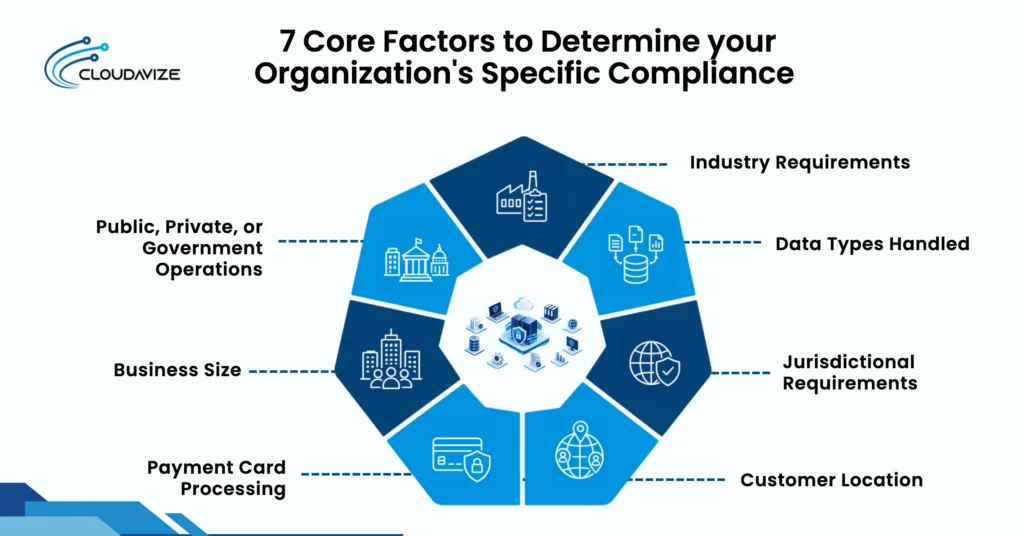
The IT compliance standards that apply to a business depend primarily on its industry and the data it handles, followed by jurisdiction, customer location, payment activities, business size, and whether it operates in the private, public, or government sector. These factors help determine whether a requirement is a legal obligation, industry requirement, contractual condition, or voluntary compliance framework. Businesses should reassess their compliance scope whenever their services, customers, locations, data processing, contracts, or organizational structure materially change.
Evaluate these 7 core factors to determine your organization’s specific compliance scope:
- Industry Requirements
Industry requirements can trigger specific compliance regulations based on the services a business provides and its role within a regulated sector. Healthcare organizations and qualifying business associates may fall under HIPAA, while certain financial institutions are subject to GLBA and the FTC Safeguards Rule. Customer contracts may also introduce standards such as SOC 2 or ISO/IEC 27001. Businesses should reassess industry compliance requirements when entering new sectors, adding regulated services, working with regulated customers, or changing their operational role.
- Data Types Handled
The information a business collects, processes, stores, or transmits can determine which IT compliance requirements apply. For example, ePHI is subject to HIPAA when handled by covered entities or business associates, while payment account data can bring systems within PCI DSS scope. Personal data may also trigger GDPR or other privacy requirements when their applicability conditions are met. Organizations should reassess compliance whenever they introduce new data categories or materially change how sensitive information is processed, stored, transmitted, or shared.
- Jurisdictional Requirements
Countries, states, and other jurisdictions can impose different cybersecurity, privacy, and data protection requirements. GDPR, for example, applies to organizations established in the EU and can also reach organizations outside the EU that offer goods or services to individuals there or monitor their behavior. Businesses should identify where they operate and process regulated information rather than relying solely on headquarters location. Compliance scope should be reviewed when expanding into new jurisdictions, establishing offices, changing data-processing locations, or entering new geographic markets.
- Customer Location
Customer location can affect regulatory compliance even when the business itself operates elsewhere. GDPR demonstrates this extraterritorial reach because qualifying organizations outside the EU can become subject to the regulation by targeting individuals in the EU or monitoring their behavior. Similar geographic considerations can arise under other privacy laws. Businesses should map where customers and affected individuals are located and reassess requirements when entering new markets, expanding international e-commerce, targeting customers in additional jurisdictions, or changing technologies used to collect and monitor personal information.
- Payment Card Processing
Businesses that accept payment cards should evaluate PCI DSS because the standard applies to entities that store, process, or transmit cardholder data and can affect cardholder data environment security. Using an outside payment processor does not automatically eliminate every PCI DSS responsibility. Businesses should reassess compliance scope when they introduce payment methods, processors, e-commerce platforms, terminals, integrations, or service providers that change how payment account data enters, moves through, or interacts with their technology environment.
- Business Size
The size of the business can affect regulatory thresholds, exemptions, and the way compliance requirements are implemented, but SMB status does not automatically provide an exemption. The European Commission confirms that qualifying SMEs must comply with GDPR, although some obligations vary according to processing activities and risks. The FTC also requires Safeguards Rule programs to reflect business size and complexity. Organizations should reassess compliance as revenue, workforce size, data-processing volumes, business complexity, customer base, or other legally defined thresholds materially change.
- Public, Private, or Government Operations
Organizational status and government relationships can change applicable IT compliance requirements. Private companies generally face requirements based on their industry, data, jurisdiction, and contracts, while federal agencies and certain government contractors can encounter additional federal cybersecurity requirements. For example, defence contractors handling FCI or CUI may face CMMC requirements specified in applicable DoD contracts. Businesses should reassess their compliance scope when pursuing government contracts, becoming subcontractors, handling government information, entering regulated supply chains, changing ownership status, or beginning operations subject to additional public-sector requirements.
What Are the Best Practices for Managing Compliance Across Multiple Standards?
Best practices for managing compliance across multiple standards include mapping common controls, building a shared control library, centralizing documentation and audit evidence, and automating evidence collection and control monitoring. Businesses should also prioritize risks, assign control owners, maintain audit trails, and conduct regular compliance reviews. IT compliance services can support these efforts by helping businesses coordinate requirements, controls, evidence, and monitoring across multiple compliance frameworks.
The following practices can help organizations manage compliance requirements more efficiently:
- Map Common Controls
Map requirements from each applicable standard to controls that address the same or similar objectives. A single access-control process, for example, may support requirements across several compliance frameworks without requiring separate implementations. NIST provides informative references mapping CSF 2.0 to ISO/IEC 27001, PCI DSS, CIS Controls, and NIST SP 800-53. Maintain a crosswalk showing each requirement, associated control, evidence, and remaining framework-specific obligations so overlap does not obscure meaningful differences.
- Build a Shared Control Library
Create a central library containing reusable security controls and link each control to every compliance requirement it supports. This prevents teams from defining separate versions of access management, vulnerability management, incident response, or encryption controls for each framework. CIS provides mappings to more than 25 frameworks, including PCI DSS, NIST CSF, NIST SP 800-53, HIPAA, and ISO/IEC 27001. As the number of controls and frameworks increases, spreadsheets can become difficult to maintain consistently.
- Centralize Documentation
Store compliance policies, procedures, risk assessments, control descriptions, system inventories, and related records in a controlled central repository. Centralization reduces duplicated documents and helps teams use the same approved information across multiple audits and assessments. It also makes it easier to trace relationships between compliance requirements, security controls, risks, and responsible teams. GRC tools can centralize documentation and make reports available for audits and reviews. Version control and scheduled reviews should keep documentation aligned with operational and regulatory changes.
- Centralize Audit Evidence
Maintain access reviews, vulnerability reports, training records, logs, configuration reports, incident records, and other audit evidence in one organized repository. Map each artifact to the controls and framework requirements it supports so the same valid evidence can be reused where appropriate. Record its owner, collection date, assessment period, and status to maintain traceability. Centralization reduces repeated evidence requests and becomes increasingly valuable when several frameworks, systems, audits, and control owners must be coordinated.
- Automate Evidence Collection
Connect relevant systems to automatically collect recurring evidence such as configurations, access information, vulnerability results, logs, tickets, and control-testing records. Map collected evidence directly to the controls and requirements it demonstrates instead of accumulating unstructured files. Automated collection reduces repetitive manual requests and supports more consistent audit preparation. It becomes particularly useful for organizations managing frequent assessments, multiple cloud environments, numerous controls, or several frameworks where manual evidence gathering creates substantial administrative work.
- Use a GRC Platform
Use a Governance, Risk, and Compliance (GRC) platform when requirements, controls, risks, policies, evidence, owners, assessments, and remediation activities become difficult to coordinate manually. Configure the platform to map shared controls across frameworks, assign responsibilities, centralize documentation, track findings, and support evidence collection and continuous monitoring. This can reduce separate compliance trackers and duplicated workflows. For SMBs, a GRC platform becomes more practical as frameworks, systems, audits, customer requests, and control owners increase.
- Automate Control Monitoring
Configure automated monitoring to continuously check security controls instead of waiting for periodic audits. Track configuration changes, access activity, patch status, disabled safeguards, and other control deviations, then create alerts or remediation tasks when issues appear. Link each monitored control to the compliance requirements it supports so one check can provide visibility across multiple frameworks. NIST CSF 2.0 specifically includes Continuous Monitoring (DE.CM) within its Detect function.
- Apply Risk-Based Prioritization
Rank compliance activities according to regulatory obligations, sensitive information, business impact, threats, vulnerabilities, and identified control gaps. Address high-impact risks first rather than allocating equal resources to every requirement. Use risk assessments to determine which controls need immediate remediation, and document why you chose those priorities. NIST CSF 2.0 supports this approach by helping organizations understand, assess, prioritize, and communicate cybersecurity risks regardless of their size, sector, or maturity.
- Assign Clear Control Owners
Assign every shared control to a named person or team responsible for implementation, operation, evidence collection, remediation, and review. Record ownership alongside mapped requirements, risks, evidence deadlines, and outstanding findings so responsibilities remain clear across frameworks. This prevents compliance tasks from being overlooked when several departments are involved. NIST CSF 2.0 specifically calls for establishing, communicating, understanding, and enforcing cybersecurity roles, responsibilities, and authorities to support accountability.
- Maintain Audit Trails
Record control changes, approvals, assessments, evidence submissions, exceptions, findings, remediation actions, and responsible personnel in a traceable system. Connect each record to the relevant control and compliance requirement so auditors can follow what occurred, when it occurred, and who performed or approved the action. This reduces the need to reconstruct historical activity before assessments. NIST’s Risk Management Framework similarly incorporates control assessment, authorization, accountability, and continuous monitoring into an ongoing risk-management process.
- Conduct Regular Compliance Reviews
Schedule periodic reviews of applicable standards, control mappings, policies, risks, evidence, exceptions, and unresolved remediation tasks. Compare current controls with applicable requirements and update them when regulations, technologies, systems, contracts, or business operations change. Include additional reviews after major organizational or cybersecurity events instead of relying only on an annual assessment. NIST implementation guidance recommends reviewing cybersecurity strategies at least annually and after major events, alongside periodic management reviews of assigned responsibilities.