
How Much Does Cloud Migration Cost? Cost, Pricing, and Estimates
Cloud migration costs range from $5,000 to $250,000+, depending on migration scope, workload type, data volume, application complexity, technical requirements, and required professional services. A small migration costs $5,000 to $20,000 for a few workloads with limited dependencies, while a moderate migration costs $20,000 to $80,000 for several servers and applications. A complex migration ranges from $75,000 to $250,000 for many workloads, databases, and integrations, while a large enterprise migration exceeds $250,000 for extensive workloads, multiple migration waves, and strict security or downtime requirements. These figures are planning ranges, not fixed cloud migration prices.
Workload-level costs also affect the final budget. Server migration ranges from $1,000 to $8,000+ per server, data migration from $5,000 to $250,000+, database migration from $5,000 to $75,000+, and application migration from $5,000 to $1 million+ per application. Provider pricing, migration tools, licensing changes, temporary infrastructure, testing, downtime, and stabilization can further increase total cloud migration costs.
What Is the Average Cloud Migration Cost?
The average cost of cloud migration ranges from $5,000 to $20,000 for a small migration, $20,000 to $80,000 for a moderate migration, $75,000 to $250,000 for a complex migration, and $250,000+ for a large enterprise migration. These ranges provide a more practical estimate of cloud migration costs than a single average because migration scope, workload complexity, data volume, technical requirements, and required professional services vary by project. For this reason, businesses should use the earlier planning bands to estimate a migration budget rather than rely on a single arithmetic average.
Cloud Migration Cost by Project Scope:
| Project Scope | Migration Scope Details | Estimated Average Cost |
| Small Migration | Few workloads, limited data, minimal dependencies, and straightforward rehosting | $5,000-$20,000 |
| Moderate Migration | Several servers and applications, moderate data volume, multiple dependencies, and some platform changes | $20,000-$80,000 |
| Complex Migration | Many workloads, databases, integrations, hybrid requirements, and significant application or infrastructure changes | $75,000-$250,000 |
| Large / Enterprise Migration | Large workload portfolio, multiple migration waves, strict security or compliance requirements, low downtime, and modernization | $250,000+ |
How Much Does Cloud Migration Cost by Workload Type?
Cloud migration prices range from $1,000 to $1,000,000+ depending on the workload type and migration complexity. Server migrations cost $1,000 to $8,000+ per server, while data migrations range from $5,000 to $250,000+. Database migrations cost $5,000 to $75,000+, and application migrations range from $5,000 to $1,000,000+ per application. Workload complexity, data volume, system dependencies, compatibility requirements, remediation, testing, and downtime requirements all influence the final cloud migration cost.
How Much Does Server Migration Cost?
Server migration costs range from $1,000 to $3,000 per straightforward server and $3,000 to $8,000+ per complex server. A server with a standard operating system, limited storage, and few dependencies requires less migration labor and testing. Prices increase when servers contain large storage volumes, legacy operating systems, application dependencies, compatibility issues, or strict downtime requirements. Required remediation, replication, configuration, validation, and cutover work can also increase the server migration cost and the total cloud migration budget.
How Much Does Data Migration Cost?
Data migration costs range from $5,000 to $15,000 for a small, straightforward migration, $20,000 to $60,000 for a moderate migration, and $250,000+ for a complex data migration. The final data migration cost depends on data volume and the work required to transfer, replicate, transform, and validate the data. Large datasets, repeated transfers, transformation requirements, temporary storage, longer replication periods, and extensive validation increase migration expenses by requiring more resources and extending the migration timeline.
How Much Does Database Migration Cost?
Database migration costs range from $5,000 to $15,000 for a straightforward same-engine migration and $15,000 to $75,000+ for a complex cross-engine migration. Same-engine migrations require fewer compatibility changes, while cross-engine projects can require schema conversion, stored procedure changes, data replication, and database remediation. Prices also increase when teams must address complex schemas, application dependencies, strict validation requirements, or limited downtime. These requirements increase engineering, testing, replication, and cutover work within the database migration project.
How Much Does Application Migration Cost?
Application migration costs range from $5,000 to over $1,000,000 per application, depending primarily on the migration strategy, application complexity, and organization size. Applications requiring limited configuration changes and testing remain near the lower end of the range. Costs increase when applications require code changes, platform modifications, dependency remediation, integration work, database changes, security configuration, or extensive testing. More complex applications require more engineering effort, take longer to migrate, and cost more.
How Do Cloud Migration Services Charge for Migration?
Cloud migration project costs can range from $8,000 to $60,000 for smaller migrations, $100,000 to $500,000+ for mid-market projects, and $500,000+ for large enterprise migration programs. Cloud migration services may charge professional fees using fixed-project, hourly, per-server, per-workload, or data-volume-based pricing. The final pricing depends on workload volume, application dependencies, migration strategy, data movement, integration requirements, and the amount of refactoring involved.
What Are the Common Cloud Migration Pricing Models?
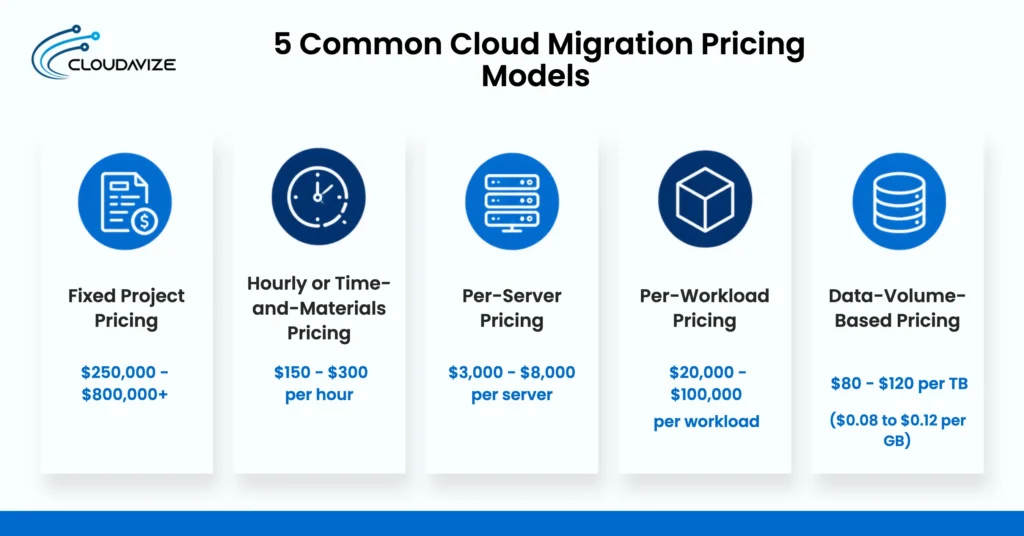
The common cloud migration pricing models include fixed project pricing, hourly or time-and-materials pricing, per-server pricing, per-workload pricing, and data-volume-based pricing. These models determine how cloud migration providers calculate professional-service fees based on project scope, workload quantity, data volume, migration complexity, and required labor. Providers may use a single pricing model for a defined migration or combine multiple models when different workloads require different levels of engineering effort.
5 Common cloud migration pricing models include:
- Fixed Project Pricing
Fixed project pricing ranges from $25,000 to $80,000 for small business migrations, $80,000 to $250,000 for mid-market projects, and $250,000 to $800,000+ for large enterprise scopes. The cloud migration service provider charges one agreed price for a defined migration scope, deliverables, assumptions, and exclusions based on workload complexity and required engineering effort.
- Hourly or Time-and-Materials Pricing
Cloud migration services can range from $150 to $300 per hour, where businesses pay based on the actual time, engineering effort, and resources required to complete the migration project. The final cost depends on migration complexity, required expertise, workload scope, remediation needs, and project duration.
- Per-Server Pricing
Cloud migration services can range from $3,000 to $8,000 per server, with charges based on the number of servers migrated, server complexity, configuration requirements, dependencies, and migration effort. Complex servers with larger storage volumes, legacy systems, application dependencies, remediation, testing, and cutover requirements may require higher pricing tiers.
- Per-Workload Pricing
Cloud migration services can range from $20,000 to $100,000 per workload, where applications, databases, and other workloads are priced individually based on workload complexity, technical requirements, dependencies, and migration effort. Complex workloads requiring remediation, integration changes, database updates, testing, and additional engineering resources may fall toward the higher end of the pricing range.
- Data-Volume-Based Pricing
Cloud migration services can range from $80 to $120 per TB ($0.08 to $0.12 per GB), with costs calculated based on the amount of data processed, migrated, or transferred during the project. The final cost depends on data volume, transfer method, replication requirements, transformation needs, validation processes, and the complexity of moving large datasets.
What Is Included in Cloud Migration Service Pricing?
Cloud migration service pricing includes assessment, migration planning, cloud architecture, engineering, project management, workload migration, testing, cutover, stabilization, and post-migration support. The exact service coverage depends on the provider’s defined scope, deliverables, assumptions, and exclusions. Cloud consumption, software licenses, data transfer charges, third-party migration tools, and other external expenses may fall outside the professional-service fee, so businesses should identify which costs are included and which are excluded before comparing cloud migration pricing.
How Do Migration Tools Affect Cloud Migration Pricing?
Migration tools affect cloud migration pricing through free, time-limited, licensed, per-server, or usage-based pricing models. A licensed migration tool can create a fixed project expense, while per-server or usage-based tools increase costs according to workload volume or consumption. Some tools may reduce the need for professional labor by automating data transfer, replication, or workload migration. Migration-tool pricing remains one component of the overall migration expense and should be calculated separately from professional services and other cloud transition costs.
How Can You Calculate an Accurate Cloud Migration Cost Estimate?
Businesses can estimate cloud migration costs by combining provider fees, technical migration expenses, transition costs, and stabilization expenses into a single project budget. The estimate should separate one-time migration costs from recurring cloud operating costs and identify expenses that sit outside the provider quote. Businesses should then compare the estimate against the defined migration scope, assumptions, exclusions, and required work to determine whether the budget covers the full cloud transition.
What Costs Should Be Included in a Cloud Migration Estimate?
A cloud migration cost estimate should include professional services, workload remediation, data migration, migration tools, temporary resources, testing, cutover, security or licensing changes, transition expenses, and stabilization. Professional cloud migration services cover the provider’s migration work, while remediation accounts for required workload changes. Tools and temporary resources support migration execution, and testing and cutover cover validation and transition work. Including costs outside the provider quote creates a more complete migration budget and reduces the risk of underestimating one-time expenditure.
How Do You Calculate the Total Cost of Cloud Migration?
Businesses can calculate the total one-time cloud migration cost by combining all project expenses instead of treating the provider quote as the complete migration budget. The calculation should include professional services, workload remediation, data migration, migration tools, temporary resources, testing, transition activities, and stabilization costs.
Formula:
Total One-Time Cloud Migration Cost = Professional Services + Workload Remediation + Data Migration + Migration Tools and Temporary Resources + Testing and Cutover + Transition Costs + Stabilization
For example, if a business estimates $40,000 for professional services, $25,000 for workload remediation, $15,000 for data migration, $10,000 for migration tools, $12,000 for testing and cutover, $8,000 for transition costs, and $10,000 for stabilization, the total one-time cloud migration cost equals $120,000.
This calculation excludes recurring cloud operating costs, which fall under cloud migration TCO. AWS identifies migration services, tools, temporary infrastructure, and project resources as key migration cost components.
How Can Businesses Compare and Evaluate Cloud Migration Cost Estimates?
Businesses can compare cloud migration cost estimates by checking scope and workload coverage, assumptions and exclusions, pricing models, technical charges, testing and cutover, licenses and transition expenses, change-request terms, and support. Comparing provider quotes helps identify missing services, technical work, and transition prices.
Key Cost Categories to Compare:
- Pre-Migration Expenses: Evaluate costs related to application audits, data restructuring, dependency assessment, migration planning, and network security redesign before the migration begins.
- Migration Execution Costs: Review expenses for data transfer, migration tools, testing, third-party consultants, temporary resources, and parallel infrastructure required during the transition period.
- Post-Migration Operations: Compare ongoing cloud costs, including compute, storage, security tools, monitoring services, support, and internal training requirements.
- Hidden Expenses: Identify additional costs from software license changes, downtime-related productivity losses, staff reallocations, and unexpected remediation work.
Evaluation Approach:
- Use Provider Tools: Use tools such as the AWS Pricing Calculator to estimate predictable cloud resource costs.
- Separate Timelines: Distinguish one-time migration expenses from ongoing cloud operating costs.
- Align With Business Value: Compare migration investment against operational improvements, productivity, scalability, and resilience, not infrastructure savings alone.
Should Businesses Get a Cloud Migration Cost Estimate From a Provider?
Businesses should get a professional cloud migration cost estimate when internal teams cannot accurately define migration scope, technical requirements, or engineering effort. Complex environments with legacy applications, unclear dependencies, multiple databases, hybrid infrastructure, compliance requirements, or strict downtime limits often require detailed assessment. For example, a Dallas business running multiple applications across on-premises servers may need a provider assessment to identify workloads, migration steps, and transition costs. A scoped plan from cloud migration services in Dallas helps businesses build a realistic migration budget before execution.
What Hidden Costs Can Increase Cloud Migration Costs?
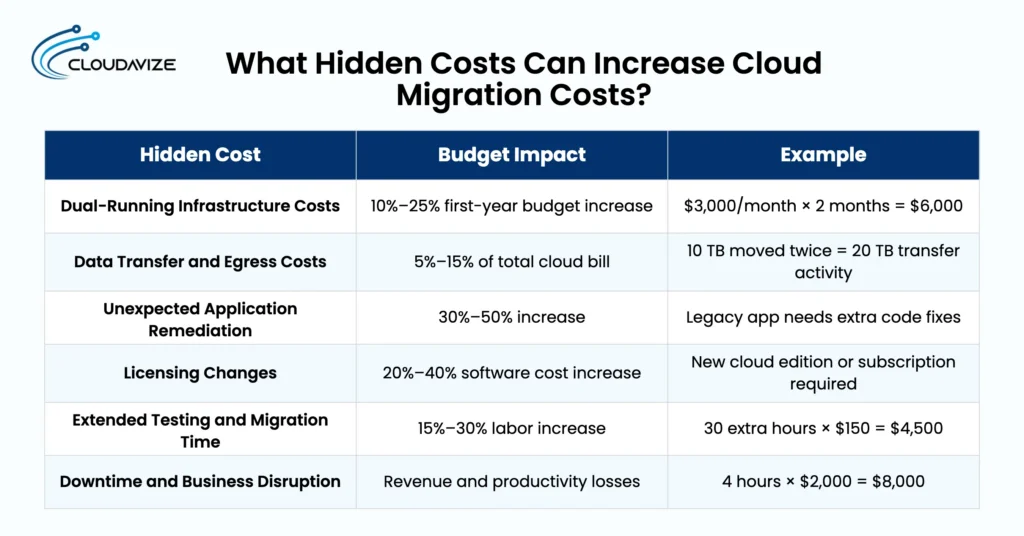
Hidden cloud migration costs include dual-running infrastructure, data transfer and egress charges, unexpected application remediation, licensing changes, extended testing, and downtime-related expenses. These costs can arise after the original migration budget is prepared, increasing the final expenditure. Businesses should account for these expenses before migration begins to create a more complete cloud migration cost estimate.
The following hidden costs can increase the final migration budget:
- Dual-Running Infrastructure Costs
Maintaining two environments during migration can increase first-year operational budgets by 10% to 25% because businesses continue paying for existing on-premises infrastructure while also consuming cloud resources. This overlap supports replication, testing, validation, and phased cutover but creates additional expenses for servers, storage, networking, and cloud services. For example, if the existing infrastructure costs $3,000 per month and remains active for two extra months, the transition adds $6,000 in temporary costs.
- Data Transfer and Egress Costs
Large-scale data movement can add 5% to 15% to the total cloud bill because bulk uploads, cross-region transfers, and bandwidth usage often exceed initial migration estimates. These charges increase when businesses transfer datasets multiple times for replication, testing, and final cutover. For example, moving 10 TB of data twice creates 20 TB of total transfer activity, which can generate additional charges based on cloud provider pricing.
- Unexpected Application Remediation
Additional application changes can increase initial migration estimates by 30% to 50% when legacy systems require unexpected code updates, dependency fixes, compatibility adjustments, or architecture changes. These issues often appear during testing when applications interact with the new cloud environment. For example, an application using outdated libraries may require extra development work before it can operate correctly after migration.
- Licensing Changes
New licensing requirements can increase software costs by 20% to 40% because existing on-premises licenses may not transfer directly to cloud environments, virtual processors, or cloud-specific editions. Businesses may need new subscriptions or revised licensing agreements after migration. For example, a database license designed for physical servers may require a different cloud licensing model, increasing the overall migration budget.
- Extended Testing and Migration Time
Longer project timelines can increase labor and consultant expenses by 15% to 30% when technical issues delay migration waves or extend deployment periods. Additional testing requires more engineering hours, temporary infrastructure, and project coordination. For example, if migration validation requires 30 extra consulting hours at $150 per hour, the business adds $4,500 in additional labor costs.
- Downtime and Business Disruption
Operational interruptions can cost businesses thousands to millions of dollars depending on revenue impact, system importance, and outage duration. Migration-related downtime can affect employee productivity, customer transactions, and critical business operations during final cutover. For example, a company losing $2,000 in operational value per hour could experience an $8,000 impact from four hours of downtime, excluding recovery expenses.
What Is the Total Cost of Ownership for Cloud Migration?
Cloud migration TCO is the total financial cost of migrating to and operating a cloud environment over a defined period. It combines the one-time cloud migration investment with recurring cloud expenses and compares them with the cost of maintaining the existing on-premises environment. Unlike a migration cost estimate, which focuses on transition expenses, TCO measures the broader financial impact of cloud migration over several years.
What Does Cloud Migration TCO Include?
Cloud migration TCO includes the one-time migration investment plus costs for recurring compute, storage, databases, backup, security, monitoring, support, and cloud t expenses. If migration costs $50,000 and ongoing cloud operations cost $6,000 per month, the three-year TCO would be $50,000 plus $216,000 in recurring cloud costs, for a total of $266,000 before other applicable expenses.
How Does Cloud Migration TCO Compare With On-Premises IT Costs?
Businesses compare cloud migration TCO with on-premises IT costs by measuring equivalent expenses over the same period. Cloud migration shifts spending from upfront CapEx investments to operational OpEx costs through recurring subscriptions. On-premises environments require hardware, networking, and maintenance investments, while cloud environments use flexible payment models. Cloud TCO can reduce IT labor costs by 25% to 40% but may increase expenses for high-volume workloads. For instance, if on-premises IT costs $300,000 over three years and cloud TCO is $266,000, moving to the cloud saves $34,000.
How Do Ongoing Cloud Costs Affect Migration TCO?
Ongoing cloud costs increase migration TCO through compute usage, storage growth, networking, databases, managed services, backups, monitoring, support, and cloud management expenses. For example, a cloud environment costing $6,000 per month creates $72,000 in annual operating costs. If unused resources increase monthly spending to $7,000, annual costs rise to $84,000, adding $36,000 to a three-year TCO unless the business monitors and optimizes resource usage.
What Factors Affect Cloud Migration Costs?
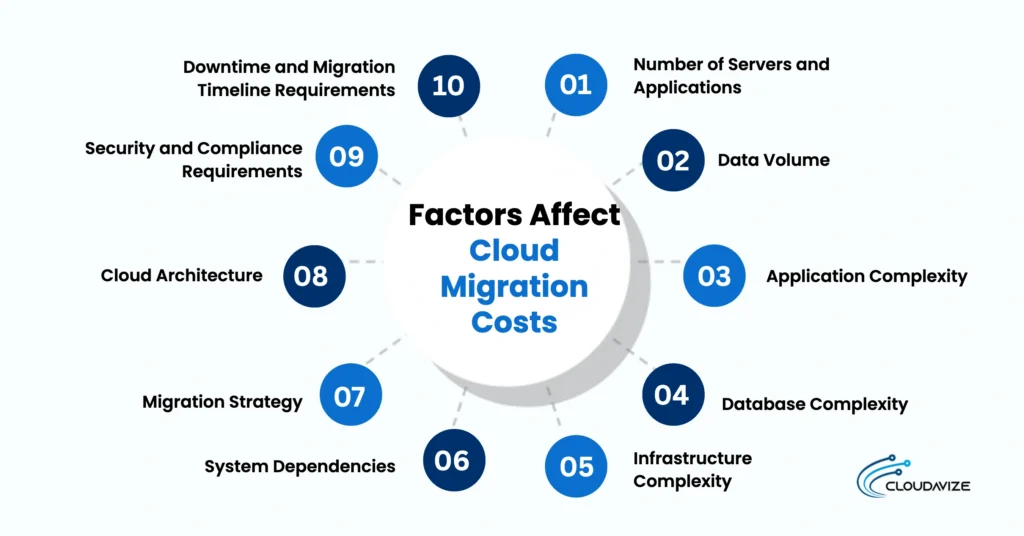
Factors affecting cloud migration costs include workload quantity, data volume, application and database complexity, infrastructure, dependencies, migration strategy, cloud architecture, security requirements, and downtime limits. These factors determine how much discovery, engineering, configuration, transfer, testing, and cutover work the migration requires. A broad environment with complex technical requirements requires more resources than a smaller migration with a defined scope.
Below are the factors affecting cloud migration cost:
- Number of Servers and Applications
The number of servers and applications directly affects migration labor, testing, and coordination requirements. A business moving five servers may require limited assessment and migration planning, while an environment with 100 servers and 30 applications needs multiple migration waves. For example, migrating 50 additional servers at an average cost of $3,000 per server can add approximately $150,000 to the migration budget.
- Data Volume
The amount of data transferred affects storage, replication, validation, and transfer expenses during migration. Moving 500 GB requires fewer resources than transferring 50 TB of business data. For example, transferring an additional 20 TB of data at a provider transfer rate of $0.09 per GB can add around $1,800 in data movement charges, excluding replication and validation costs.
- Application Complexity
Application complexity increases migration costs when workloads require code changes, dependency fixes, integration updates, or compatibility adjustments. A standalone application requires less engineering than a legacy application connected to multiple systems. Resolving 40 additional development and testing hours at $150 per hour can add $6,000 to the application migration cost.
- Database Complexity
Database migration cost depends heavily on what must happen to the database during the move. A same-engine transfer may require replication and validation, while a cross-engine migration can involve schema conversion, stored procedure changes, compatibility work, and broader testing. Complex databases with strict downtime requirements also require more cutover planning, increasing the engineering effort in the migration budget.
- Infrastructure Complexity
Infrastructure complexity increases costs when businesses operate hybrid environments, multiple locations, custom networks, or legacy systems. A simple cloud connection requires fewer configuration tasks than an environment requiring complex networking and security integration. Additional architecture and networking work for a hybrid environment can increase professional-service costs by $10,000 or more depending on implementation requirements.
- System Dependencies
System dependencies increase migration costs because applications, databases, APIs, identity systems, and third-party services must move in the correct sequence. A workload connected to multiple business systems requires additional discovery and testing. For example, identifying and validating 20 application dependencies may require additional engineering hours, increasing migration labor and extending the project timeline.
- Migration Strategy
Rehosting, replatforming, and refactoring involve different levels of engineering effort and upfront costs. Rehosting moves workloads with limited application modification, while replatforming changes selected platforms or configurations. Refactoring can involve changes to code, architecture, integrations, databases, DevOps, and security. A strategy requiring more technical modification therefore increases professional labor, testing requirements, and initial cloud migration costs.
- Cloud Architecture
The target cloud design directly affects the work required before workloads can operate. A single-region deployment with basic networking requires fewer configuration steps than a multi-region environment with disaster recovery and hybrid connectivity. Availability requirements, managed services, networking, regions, and recovery architecture can introduce additional implementation and testing tasks, increasing both migration effort and the planned project budget.
- Security and Compliance Requirements
Security and compliance requirements increase migration costs when businesses need encryption, identity controls, logging, security testing, and regulatory validation. A standard workload requires fewer security activities than a regulated system. For example, implementing additional compliance controls, audits, and security testing can add $10,000 to $50,000+ depending on workload requirements.
- Downtime and Migration Timeline Requirements
A workload that can remain offline for several hours provides a wider cutover window than a system requiring near-continuous availability. Strict downtime limits may require advance replication, parallel environments, additional testing, rollback preparation, and more extensive cutover coordination. Compressed migration schedules may also require more resources to work simultaneously, increasing labor and temporary infrastructure expenses within the migration budget.
How Do Cloud Migration Strategies Affect Cost?
Cloud migration strategies affect cost by changing the amount of engineering, application modification, testing, and implementation work required during migration. Rehosting requires fewer technical changes and has a lower upfront cost, while replatforming requires selected platform changes. Refactoring requires broader application- and architecture-level changes, resulting in the highest upfront migration cost among the three strategies.
The table below provides a quick comparison of each strategy’s cost, engineering workload, timeline, and long-term cloud value:
| Strategy | Upfront Cost | Engineering Effort | Engineering time | Long-Term ROI |
| Rehosting (“Lift & Shift”) | Low | Minimal code changes | 1-3 weeks | Moderate (risk of higher cloud run costs) |
| Replatforming (“Lift & Reshape”) | Medium | Platform & database tweaks | 3-6 weeks | Higher (leverages managed services) |
| Refactoring (“Re-architecting”) | High | Heavy development & testing | 6-12+ weeks | Maximum (cloud-native optimization) |
How Does Rehosting Affect Cloud Migration Cost?
Rehosting keeps upfront cloud migration costs lower because it requires minimal application modification, development effort, and remediation work. This approach moves existing applications to the cloud with limited changes, reducing engineering and testing requirements during migration. Around 70% of workloads can be addressed through rehost, relocate, or replatform approaches, making these strategies common starting points for large migration programs. Rehosting can still increase post-migration costs if businesses move oversized workloads without optimizing resource allocation in the cloud environment.
How Does Replatforming Affect Cloud Migration Cost?
Replatforming increases upfront migration effort because teams make targeted platform changes, including operating-system upgrades, database modifications, compatibility adjustments, configuration updates, and additional testing. These changes require more engineering work than rehosting while avoiding the full redevelopment effort of refactoring. Replatforming effort can increase by 1–3 effort units for low-complexity workloads, 2–5 for medium-complexity workloads, and 4–8 for high-complexity workloads when upgrading operating systems or database versions. Additional technology changes can add 10–15, 20–30, or 40–60 effort units depending on workload complexity. These modifications can improve cloud efficiency while increasing initial migration costs.
How Does Refactoring Affect Cloud Migration Cost?
Refactoring incurs the highest upfront cost by adding software development, architectural changes, integration work, database modifications, DevOps configuration, security implementation, and broader testing to the migration scope. These activities require more engineering labor and can extend the migration timeline. For example, redesigning a legacy application into cloud-based components requires developers to modify and validate the application before cutover, increasing the initial migration investment.
How Much Can Cloud Migration Save?
Cloud migration can reduce infrastructure costs by 20% to 40% after workloads stabilize, while long-term TCO reductions can reach 30% to 60% over five to ten years when businesses optimize cloud usage. These savings depend on removing unnecessary infrastructure, reducing hardware and maintenance expenses, improving resource utilization, and controlling cloud operating costs. Businesses should reduce migration expenses by removing unnecessary data and workloads, resolving dependencies early, limiting avoidable application changes, and reducing downtime without removing required testing or security work.
Cost controls should continue after workloads move to the cloud. The Flexera 2026 State of the Cloud Report, based on a survey of 753 cloud decision-makers and users, found that respondents estimated 29% of IaaS and PaaS cloud spending was wasted, while 68% identified cloud cost optimization as their leading cloud initiative. Monitoring usage, rightsizing resources, and removing unnecessary cloud spending help maintain post-migration savings.
What Are the Financial Benefits of Cloud Migration?
The financial benefits of cloud migration include lower hardware investment, reduced data center expenses, fewer infrastructure refresh costs, lower maintenance costs, and reduced spending on unused capacity. For example, a business that eliminates $30,000 in annual hardware and facility expenses but adds $20,000 in annual cloud costs produces $10,000 in potential annual operating savings from those cost categories.
How Much Can Businesses Save by Moving IT Infrastructure to the Cloud?
Businesses can achieve 20% to 60% reductions in total cost of ownership (TCO) or overall IT spending over five to ten years by moving IT infrastructure to the cloud. You can calculate potential cloud migration cost savings by subtracting future annual cloud costs from current annual IT costs. The actual savings depend on which on-premises expenses are eliminated, how efficiently cloud resources are managed, and the level of optimization after migration.
- Potential Annual Operating Savings = Current Annual IT Cost − Future Annual Cloud Cost
If a business currently spends $180,000 per year on IT and its future cloud costs are $140,000 per year, the business could save $40,000 annually. The actual savings depend on factors such as cloud usage, infrastructure requirements, licensing, support costs, and ongoing resource management, which can affect the difference between current IT spending and future cloud expenses.
How Do Cloud Migration Cost Savings Compare With Migration Costs?
Cloud migration cost savings can be compared with upfront migration costs to determine whether the expected savings justify the initial investment and how long it may take to recover the cost. Cloud migration savings generally outweigh initial migration costs over a three-to-five-year period, with payback periods often averaging around 16 months. For example, a migration costing $80,000 that produces $40,000 in annual operating savings would recover the initial investment in approximately two years. After the payback period, savings can contribute to a positive financial result if future cloud operating costs remain within the planned budget.
How Can Businesses Reduce Cloud Migration Costs?
Businesses can reduce cloud migration costs by removing unnecessary data and workloads, resolving dependencies early, limiting avoidable application changes, reducing downtime, and controlling unexpected expenses before migration begins. Cost reduction should focus on reducing the data, infrastructure, engineering, and migration time required without removing necessary testing or security work. A defined migration scope also helps businesses allocate resources to workloads that need to move.
How Can Businesses Reduce Data Migration Costs?
Businesses can reduce data migration costs by deleting duplicate data, archiving information that does not need to move, limiting repeated transfers, shortening replication periods, and selecting an appropriate transfer method. For example, reducing a 20 TB dataset to 12 TB before migration means the team transfers and validates 8 TB less data. This reduces transfer requirements, temporary storage usage, and migration time.
How Can Businesses Reduce Server Migration Costs?
Businesses can reduce server migration costs by retiring unused servers, grouping similar workloads, automating repeated migration tasks, and resolving compatibility problems before migration begins. A business with 50 servers may identify 10 that no longer support active workloads and exclude them from the migration. Reducing the server count lowers the amount of assessment, configuration, replication, testing, and cutover work required.
How Can Businesses Reduce Application Migration Costs?
Businesses can reduce application migration costs by prioritizing workloads, removing unnecessary applications, selecting the right migration strategy, addressing dependencies early, and automating repetitive migration tasks. Early application assessment can identify systems to retire, consolidate, rehost, or modernize before migration begins, reducing unnecessary engineering and testing work. Businesses can also migrate workloads in phases to catch issues early and avoid costly rework across the environment.
How Can Businesses Reduce Cloud Migration Downtime Costs?
Businesses can reduce cloud migration downtime costs through advanced replication, tested cutover procedures, rollback plans, suitable migration windows, and workload prioritization. For example, replicating the database data before the scheduled cutover means that only the remaining changes need to be synchronized during the migration window. A shorter outage reduces operational interruptions, employee downtime, support needs, and the potential financial impact of business systems being unavailable.
How Can Businesses Avoid Unexpected Cloud Migration Costs?
Businesses can avoid unexpected cloud migration costs through detailed discovery, explicit quote assumptions, contingency budgeting, license checks, transfer-fee reviews, dependency validation, cutover rehearsals, and defined change-control rules. For example, checking database licensing before migration can identify a new license requirement before it becomes an unplanned expense. Clear provider exclusions and change-request terms also help businesses identify which additional work could increase the migration budget.