
Top 10 Benefits of Disaster Recovery for Your Business
The benefits of a Disaster Recovery (DR) Plan include faster recovery, reduced data loss, protection of critical systems, business continuity, lower outage costs, compliance support, protection of customer trust, better risk readiness, clear crisis communication, and flexible recovery options. Together, these benefits help businesses, including small and mid-sized Businesses (SMBs), restore critical operations, protect valuable business data, reduce financial losses, and maintain customer confidence during cyberattacks, hardware failures, natural disasters, and other unexpected disruptions.
Because every business has unique operational and recovery needs, disaster recovery strategies should be tailored to business size, industry, and risk profile. Many organizations work with a Managed Service Provider (MSP) or disaster recovery service provider to design, test, monitor, and maintain recovery solutions that align with their operational goals. A customized disaster recovery strategy strengthens resilience, simplifies recovery, and helps businesses remain prepared for future disruptions.
The following 10 benefits highlight the importance of disaster recovery for businesses:
- Faster Recovery
By establishing a blueprint to restore critical IT infrastructure after cyberattacks, hardware failures, or natural disasters, a Disaster Recovery (DR) Plan enables businesses to recover faster. For small and mid-sized businesses (SMBs), where limited IT resources and tighter operational margins make downtime especially costly, rapid recovery is essential for maintaining business stability. Clearly defined Recovery Time Objectives (RTOs), combined with cloud-based recovery, virtualized environments, and documented recovery procedures, help organizations restore mission-critical applications and services within acceptable timeframes while minimizing operational disruption.
Faster recovery limits operational disruption, protects revenue, and helps employees and customers regain access to critical services sooner. According to Keiser University, organizations with a tested disaster recovery and business continuity plan are 2.5 times more likely to recover quickly after a disaster. Regular testing, documented recovery procedures, and clearly defined priorities help businesses resume operations efficiently while reducing the financial and operational impact of prolonged outages. - Reduced Data Loss
Reducing data loss is one of the greatest benefits of a disaster recovery plan because it protects critical business information during cyberattacks, hardware failures, power outages, and natural disasters. Recovery Point Objectives (RPOs) define the acceptable amount of data loss between backups, helping SMBs restore recent files with minimal disruption. Immutable backups and automated recovery copies further strengthen data protection by preserving business data and enabling reliable restoration in the event of unexpected incidents.
Protecting data minimizes operational disruption, safeguards revenue, and preserves customer trust. It also supports regulatory compliance by ensuring that sensitive information remains recoverable during audits and emergencies. With secure backup strategies, regular recovery testing, and verified recovery copies, small and mid-sized businesses can reduce the risk of permanent data loss, strengthen operational resilience, and recover confidently from unexpected disruptions. - Critical System Protection
A disaster recovery plan ensures your business can quickly resume operations after a disruptive event, such as a ransomware attack, hardware failure, or power outage. Protecting mission-critical systems is essential because applications, databases, servers, and network infrastructure support the daily operations, productivity, and customer services that keep a business running. Recovery plans prioritize these critical assets, ensuring essential workloads are restored before less important resources, reducing operational disruption and keeping core business functions available.
Protecting critical systems such as servers, databases, applications, networks, and cloud infrastructure helps maintain employee productivity, customer access, and uninterrupted service delivery during unexpected incidents. Regular replication, recovery testing, and infrastructure monitoring verify that critical workloads remain recoverable and perform as expected after a disruption. This structured approach strengthens operational resilience, shortens service interruptions, and enables businesses to restore essential functions efficiently without compromising daily operations or customer experience. - Business Continuity
A well-designed disaster recovery plan strengthens business continuity by reducing recovery time, minimizing financial impact, and ensuring operational resilience. Whether caused by a cyberattack, power outage, natural disaster, or hardware failure, a disaster recovery strategy keeps employees connected to essential applications, communication tools, and business data. This allows critical operations to continue while recovery efforts are underway, reducing disruption across the organization.
Business continuity from disaster recovery also protects revenue, customer relationships, and long-term operational stability. According to IBM, businesses take more than 100 days to fully recover from a disruptive incident, highlighting that recovery is often a prolonged process rather than a quick IT fix. A tested disaster recovery plan gives SMBs a structured recovery path, helping them maintain essential operations and support customers even during extended disruptions. - Lower Outage Costs
By restoring critical systems through predefined recovery procedures, a disaster recovery plan reduces the costs associated with unexpected outages and minimizes operational disruptions for small and mid-sized businesses. Automated failover, prioritized system recovery, and documented response processes help IT teams recover faster without relying on lengthy troubleshooting. This reduces emergency repair efforts, limits overtime expenses, and enables employees to resume essential business activities with minimal delays.
Lower recovery costs strengthen financial resilience by reducing the impact of prolonged outages. Information Technology Intelligence Consulting (ITIC) reports that 90% of businesses experience hourly downtime costs exceeding $300,000, while 41% of enterprises estimate losses ranging from $1 million to more than $5 million per hour. For SMBs, reducing downtime is essential, as brief disruptions can significantly affect revenue, customer satisfaction, and operations, emphasizing the need for cost-effective recovery strategies to strengthen financial resilience. - Compliance Support
A structured recovery approach enables businesses to restore critical systems quickly, lowering the costs associated with unexpected outages and reducing operational disruption. SMBs operating under frameworks such as HIPAA, GDPR, PCI DSS, ISO 27001, and DORA must demonstrate that critical data remains protected, recoverable, and accessible during unexpected disruptions. A well-documented recovery strategy provides the evidence auditors need to verify compliance and organizational preparedness.
Compliance extends beyond protecting data to proving that recovery controls work when needed. Regular disaster recovery testing, detailed incident logs, encrypted backups, and immutable storage strengthen governance while reducing regulatory and legal risks. Strong compliance practices also improve stakeholder confidence, simplify audit processes, and may lower cyber insurance premiums by demonstrating a mature approach to data protection and operational resilience. - Customer Trust Protection
Customer trust is built through consistent service and reliable communication, especially during unexpected disruptions, and a disaster recovery plan helps small and mid-sized businesses meet customer expectations by maintaining service availability, restoring customer-facing systems quickly, and providing clear updates throughout the recovery process. When customers receive timely information and experience minimal disruption, they are more likely to remain confident in the organization’s ability to manage challenging situations.
Trust also depends on how businesses handle customer information during an incident. Secure recovery processes, verified backups, and controlled access to sensitive data demonstrate accountability and reinforce confidence in the organization’s operations. By protecting both service reliability and customer relationships, a disaster recovery plan strengthens brand reputation, improves customer retention, and supports long-term business growth. - Better Risk Readiness
Preparing for a disruption before it occurs is one of the greatest advantages of a disaster recovery plan. Risk assessments, business impact analyses, and documented recovery strategies help organizations identify vulnerabilities, prioritize critical assets, and establish clear response procedures before cyberattacks, natural disasters, or infrastructure failures affect operations. This proactive approach enables SMBs to make faster decisions, reduce uncertainty, and respond more effectively to unexpected incidents.
Preparedness also delivers measurable financial value. A landmark study by the U.S. Chamber of Commerce and Allstate reveals that every dollar invested in disaster preparedness and climate resilience can save up to $13 in recovery costs, cleanup, and preserved economic output. By identifying potential risks early and maintaining an up-to-date recovery strategy, small and mid-sized businesses strengthen operational resilience, improve organizational confidence, and respond to disruptions with greater coordination, control, and efficiency. - Clear Crisis Communication
A disaster recovery plan establishes clear communication procedures before a crisis occurs, ensuring employees, customers, vendors, and stakeholders receive accurate information throughout the recovery process. Assigned communication roles, predefined contact lists, and documented response protocols reduce confusion, enabling teams to coordinate actions quickly and make informed decisions under pressure without disrupting critical business activities.
Effective communication also protects an organization’s reputation during high-pressure situations. Timely updates on service availability, recovery progress, and expected resolution times reassure customers and prevent misinformation from spreading. Clear documentation of decisions and response activities creates accountability, improves collaboration across departments, and provides a reliable record for management and external stakeholders. Consistent communication helps organizations maintain confidence, reduce uncertainty, and manage disruptions with greater transparency and control. - Flexible Recovery Options
With flexible recovery strategies tailored to different business needs, a Disaster Recovery (DR) Plan enables organizations to protect applications, workloads, and infrastructure based on their operational importance. Custom Recovery Time Objectives (RTOs) and Recovery Point Objectives (RPOs) ensure mission-critical systems are restored first, while less critical workloads follow appropriate recovery priorities. Support for cloud, on-premises, virtual, and hybrid environments allows recovery capabilities to scale as the business grows.
Managed Service Providers (MSPs) further enhance recovery flexibility by designing customized disaster recovery strategies, monitoring recovery readiness, and managing backup and restoration processes. This tailored approach reduces operational complexity, optimizes recovery resources, and helps businesses adapt to changing technologies, expanding workloads, and evolving business requirements without compromising resilience.
How Do Different Business Types Benefit From Disaster Recovery?
Different business types benefit from disaster recovery by addressing their unique operational, financial, and recovery requirements. Small businesses focus on minimizing revenue loss and restoring critical business records, midsize organizations prioritize scalable system protection and uninterrupted customer service, while enterprises emphasize cross-department recovery, regulatory compliance, and financial risk management. Tailoring disaster recovery strategies to business size improves operational resilience, reduces disruption, and supports faster, more effective recovery.
How Do Small Businesses Benefit From Disaster Recovery?
Small businesses benefit from a disaster recovery plan through revenue gap control, recovery of customer and financial records, and faster reopening after a disruption. A disaster recovery strategy helps restore critical operations, protect essential business records, and resume customer services quickly, enabling owners to reduce financial losses, maintain customer confidence, and recover from unexpected disruptions more efficiently and resiliently.
For small businesses, disaster recovery offers three essential benefits, including:
- Revenue gap control
Minimizing downtime is a primary goal of disaster recovery (DR) because it helps small businesses reduce revenue losses by restoring revenue-generating applications quickly after a disruption. Defined Recovery Time Objectives (RTOs), Recovery Point Objectives (RPOs), automated failover, and reliable backups enable faster recovery and keep critical systems available. An effective DR strategy protects cash flow, preserves customer confidence, limits lost sales, and allows normal business operations to resume with minimal financial impact. - Customer and financial record recovery
Disaster recovery enables businesses to restore critical customer and financial records, including customer databases, invoices, payment records, transaction histories, and account statements. Secure backups and cloud-based recovery solutions protect data from loss and allow rapid restoration after disasters. Quick access to these records supports business continuity, maintains customer service, reduces operational disruption, and minimizes financial losses. - Faster reopening after disruption
A well-defined disaster recovery strategy enables businesses to reopen quickly after power outages, cyberattacks, or natural disasters. Automated failover, documented disaster recovery procedures, and prioritized system restoration reduce downtime and accelerate the return of essential services. Faster reopening helps retain customers, protect business reputation, minimize revenue loss, and strengthen long-term operational resilience and business continuity.
How Do Midsize Businesses Benefit From Disaster Recovery?
Midsize businesses benefit from disaster recovery through enhanced system protection, faster infrastructure recovery, and continuity of customer service. As organizations expand, disaster recovery safeguards increasing numbers of applications, servers, and business-critical systems while reducing downtime and data loss. Scalable recovery solutions help maintain operations, protect financial performance, and ensure customer-facing services remain available during and after disruptive events.
3 benefits of disaster recovery for mid-sized businesses are:
- Growing system protection
Scalable disaster recovery solutions expand as business operations grow, protecting new applications, servers, databases, and network infrastructure without requiring major system overhauls. As midsize businesses add more digital assets, comprehensive recovery coverage reduces the risk of data loss and downtime. This scalable protection supports business growth while strengthening long-term operational resilience and continuity. - Faster infrastructure recovery
A Disaster Recovery (DR) Plan helps midsize businesses restore servers, networks, applications, and virtual environments quickly after outages or cyberattacks, enabling operations to resume with minimal disruption. Prioritized recovery plans, automated failover, and reliable backups accelerate infrastructure restoration while reducing downtime and associated costs. Faster infrastructure recovery improves productivity, minimizes financial losses, and ensures essential business functions return to normal as quickly as possible. - Customer service continuity
With a well-defined Disaster Recovery (DR) strategy in place, businesses can maintain continuous access to customer-facing systems, including support platforms, order processing, communication tools, and online services during disruptive events. Rapid restoration of these critical functions minimizes service interruptions, preserves customer relationships, and protects brand reputation. Consistent service availability strengthens customer confidence while helping organizations maintain operational stability and deliver reliable customer experiences throughout the recovery process.
How Do Enterprise Businesses Benefit From Disaster Recovery?
Small businesses benefit from disaster recovery by protecting revenue, safeguarding essential business records, and reopening operations quickly after unexpected disruptions. Midsize businesses rely on disaster recovery to protect expanding IT environments, restore infrastructure efficiently, and maintain uninterrupted customer service. Enterprise businesses use disaster recovery to coordinate cross-departmental recovery efforts, support regulatory compliance, and reduce financial exposure. Tailoring recovery strategies to business size improves resilience and operational readiness.
3 core benefits of disaster recovery for enterprise organizations include:
- Cross-department recovery
A coordinated disaster recovery plan enables multiple departments, including IT, finance, operations, and customer service, to restore critical systems simultaneously after a disruption. Unified recovery plans improve communication, streamline workflows, and ensure business functions remain aligned throughout the recovery process. This synchronized approach minimizes operational delays, supports regulatory requirements, and helps enterprises maintain continuity across complex, interconnected environments. - Compliance documentation
Well-maintained disaster recovery plans, incident logs, backup records, and disaster recovery test results help enterprises demonstrate compliance with industry regulations and audit requirements. Accurate documentation provides evidence of recovery readiness, supports governance efforts, and reduces the risk of regulatory penalties. Consistent recordkeeping also strengthens risk management and improves organizational accountability during and after disruptive events. - Financial exposure control
A disaster recovery plan helps control financial exposure by reducing the costs associated with downtime, data loss, operational disruptions, and regulatory non-compliance. By restoring critical applications and business data quickly, organizations minimize lost revenue, lower recovery expenses, and reduce the risk of compliance-related penalties. This financial protection strengthens business stability and supports long-term operational resilience.
What Disaster Recovery Tips Should Businesses Follow?
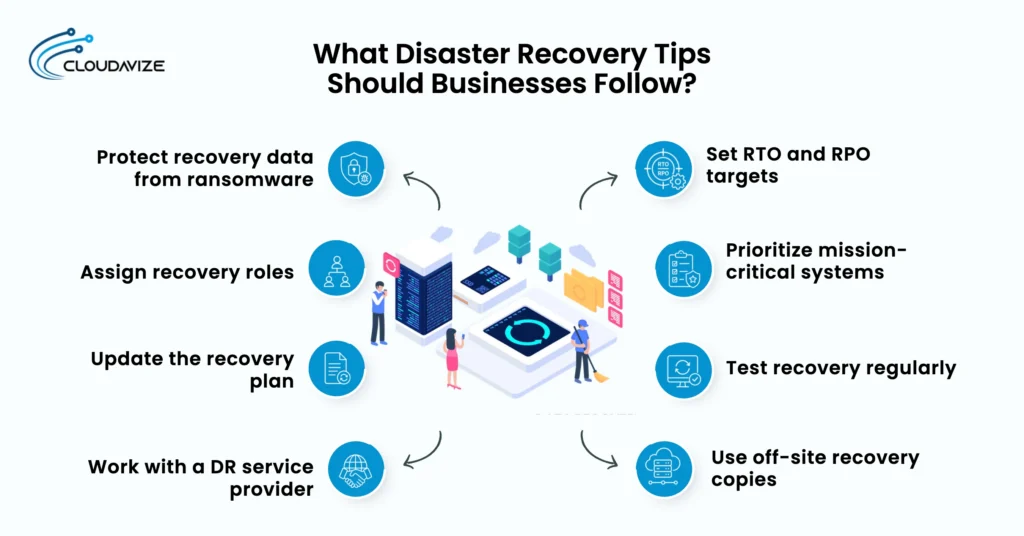
Businesses should set RTO and RPO targets, prioritize mission-critical systems, test recovery regularly, use off-site recovery copies, protect recovery data from ransomware, assign recovery roles, update the recovery plan, and work with a disaster recovery (DR) service provider. Following these best practices reduces downtime, minimizes data loss, strengthens cyber resilience, and ensures organizations can restore critical operations quickly while maintaining business continuity during unexpected disruptions.
8 disaster recovery tips every business should follow are:
- Set RTO and RPO targets
Define Recovery Time Objectives (RTOs) to establish how quickly systems must be restored and Recovery Point Objectives (RPOs) to determine the maximum acceptable amount of data loss. These targets guide recovery priorities, resource allocation, and backup strategies. Well-defined RTOs and RPOs help organizations restore critical services efficiently while supporting business continuity and operational resilience. - Prioritize mission-critical systems
Identify the applications, databases, and infrastructure that are essential to daily business operations. Prioritizing these mission-critical systems ensures they are restored before less important assets, reducing operational disruption and financial impact. Focusing recovery efforts on the most important services enables organizations to maintain continuity and resume core business functions more quickly after an incident. - Test recovery regularly
Conduct disaster recovery testing at least twice a year to verify that backup, recovery, and failover processes work as expected. Simulated disaster scenarios help identify weaknesses, validate recovery procedures, and measure whether recovery objectives can be met. Regular testing improves preparedness and ensures recovery plans remain effective as systems and business requirements evolve. - Use off-site recovery copies
Store backup data in a secure off-site or cloud-based location to protect it from local disasters, hardware failures, and physical damage. Geographically separated recovery copies ensure critical information remains available even if primary systems become inaccessible. Regularly testing off-site backups confirms data integrity and supports reliable recovery during unexpected disruptions. - Protect recovery data from ransomware
Safeguard backup data by using immutable storage, isolated backup environments, and strong access controls to prevent unauthorized modification or deletion. Regular security audits help identify vulnerabilities and strengthen backup protection. Securing recovery data ensures organizations can restore clean, uncompromised information quickly after ransomware attacks or other cybersecurity incidents. - Assign recovery roles
Define clear responsibilities for incident coordinators, communications leads, IT administrators, and recovery specialists before a disaster occurs. Assigning specific roles eliminates confusion, improves coordination, and speeds decision-making during recovery. A well-organized response team helps restore systems efficiently, minimize downtime, and maintain business continuity throughout the recovery process. - Update the recovery plan
Review and update the disaster recovery plan regularly to reflect changes in business operations, technology, personnel, vendors, and locations. Keeping documentation current ensures recovery procedures remain accurate and relevant. Routine updates improve preparedness, reduce response delays, and help organizations adapt to evolving operational and cybersecurity risks. - Work with a DR service provider
Partnering with an SMB disaster recovery provider gives businesses access to specialized expertise, managed recovery solutions, continuous monitoring, and scalable backup infrastructure. Reliable disaster recovery service providers help small and mid-sized businesses maintain up-to-date recovery plans, improve recovery readiness, and support faster restoration of critical systems. Their guidance is especially valuable for organizations with complex or rapidly changing IT environments.
What Are the Limitations of Disaster Recovery?
Disaster recovery has limitations, including the need for regular testing, dependence on current backups, the requirement for clear recovery roles, setup and storage costs, and the inability to prevent every outage. While disaster recovery helps organizations restore operations after disruptions, it does not eliminate all risks. Businesses must maintain updated plans, reliable backups, and ongoing improvements to reduce downtime and strengthen recovery readiness.
5 key limitations of disaster recovery include:
- Requires regular testing
Disaster recovery plans must be tested regularly to ensure they work effectively during real incidents. Without testing, organizations may discover gaps in recovery procedures, backup processes, or system dependencies only after a disruption occurs. Scheduled testing helps validate recovery steps, identify weaknesses, and improve preparedness as business systems and operational requirements change. - Depends on the current backups
Effective recovery depends on having accurate, complete, and up-to-date backups available when needed. Outdated or incomplete backups can lead to data loss and longer recovery times after a disaster. Organizations should maintain reliable backup schedules and regularly verify backup integrity to ensure critical information can be restored successfully during disruptive events. - Needs clear recovery roles
Disaster recovery requires clearly assigned roles and responsibilities to avoid confusion during an incident. Defining roles such as incident coordinator, communications lead, and data recovery specialist helps teams respond faster and coordinate recovery activities effectively. Without clear ownership, decision-making delays and operational errors can slow restoration efforts and impact business continuity. - Can involve setup and storage costs
Implementing disaster recovery requires investment in backup infrastructure, cloud storage, recovery tools, and specialized services. Costs can vary depending on data volume, system complexity, and required recovery speed. Organizations must balance recovery needs with available resources to develop a practical strategy that provides adequate protection without creating unnecessary expenses. - Does not prevent every outage
Disaster recovery helps organizations recover from disruptions but does not completely prevent outages. Events such as natural disasters, cyberattacks, hardware failures, or widespread service interruptions may still cause temporary downtime. Businesses should combine recovery planning with preventive measures, risk management, and security practices to reduce the likelihood and impact of disruptions.