
IT outsourcing involves partnering with external service providers to manage a company’s IT functions, allowing businesses to focus on their core objectives. This reduces operational costs by eliminating the need for full-time IT staff and costly infrastructure. It also grants access to specialized expertise and advanced technologies, helping companies enhance security, ensure business continuity, and quickly scale operations to meet market demands. This flexibility drives innovation, streamlines operations, and supports long-term growth, benefiting both large enterprises and SMBs.
Here are 10 ways in which IT outsourcing drives measurable value across business operations, security, and long-term planning:
- Reduces IT Costs: Eliminate expenses associated with full-time IT staff, infrastructure, and technology upgrades.
- Provides Access to Expertise: Access specialized skills and advanced technologies without hiring expensive in-house experts.
- Increases Scalability and Flexibility: Quickly scale IT resources up or down based on demand, without long-term commitments.
- Enhances Security and Risk Management: Proactively address cyberthreats and compliance needs with advanced monitoring tools and industry experience.
- Improves Focus on Core Business Functions: Allows internal teams to focus on strategic business activities instead of IT management.
- Drives Technological Innovation: Stay competitive with access to the latest tools, platforms, and cutting-edge technologies.
- Speeds Up Time-to-Market: Accelerate product development and delivery with external IT support and industry expertise.
- Offers 24/7 Support and Availability: Ensure continuous operations and quick issue resolution, no matter the time zone.
- Strengthens Business Continuity: Reduce downtime with disaster recovery plans, backup solutions, and proactive monitoring.
- Aligns IT Strategy with Business Goals: Ensure that technology investments support long-term business objectives and growth.
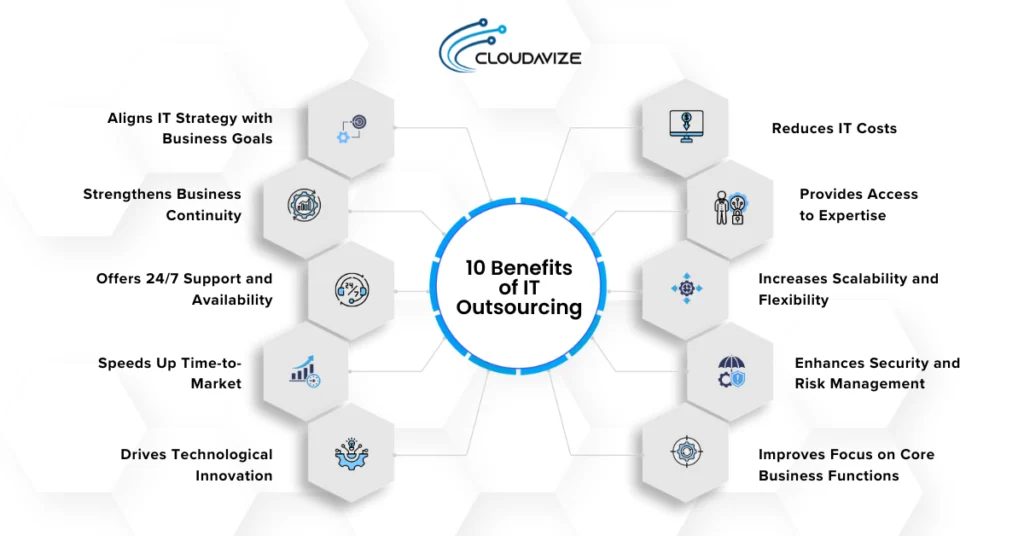
Table of Contents
1. Reduces IT Costs
By outsourcing IT services, businesses eliminate the need for a full-time IT staff, which comes with high salaries, benefits, and training costs. According to Glassdoor, the average annual salary for an IT employee ranges from $78,000 to $141,000, which can be a massive financial burden for SMBs with limited investment capital.
Companies also avoid investments in infrastructure and software through IT outsourcing, since external IT service providers are already equipped with the necessary technology, infrastructure, and expertise. This means businesses can simply pay for the specific services and technologies they need. This flexibility enables companies to allocate resources efficiently and scale their operations as needed without incurring high expenses. As a result, IT outsourcing leads to significant savings, helping businesses stay within budget while optimizing their technological resources.
2. Provides Access to Expertise
When businesses outsource IT services to MSPs, they gain access to specialized knowledge and skills that may not be available internally. For instance, hiring experts in expensive fields like AI/ML engineering, cloud architecture, and advanced cybersecurity may be financially unfeasible, especially for SMBs and start-ups. But when they partner with MSPs, they can leverage cutting-edge expertise without the high costs of recruitment and training for such specialized roles.
MSPs have a team of experts who are trained and certified in specific industry sectors. This specialization ensures businesses receive highly tailored solutions that meet their unique needs and comply with industry regulations. By outsourcing, even small businesses can access expert services and implement advanced technologies while avoiding the overhead of in-house teams. This approach helps businesses stay competitive, scale effectively, and focus on their core functions without compromising on expertise or quality.
3. Increases Scalability and Flexibility
Outsourcing IT services allows businesses to quickly adjust resources based on demand without investing in extra staff or infrastructure. For example, an e-commerce company can easily scale up IT support during busy seasons like Black Friday without hiring temporary employees. Similarly, when demand decreases, they can scale down by reducing outsourced services instead of resorting to layoffs. This flexibility enables businesses, particularly SMBs, to stay agile, avoid unnecessary investments, and align resources with their needs while keeping operations efficient.
This flexibility is further supported by SLA adjustments, which are designed to accommodate fluctuating demand and provide prompt support during peak periods. With these tailored SLAs, businesses can predict costs easily, allowing for effective budgeting without unexpected expenses.
4. Enhances Security and Risk Management
MSPs are usually better equipped to protect businesses from cyber threats than small internal teams, as they specialize in cybersecurity and have access to advanced tools and expertise. While in-house teams may struggle to stay up-to-date with the latest security risks, MSPs specialize in cybersecurity, train their staff, and use advanced tools to detect and prevent threats. They identify vulnerabilities and deploy sophisticated firewalls, threat detection systems, and intrusion prevention tools before issues escalate into major breaches. This helps safeguard sensitive data, defend against cyberattacks, protect the company’s reputation, and avoid legal risks.
By outsourcing IT services, businesses can minimize data loss and downtime risks more effectively. Providers offer disaster recovery plans, data backup solutions, and risk mitigation strategies that reduce the impact of disruptions, ensuring continuous operations and preventing system failures or data breaches.
5. Improves Focus on Core Business Functions
By delegating IT management to an MSP, businesses can focus on long-term planning and strategic growth without worrying about technical issues. Managing IT infrastructure, security, and support internally can be time-consuming and distract from important activities that directly drive business success. With experts handling these tasks, internal teams can dedicate more time to customer service, marketing, and product development, which are areas that directly impact growth and profitability.
This shift in focus improves productivity and overall operational efficiency, allowing employees to work efficiently without worrying about technical issues. With IT concerns handled externally, management can focus on innovation and long-term planning, confident that trained specialists are managing IT operations and addressing any potential threats. This ensures the business stays secure, compliant, and adaptable, without losing focus on its core goals.
6. Drives Technological Innovation
Outsourcing IT services grants access to advanced tools, platforms, and technologies that enable faster product delivery, improved scalability, and enhanced operational capabilities. External providers bring cutting-edge solutions like AI, machine learning, cloud computing, and automation, which are often too costly or complex for most small businesses to implement in-house. These technologies streamline development processes, enabling companies to build, test, and release innovative products more quickly.
By leveraging these tools, businesses can improve existing products and services faster, helping them stay competitive in a fast-evolving market. Outsourcing also ensures they stay ahead of technological advancements, adapt to customer demands more swiftly, and avoid the high costs of maintaining and upgrading infrastructure internally. This fosters continuous innovation and improvement in product delivery, operational efficiency, and market responsiveness.
7. Speeds Up Time-to-Market
The right outsourced IT experts have the expertise, tools, and resources to accelerate the time it takes to bring new products or features to market. By partnering with external providers, businesses can tap into specialized skills and cutting-edge technologies that may not be available in-house, enabling faster development and deployment. This allows companies to streamline the coding, testing, and infrastructure management processes, which ultimately reduces the market launch timeline.
IT outsourcing is especially valuable in fast-paced industries like AI, automotive, and fintech, where innovation and responsiveness decide market success. By outsourcing parts of the production process, like software development, system integration, or quality assurance, companies can improve existing offerings and respond to market demands faster. This provides a competitive advantage and ensures that businesses remain agile and customer-focused.
8. Offers 24/7 Support and Availability
Outsourcing IT tasks to MSPs grants businesses 24/7 support, enabling them to address technical issues promptly, minimize downtime, and maintain continuous operations. This is especially important for businesses that operate across multiple regions or have global operations, as it ensures productivity and customer expectations are consistently met.
IT outsourcing with round-the-clock support is vital for e-commerce, finance, healthcare, and telecommunications industries, where system downtime can heavily disrupt operations and impact customer satisfaction. In e-commerce, for example, downtime can lead to lost sales, while in healthcare, uninterrupted IT services are essential for managing patient data and providing timely care. By outsourcing IT services, businesses in these sectors can ensure their IT infrastructure remains operational, no matter the time of day.
9. Strengthens Business Continuity
IT outsourcing provides expert disaster recovery, backup solutions, and 24/7 support to ensure that business operations continue smoothly even during disruptions. External providers proactively monitor systems to detect and address potential threats before they escalate and cause downtime. In the event of system failures, cyberattacks, or staffing gaps, outsourced IT experts quickly implement recovery plans, minimizing operational disruptions and financial losses.
With outsourced IT services, businesses also benefit from enhanced security measures and regulatory compliance, further protecting against data breaches and operational interruptions. This allows internal teams to focus on strategic goals while the outsourced experts handle critical IT functions. By having skilled professionals dedicated to maintaining business continuity, both SMBs and large companies can safeguard their operations and ensure resilience, even in times of crisis.
10. Aligns IT Strategy with Business Goals
Partnering with MSPs and establishing defined SLAs allows businesses to align their technology investments with their strategic objectives. This collaboration helps businesses tailor their IT infrastructure to support specific goals like operational efficiency, customer satisfaction, and innovation. These providers help create long-term IT strategies that reflect both current business needs and future growth opportunities, ensuring that technology evolves alongside the company.
Outsourcing IT services also provides access to industry-leading solutions, allowing businesses to adopt cutting-edge technologies like cloud computing, AI, and automation. This not only keeps IT systems reliable but also scalable, reducing the burden of resource management on internal teams. With IT aligned to business strategy, companies can stay competitive, respond to changing market conditions, and achieve sustainable growth while optimizing resources effectively.
How to Ensure Successful IT Outsourcing for Your Business?
Successful IT outsourcing starts with establishing clear Service Level Agreements (SLAs) that define performance expectations, timelines, and deliverables. These SLAs set measurable goals and ensure both parties are aligned from the start. Regular communication and status updates are vital for maintaining transparency and addressing potential issues before they impact operations.
Choosing the right MSP for outsourced IT services is equally important, as a provider with the necessary expertise, tools, and resources will be better equipped to meet your specific business objectives. Both SMBs and large businesses need to set Key Performance Indicators (KPIs) within the SLA to track performance effectively. Continuously evaluating the relationship through regular reviews further ensures the MSP adapts to your evolving needs and resolves any challenges that arise. This approach helps maintain alignment with your long-term goals and business priorities, ensuring a successful outsourcing partnership.