Managed Cloud Services: Benefits, Providers, and Use Cases
Managed cloud services are critical in helping organizations optimize and maintain their cloud environments without carrying the full operational burden internally. Delivered by specialized Managed Service Providers (MSPs), these services support enterprises, SMBs, and startups by handling tasks such as provisioning, monitoring, security enforcement, and performance optimization while allowing businesses to retain strategic control over infrastructure decisions. By shifting operational responsibilities to MSPs, organizations free up internal resources to prioritize innovation, product development, and market responsiveness.
In contrast to unmanaged cloud models or traditional IT outsourcing, managed services offer proactive operational frameworks tailored to different deployment needs, including public, private, hybrid, and multi-cloud environments. Choosing the right service model and understanding the provider landscape is essential for organizations aiming to build resilient, scalable, and cost-efficient digital ecosystems that align with long-term business strategies.
What Are Managed Cloud Services?
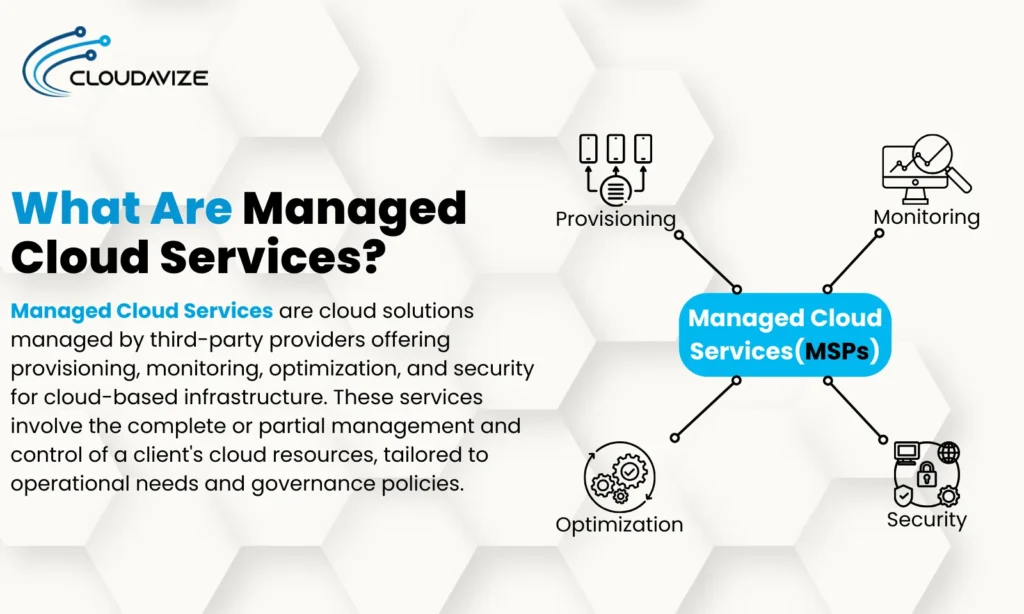
Managed Cloud Services are cloud solutions managed by third-party providers offering provisioning, monitoring, optimization, and security for cloud-based infrastructure. These services involve the complete or partial management and control of a client’s cloud resources, tailored to operational needs and governance policies.
Managed cloud platforms typically include infrastructure provisioning, resource monitoring, performance optimization, and security enforcement, enabling organizations to maintain scalable, secure, and flexible environments. Unlike unmanaged self-service IaaS models, where customers must deploy, monitor, and secure resources independently, managed services proactively support cloud environments through automation, orchestration, and compliance alignment.
The scope of managed cloud services spans public, private, hybrid, and multi-cloud deployments, offering enterprises, SMBs, and startups the ability to adopt cloud platforms without forfeiting operational oversight. Managed service providers (MSPs) maintain resource health, optimize performance, and secure critical assets while allowing internal teams to focus on strategic transformation rather than day-to-day management.
By consolidating infrastructure expertise with security frameworks and operational governance, managed cloud services help organizations scale efficiently, reduce risk exposure, and innovate faster across dynamic cloud environments.
How Managed Cloud Differs From Traditional IT Outsourcing?
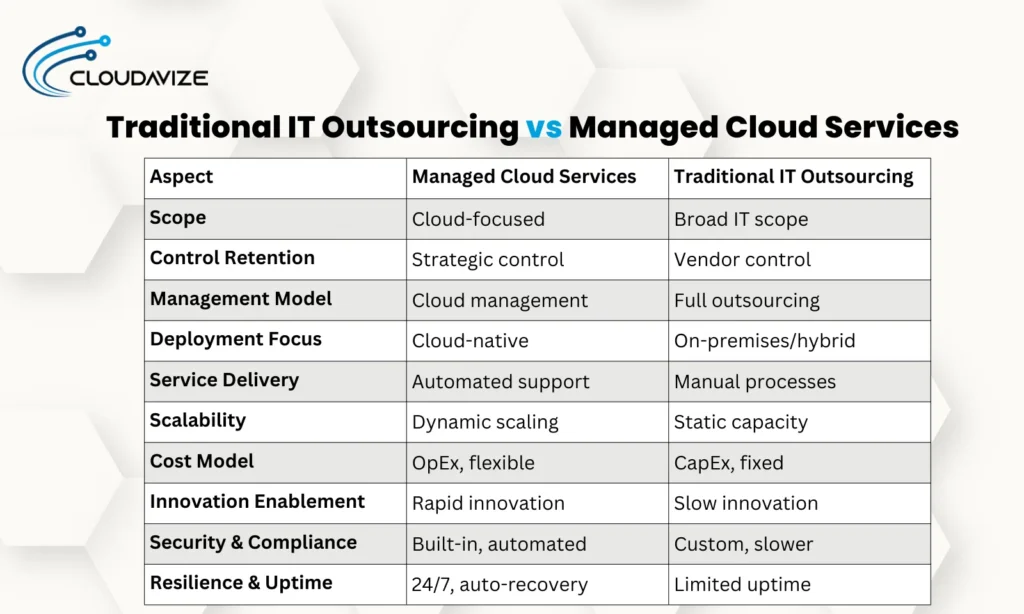
Managed cloud services focus on maintaining and optimizing cloud infrastructure with operational flexibility, whereas traditional IT outsourcing transfers complete technology ownership, including helpdesk and on-premises data centers, to external vendors.
Managed service models support cloud-native deployments, maintain security, and scale environments dynamically while allowing enterprises to retain strategic control. In contrast, traditional outsourcing often limits flexibility by embedding rigid, broad-scope contracts that reduce visibility and slow innovation.
The major differences separating managed cloud services from traditional IT outsourcing are outlined below:
| Aspect | Managed Cloud Services | Traditional IT Outsourcing |
| Scope | Focuses on cloud-based infrastructure and services | Broad IT functions including desktops, servers, and networks |
| Control Retention | Enterprise retains strategic control and governance | Vendor assumes full operational ownership |
| Management Model | Complete or partial cloud resource management | Full outsourcing of IT operations |
| Deployment Focus | Cloud-native and multi-cloud environments | On-premises, hybrid, and sometimes outdated systems |
| Service Delivery | Automation-driven, platform-centric support | Manual processes, contract-based service levels |
| Scalability | Dynamic scaling based on demand and workload patterns | Static capacity planning based on fixed contracts |
| Cost Model | OpEx-focused, usage-based, and flexible pricing models | Often CapEx-heavy, long-term fixed costs |
| Innovation Enablement | Supports rapid deployment of cloud-native applications | Slower innovation due to rigid operational models |
| Security and Compliance | Built-in cloud security frameworks and compliance automation | Custom implementations; often slower to adapt |
| Resilience and Uptime | 24/7 monitoring, auto-scaling, and disaster recovery support | Limited SLAs, potential downtime risks |
What Are the Key Components of Managed Cloud Services?
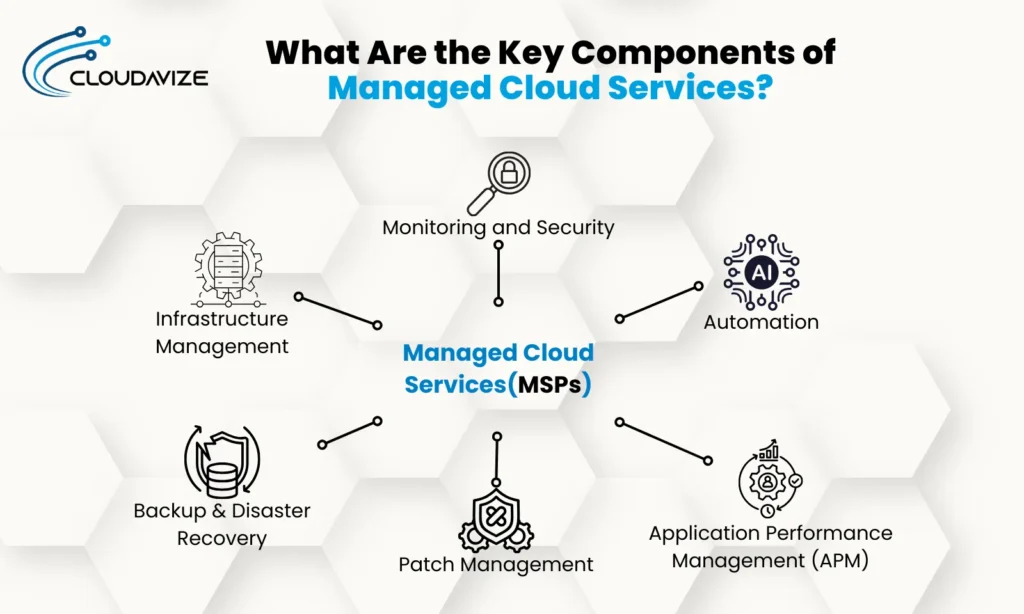
The key components of managed cloud services include infrastructure, security, and automation features that support resilient, optimized, and compliant cloud operations. These features help enterprises maintain cloud environments with minimal manual intervention while ensuring performance consistency.
Infrastructure Management and Optimization
The deployment and management of virtual resources rely on automated provisioning, orchestration, and fine-tuning processes. Provisioning activities deploy virtual machines, networks, storage pools, and load balancers according to predefined templates. , enabling standardized provisioning at scale. To maintain operational efficiency, resource orchestration frameworks dynamically allocate workloads across environments based on real-time usage patterns. Complementing these functions, tuning mechanisms optimize CPU, memory, and I/O configurations to improve cost efficiency and enhance system responsiveness without requiring manual adjustments.
Monitoring, Security, and Compliance
Around-the-clock performance monitoring and anomaly detection provide a vigilant safeguard for system health. Incident response protocols enable swift action to address irregularities, minimizing risk exposure. When deviations occur, incident response frameworks support rapid remediation efforts to minimize risk exposure. Security layers are reinforced as Identity Access Management (IAM) policies control user permissions precisely, and encryption standards secure data both in transit and at rest. Additionally, compliance toolkits enforce industry frameworks like GDPR, HIPAA, and PCI DSS, ensuring regulatory alignment across deployments.
Automation and Self-Service Tools
Operational complexity is reduced through advanced automation and intuitive self-service platforms. Cloud Management Platforms (CMPs) provide unified dashboards for visibility across multi-cloud environments. Through automation engines, organizations can orchestrate workloads, provision resources, and scale systems automatically based on demand thresholds. Auto-scaling tools dynamically adjust compute and storage capacity, maintaining optimal performance levels under variable workload conditions while preserving cost efficiency.
Backup and Disaster Recovery
Ensuring data durability and uninterrupted service involves automated backups stored across multiple geographic locations. External providers implement automated backup schedules across geographically redundant locations, maintain versioned data snapshots, and enable rapid restoration procedures in the event of system failure, cyberattacks, or accidental deletion. Disaster recovery planning also includes failover systems that restore operations with minimal downtime.
Patch Management and Updates
Managed cloud services include patch management and update features that ensure security and system stability. Managed service providers deploy critical patches automatically and schedule maintenance windows to minimize service interruptions. Through continuous system updates, workloads remain secure against known vulnerabilities. Patch validation processes verify software compatibility before rollout, reducing the risk of regression issues and ensuring operational continuity.
Application Performance Management (APM)
Monitoring application workflows in real time uncovers performance issues before they escalate, while telemetry-driven insights enable fine-tuning of system components. These capabilities help sustain consistent application responsiveness regardless of demand fluctuations. APM tools continuously track key metrics, detect delays, and analyze bottlenecks within application components. Based on collected telemetry, integrated APM systems recommend targeted optimizations across database queries, API performance, and infrastructure configurations. This proactive approach supports early anomaly detection, informed capacity planning, and dynamic tuning, ensuring applications deliver reliable and efficient user experiences under varying workloads.
What Are the Different Types of Managed Cloud Models?
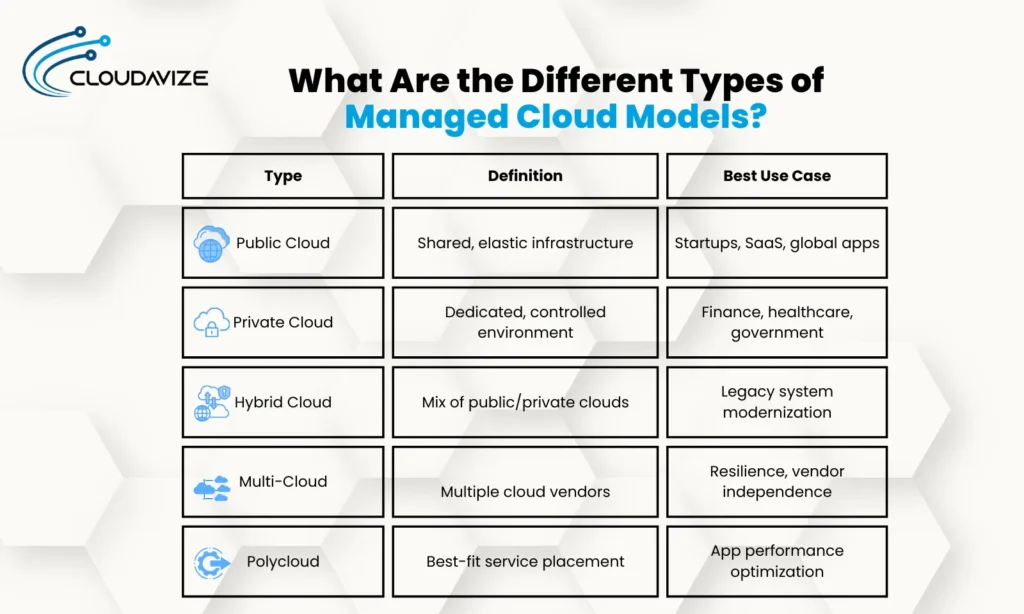
Different types of managed cloud models include Public, Private, Hybrid, and Multi-cloud strategies that cater to different operational, security, and scalability requirements. Each model supports specific use cases based on workload sensitivity, compliance needs, cost structures, and deployment flexibility. Understanding how these models differ in design and application helps organizations select the most effective path for their managed cloud strategies.
Public Cloud Managed Services
In public cloud-managed services, organizations gain access to shared infrastructure where scalability and cost-efficiency are prioritized. This enables rapid application deployment without significant upfront investments. This model suits businesses that require flexible resource scaling for dynamic workloads like SaaS platforms, content delivery networks, and consumer-facing applications, providing an agile framework for continuous growth.
Private and Hybrid Cloud Services
Private and hybrid cloud services address the need for tighter data control while offering scalable extensions through public cloud integrations. A private cloud creates a dedicated, secure environment ideal for compliance-bound industries, while hybrid configurations bridge traditional infrastructure with cloud-native technologies, allowing enterprises to modernize systems incrementally without abandoning legacy operations completely.
Multi-cloud and Polycloud Strategies
By adopting multi-cloud or polycloud strategies, enterprises strategically diversify their deployments across multiple cloud vendors, either for risk mitigation or workload optimization. Multi-cloud adoption improves fault tolerance and prevents vendor lock-in, while polycloud designs focus on mapping specific services, like AI, analytics, or storage, to the cloud platforms that deliver the best performance for each targeted application.
Comparison Table: Managed Cloud Models
| Model Type | Definition | Best Use Case |
| Public Cloud | Shared cloud infrastructure for elastic scaling | Startups, SaaS platforms, global apps |
| Private Cloud | Dedicated cloud environment with full control | Finance, healthcare, and government sectors |
| Hybrid Cloud | Integration of private cloud and public cloud infrastructure | Enterprises modernizing legacy systems |
| Multi-cloud | Distributed workloads across multiple cloud vendors | Enterprises seeking resilience and vendor independence |
| Polycloud | Specific services matched with optimal cloud providers | Specialized application performance optimization |
Who Are the Leading Managed Cloud Service Providers?
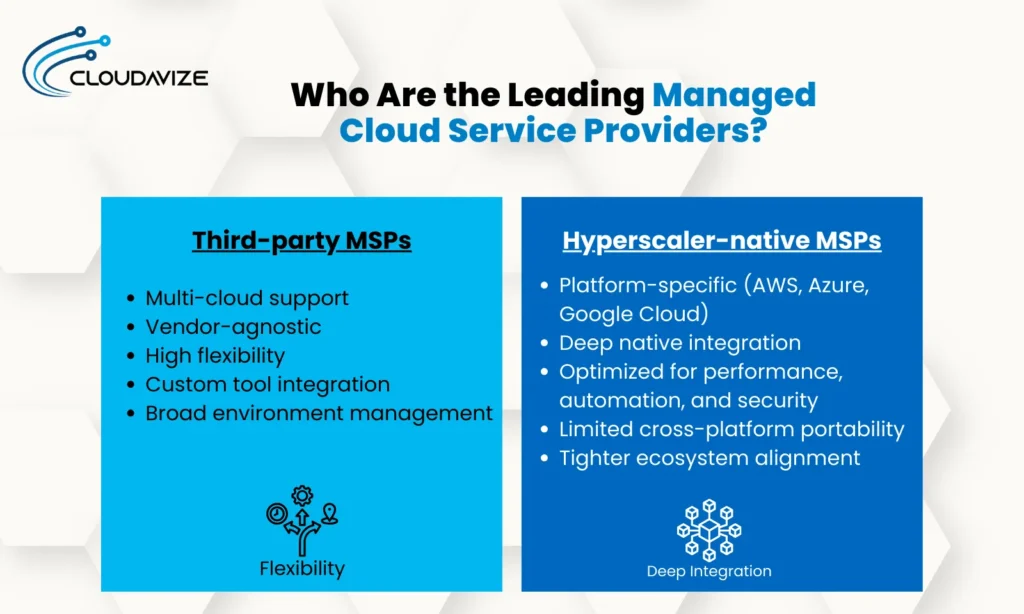
The leading managed cloud service providers are third-party or hyperscale-native, offering organizations different models for sourcing cloud management services. Third-party MSPs manage multi-cloud and hybrid environments, providing flexibility across platforms, while hyperscaler-native providers specialize in optimizing and maintaining cloud services within their proprietary ecosystems. The choice between provider types often depends on platform dependency, tooling needs, and integration strategies.
Third-Party MSPs vs. Hyperscaler-native MSPs
Third-party managed service providers focus on delivering multi-cloud, vendor-agnostic support, while hyperscaler-native MSPs operate exclusively within specific cloud platforms like AWS, Azure, or Google Cloud. Third-party MSPs enable organizations to manage diverse environments, integrate customized tools, and maintain flexibility without committing to a single vendor’s ecosystem.
By contrast, hyperscaler-native providers prioritize deep platform integration, offering services optimized for the native cloud’s automation, security, and performance frameworks. Although this tight alignment enhances native cloud capabilities, it often limits cross-platform portability and constrains future multi-cloud expansion strategies.
Open-source vs. Proprietary Platforms
Open-source cloud management platforms emphasize interoperability and customization, while proprietary management solutions focus on native optimization and integrated security within a specific ecosystem. Open-source models allow organizations to incorporate tools freely, build hybrid frameworks, and retain control over architecture choices across multiple clouds.
In contrast, proprietary platforms offer robust, pre-built automation, compliance, and monitoring solutions optimized for one environment but often restrict tool compatibility and portability. The decision between open-source and proprietary management depends on whether an organization values open flexibility more than deep, ecosystem-specific integration.
What Are the Key Benefits of Managed Cloud Services?
The key benefits of managed cloud services include cost efficiency, dynamic scalability, accelerated innovation, and enhanced uptime reliability. Managed services shift IT spending to flexible models, scale infrastructure dynamically to match workload needs, and accelerate product launches through operational automation. Continuous monitoring and proactive incident management enhance system reliability, ensuring minimal downtime and strong business continuity across cloud environments.
Cost Efficiency and OpEx Advantage
Transitioning from fixed capital expenditures (CapEx) to flexible operational expenditures (OpEx) enables organizations to better align IT costs with actual usage. Subscription pricing models eliminate upfront infrastructure investments, allowing payment only for consumed resources and reducing financial waste.
In addition to consumption-based savings, managed services optimize resource usage through automated scaling and rightsizing, minimizing unnecessary overheads. This financial flexibility supports faster reinvestment into core business initiatives without being constrained by high upfront infrastructure costs.
Scalability and Performance Optimization
Cloud environments that automatically scale resources in response to changing workloads ensure steady application performance without manual adjustments. Elasticity in resource allocation allows systems to handle sudden spikes or seasonal increases seamlessly.
Beyond raw scalability, managed services optimize platform performance by proactively tuning compute, storage, and network configurations. This continuous optimization ensures that cloud environments deliver high availability, reliability, and responsiveness tailored to operational needs.
Faster Innovation and Time-to-Market
Managed cloud services accelerate innovation cycles by removing the operational burden of infrastructure management. This allows teams to focus on developing, testing, and deploying applications faster. Automated resource provisioning and integrated DevOps pipelines streamline deployment processes significantly.
This operational agility shortens product launch timelines and supports rapid iteration, enabling businesses to respond faster to market demands and customer feedback. Managed environments foster continuous delivery practices essential for maintaining a competitive advantage in fast-moving industries.
24/7 Monitoring and Uptime
Continuous monitoring around the clock provides early warning of system irregularities, enabling rapid response before issues escalate. This proactive oversight helps maintain high availability and minimizes downtime risks in complex cloud environments.
By maintaining proactive surveillance across cloud infrastructures, managed services enhance service reliability and minimize downtime risks. This constant oversight protects business continuity, ensuring critical systems remain operational despite complex, multi-cloud deployments.
What Are the Common Use Cases for Managed Cloud Services?
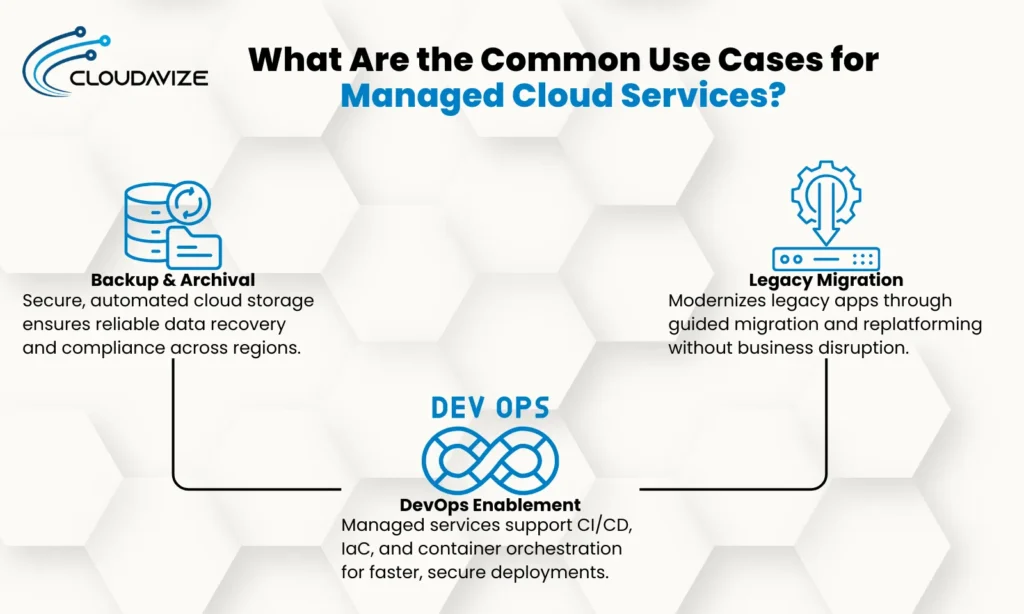
The common use cases for managed cloud services span backup solutions, cloud-native DevOps enablement, and legacy application modernization. Organizations leverage these managed capabilities to improve operational resilience, streamline development workflows, and accelerate digital transformation without disrupting core business functions.
Backup and Archival Solutions
Secure data preservation across multiple regions is essential for effective backup and archival. Automated backup schedules and versioned snapshots protect critical information from hardware failures, cyberattacks, or accidental deletion. Storing data across multi-region cloud environments enhances retention compliance and reduces recovery time objectives (RTO). This approach ensures seamless recovery and operational continuity while eliminating the complexity and cost associated with traditional on-premise backup systems.
Cloud-native DevOps Enablement
Integrating DevOps with cloud-native technologies accelerates software delivery and improves reliability. Managed services enable organizations to deploy scalable CI/CD pipelines, automate infrastructure, and orchestrate containers efficiently. Providers set up DevOps toolchains that speed application releases, automate testing, and optimize microservices across hybrid or multi-cloud environments. Using Kubernetes and embedding security through DevSecOps reduces deployment errors and boosts agility while easing the workload on internal teams.
Managed Migration and Legacy App Support
Transitioning legacy systems to modern cloud environments demands careful planning to minimize disruptions. Managed migration services evaluate workloads, map dependencies, and re-platform applications into cloud-native or hybrid architectures. Using phased migration and modernization frameworks, organizations enhance performance, scalability, and compliance while reducing technical debt. These services also support application refactoring, database transformation, and performance tuning, ensuring legacy systems remain efficient and aligned with digital strategies.
What Challenges and Risks Come With Managed Cloud Services?
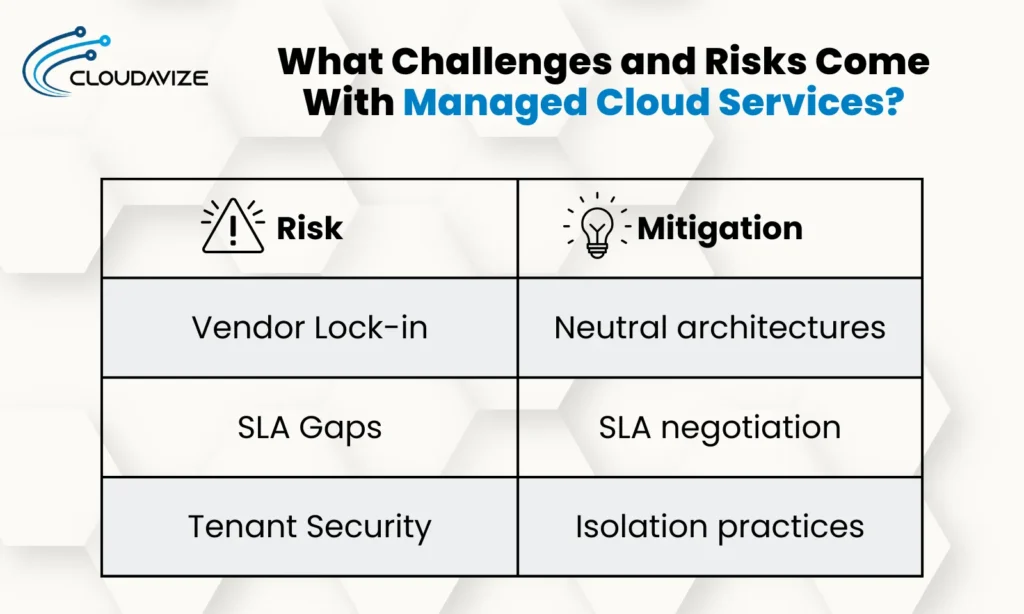
The challenges and risks of managed cloud services include vendor lock-in, service level agreement (SLA) gaps, and tenant security concerns. While managed cloud models offer operational efficiencies, they may introduce interoperability, compliance management, and system accountability complexity. Proactively addressing these risks helps organizations maintain control, resilience, and regulatory alignment across cloud deployments.
Vendor Lock-in and Interoperability Issues
Relying heavily on a single cloud provider’s ecosystem introduces risks related to vendor lock-in and limited interoperability. As organizations build on platform-specific APIs, proprietary tools, and tailored configurations, moving workloads between clouds or expanding infrastructure becomes more complex. This growing dependency increases operational friction, complicating migration efforts and reducing flexibility.
To address these challenges, enterprises must adopt neutral architectural strategies early and integrate multi-cloud management frameworks that promote system portability without sacrificing performance.
SLA Gaps and Downtime Risks
Service level agreements (SLAs) sometimes fail to fully reflect real-world operational demands, exposing organizations to downtime risks. Even with uptime guarantees, hidden exceptions or vague accountability can leave critical failures unaddressed. Gaps in monitoring, slow incident escalations, or overreliance on provider alerts further increase the chance of extended outages.
To mitigate these risks, businesses should implement independent performance monitoring, clarify remediation terms in SLAs, and establish direct escalation paths tied to key systems.
Security and Privacy in Multi-Tenant Environments
Sharing infrastructure in multi-tenant cloud environments raises distinct security and privacy challenges. Although encryption and identity controls provide essential protection, shared tenancy enlarges the attack surface if strict isolation is not maintained. Without effective tenant segmentation, continuous auditing, and real-time threat detection, breach risks intensify.
Mitigation requires strict encryption key management, adoption of zero-trust security models, and ongoing validation to ensure privacy across evolving cloud workloads.
How Are Managed Cloud Services Priced and What Should Be Considered?
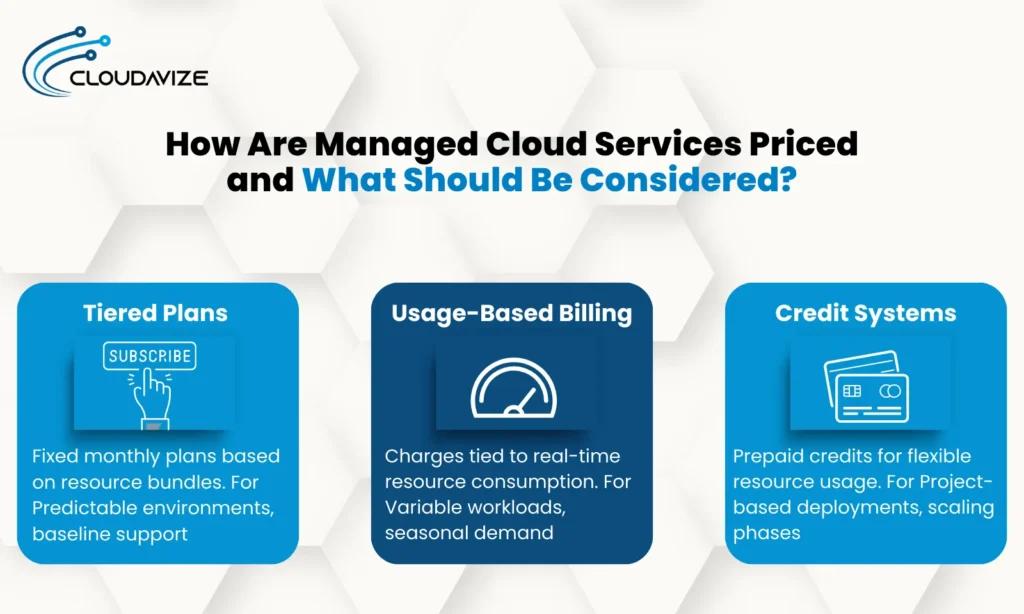
Managed Cloud Services are priced using tiers, usage billing, and credits, offering organizations flexible options based on operational needs and consumption patterns. Pricing models typically combine subscription plans for baseline support with dynamic billing mechanisms that reflect real-time usage. Strategic considerations should include service scope, cost elasticity, and available optimization opportunities without assuming fixed returns or savings.
| Pricing Model | Description | Best Use Case |
| Tiered Subscription | Fixed monthly plans based on resource bundles | Predictable environments, baseline support |
| Usage-based Billing | Charges tied to real-time resource consumption | Variable workloads, seasonal demand |
| Credit Systems | Prepaid credits for flexible resource usage | Project-based deployments, scaling phases |
Tiered Subscription Plans
Service providers often offer managed cloud services in tiered subscription plans at fixed monthly rates, providing structured options such as Essential (Basic), Professional (Standard), and Enterprise (Premium) tiers.
Essential plans typically cover fundamental compute needs, moderate storage allocations, and baseline monitoring suitable for stable environments. Professional tiers extend the offering with increased resource pools, proactive optimization tools, and faster support SLAs. Enterprise tiers deliver premium capabilities like high availability, dedicated account managers, advanced compliance frameworks, and enhanced recovery options, enabling organizations to match service levels precisely to their operational demands.
Usage-based and Credit Systems
In flexible environments, pricing for managed cloud services often relies on usage-based billing models or credit systems that dynamically reflect actual resource consumption. Monthly costs fluctuate based on how much computing, storage, or bandwidth is utilized over a billing period. Credit systems allow organizations to pre-purchase resource blocks that are redeemed as needed, offering elasticity for scaling projects or irregular usage patterns without the financial rigidity of traditional contracts.
Cost Optimization Strategies
Controlling cloud spend effectively requires deploying cost optimization strategies integrated into the management framework. Techniques such as rightsizing resources, adopting reserved or spot instances, and applying FinOps methodologies enable organizations to align expenditures with real consumption. Continuous usage monitoring and proactive resource adjustment support sustainable growth by minimizing financial waste while preserving cloud scalability and operational excellence.
FAQs About Managed Cloud Services
What Is the Difference Between Cloud Hosting and Managed Cloud?
Cloud hosting provides access to basic infrastructure resources such as virtual servers, storage, and networking, but offers minimal management beyond resource availability. In contrast, managed cloud services deliver complete lifecycle management, including provisioning, security enforcement, performance optimization, continuous monitoring, and operational support. This comprehensive management is typically enabled by specialized service providers, who extend the value of standard cloud infrastructure by actively maintaining, optimizing, and securing environments, allowing organizations to focus on strategic initiatives rather than day-to-day system upkeep.
Can Managed Cloud Help With Compliance?
Managed cloud services support compliance by enforcing regulatory frameworks, implementing security best practices, and monitoring system adherence continuously. MSPs align operations with standards like GDPR, HIPAA, PCI DSS, and ISO 27001 through integrated identity management, encryption protocols, access auditing, and automated reporting. This proactive compliance management reduces the burden on internal teams and improves overall regulatory readiness.
How Do I Choose the Right Cloud MSP?
Choosing the right cloud managed service provider depends on evaluating operational needs, security requirements, and platform expertise. Organizations should:
- Assess an MSP’s experience with multi-cloud or hybrid deployments
- Review their service-level agreements (SLAs) for uptime and support guarantees
- Examine the provider’s certifications in security, compliance, and cloud platform partnerships (such as ISO 27001, SOC 2, and AWS/Azure competencies).
- Validate the MSP’s ability to meet industry-specific compliance requirements like GDPR, HIPAA, or PCI DSS.
- Check for flexibility in service models, including fully managed, co-managed, and project-based engagements.
- Confirm transparent and predictable pricing structures, avoiding hidden fees or unclear billing practices.
- Ensure scalability support for future growth, modernization initiatives, and evolving multi-cloud strategies.