What is Cloud Management?
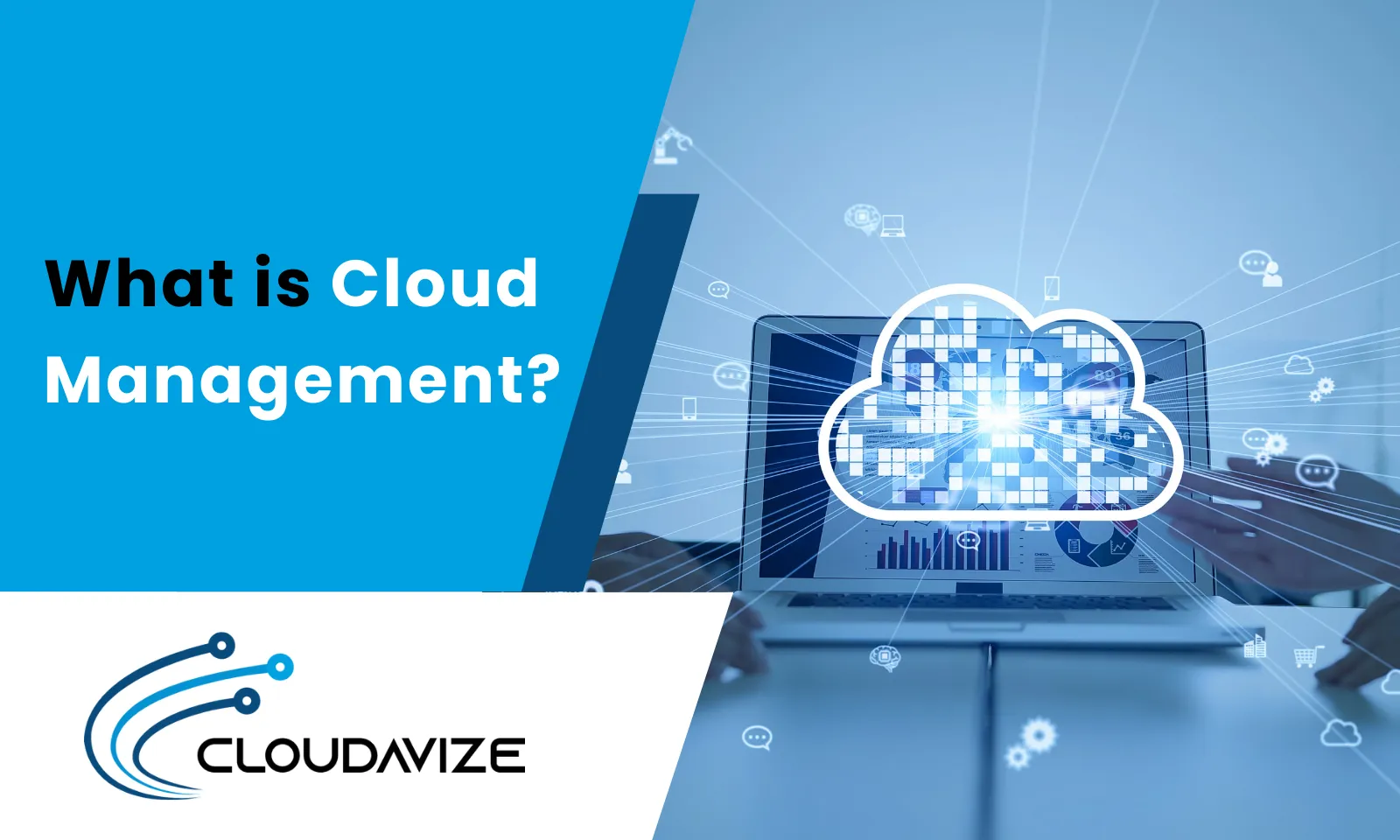
Cloud management refers to the process of controlling, optimizing, and securing cloud resources to ensure efficiency, security, and cost-effectiveness. This involves managing virtual machines, storage, databases, and cloud applications across different cloud models like public, private, hybrid, and multi-cloud environments. By leveraging cloud management platforms (CMPs) and automation tools, businesses can streamline operations, allocate resources efficiently, and enforce security policies to prevent financial waste and mitigate risks.
As organizations increasingly rely on the cloud, efficient management becomes crucial. In fact, 88% of organizations use the cloud, and 25% plan to migrate all their applications to cloud-based environments, according to O’Reilly’s report. The rapid growth of cloud adoption is driving a booming market, with projections showing the cloud computing market reaching $5,150.92 billion by 2034, growing at a CAGR of 21.20%. This highlights the importance of effective cloud management strategies to optimize costs, enhance security, and support long-term scalability.
By ensuring seamless cloud operations, businesses can focus on innovation, agility, and growth while maintaining a secure and cost-efficient infrastructure. Cloud management not only enhances IT efficiency but also ensures organizations can adapt to emerging technologies and the increasing complexity of cloud environments. The need for strong cloud management strategies is essential for businesses looking to optimize their resources and remain competitive in an increasingly digital landscape.
Why is Cloud Management Important?
Cloud management is essential for efficiently controlling cloud resources, minimizing operational costs, enhancing security, and ensuring seamless scalability. By automating workflows and optimizing resource allocation, organizations can reduce waste, improve operational efficiency, and streamline cloud-based processes. This, in turn, allows cost-monitoring tools to minimize expenses while proactive monitoring enhances performance, mitigates risks, and ensures seamless service delivery.
Major Importance of Cloud Management:
- Improves Operational Efficiency: Automates cloud processes, reducing manual intervention and human error.
- Optimizes Cost Management: Prevents unnecessary cloud expenses through real-time monitoring and resource allocation.
- Enhances Security: Implements centralized access control, encryption, and compliance enforcement.
- Ensures Scalability: Dynamically adjusts resources based on workload demands to maintain performance.
- Reduces Downtime and Risks: Proactive monitoring and automated backups minimize service disruptions.
- Strengthens Compliance: Ensures adherence to industry regulations and governance policies.
- Boosts Performance Visibility: Provides real-time insights into cloud health and performance.
What Are the Challenges of Cloud Management?
The challenges of cloud management include complexity in multi-cloud environments, cost overruns, security risks, skill shortages, and legacy system integration difficulties. Businesses must navigate diverse cloud platforms, optimize resource usage, and enforce security measures while ensuring compliance. Addressing these challenges requires skilled professionals, automation tools, and strategic planning to maintain efficiency and control.
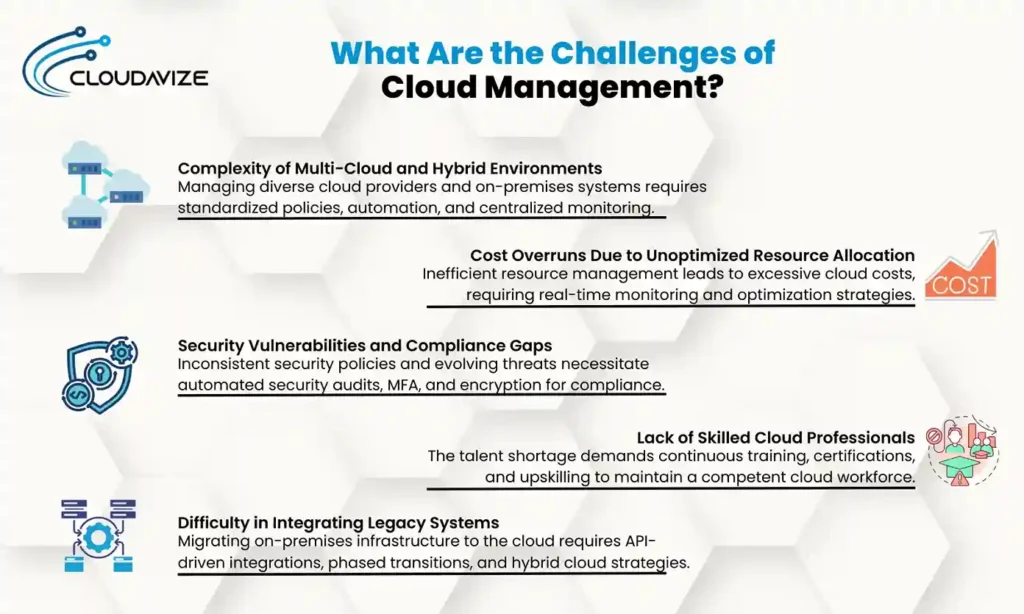
1. Complexity of Multi-Cloud and Hybrid Environments
Managing resources across multiple cloud platforms (AWS, Azure, Google Cloud) and on-premises systems introduces operational complexity due to differences in tools, security protocols, and integration frameworks. Businesses must implement standardized policies, centralized monitoring, and automation solutions to ensure consistency, prevent misconfigurations, and maintain control over hybrid environments.
2. Cost Overruns Due to Unoptimized Resource Allocation
Cloud costs escalate when resources remain idle, services are misconfigured, or workloads are inefficiently distributed. Without proper monitoring, businesses overpay for unused capacity, exceeding budgets. Implementing cloud cost management tools, automation, and real-time alerts ensures optimal resource allocation, reducing unnecessary expenses while maintaining performance.
3. Security Vulnerabilities and Compliance Gaps
The constantly evolving threat landscape and complex compliance requirements make security management a challenge. Inconsistent security policies, lack of centralized compliance monitoring, and human errors expose businesses to cyberattacks, data breaches, and regulatory fines. Implementing automated security audits, multi-factor authentication (MFA), and encryption strengthens cloud security while ensuring adherence to GDPR, HIPAA, and ISO 27001 regulations.
4. Lack of Skilled Cloud Professionals
The rapid adoption of cloud computing has outpaced the availability of skilled professionals, making it difficult for organizations to hire and retain cloud architects, security engineers, and DevOps specialists. Businesses must invest in continuous training, offer certifications (AWS, Google Cloud, Azure), and upskill existing employees to bridge the skills gap and maintain a highly competent cloud workforce.
5. Difficulty in Integrating Legacy Systems
Migrating legacy on-premises systems to modern cloud environments requires complex modifications, refactoring, and middleware solutions to ensure compatibility. Businesses face challenges with data migration, application dependencies, and operational disruptions. Adopting a hybrid cloud model, API-driven integrations, and phased migration strategies enables smoother transitions while minimizing downtime and ensuring business continuity.
What are the Key Features of Cloud Management?
Key features of cloud management include multi-cloud integration, automation, cost control, security, performance monitoring, and scalability. These capabilities help businesses efficiently manage cloud resources, optimize spending, enhance security, and maintain high availability.
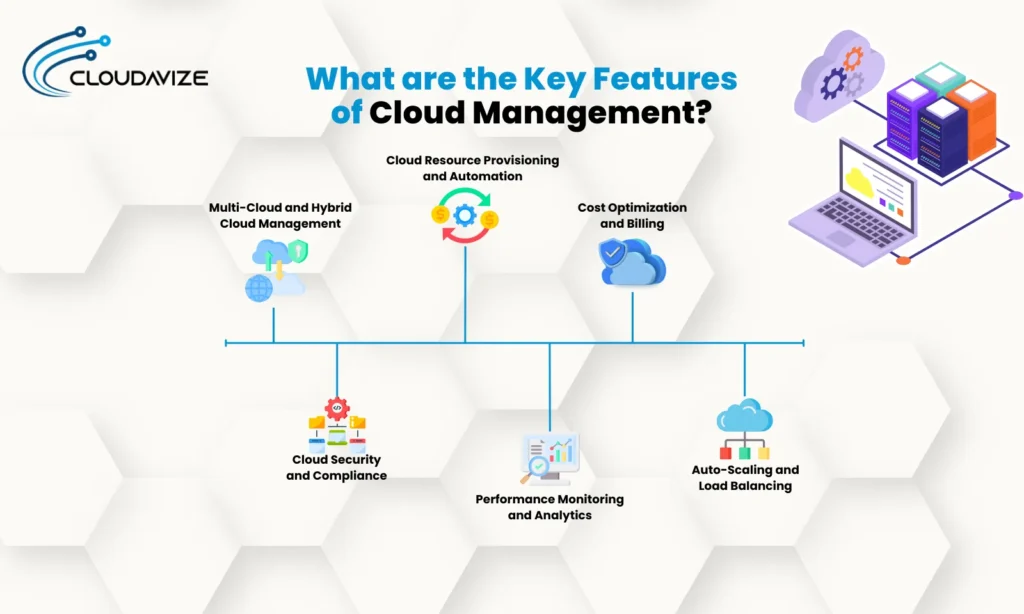
Below are the top 6 essential features of cloud management
Multi-Cloud and Hybrid Cloud Management
Managing resources across multiple cloud platforms (AWS, Azure, Google Cloud) and on-premises infrastructure ensures flexibility and prevents vendor lock-in. Cloud management platforms provide a unified interface to integrate and control workloads, enabling businesses to run applications across different environments without operational disruptions.
Cloud Resource Provisioning and Automation
Automating the deployment, configuration, and scaling of cloud resources eliminates manual efforts, reduces human errors, and speeds up service delivery. Automated provisioning through tools like Infrastructure as Code (IaC) enable businesses to efficiently manage virtual machines, storage, and networking while ensuring scalability.
Cost Optimization and Billing
Real-time cost monitoring and resource right-sizing help businesses control expenses and avoid waste. Leveraging reserved instances, optimizing workloads, and setting spending alerts enable better financial management of cloud resources. Cloud cost management tools like AWS Cost Explorer and Azure Cost Management provide real-time insights into spending patterns, enabling businesses to optimize workloads and eliminate underutilized resources.
Cloud Security and Compliance
Strong security policies, encryption, identity management, and access controls protect cloud environments from cyber threats. Cloud management solutions enforce compliance frameworks such as GDPR, HIPAA, and SOC 2, reducing security vulnerabilities and ensuring data protection across all cloud operations.
Performance Monitoring and Analytics
Tracking resource performance and system health in real-time provides businesses with actionable insights to optimize resource allocation. Performance analytics tools identify bottlenecks, predict workload demands, and ensure smooth operations, preventing downtime and maintaining service quality.
Auto-Scaling and Load Balancing
Dynamic scaling automatically adjusts computing resources based on traffic fluctuations, preventing downtime and improving cost efficiency. Auto-scaling provides additional resources during high demand and scales them down during low usage periods, preventing over-provisioning. Load balancing distributes workloads evenly across cloud instances, maintaining optimal system performance.
How Does Cloud Management Work?
Cloud management works by integrating cloud services, optimizing resource usage, monitoring performance, securing data, and ensuring compliance. It uses automation and analytics to streamline operations, prevent inefficiencies, and maintain system reliability. Management tools and platforms help businesses provision resources, enforce security policies, track costs, and scale infrastructure as needed.
What are the Key Processes involved in Cloud Management?
The key processes involved in cloud migration are discussed below
- Integration of Cloud Services – Cloud management platforms integrate multiple cloud providers (AWS, Azure, Google Cloud) and on-premises systems into a unified environment. This enables seamless interoperability between different cloud services, preventing vendor lock-in and enhancing flexibility.
- Resource Optimization and Usage Monitoring – CMPs track resource consumption and automate workload distribution to maximize efficiency. By analyzing real-time data, businesses can allocate resources dynamically, preventing over-provisioning or underutilization.
- Performance Monitoring and Analytics – Continuous monitoring of cloud infrastructure ensures optimal performance. Cloud management tools provide detailed insights into system health, application performance, and traffic loads, enabling businesses to detect and resolve issues before they impact operations.
- Security Enforcement and Compliance Management – Cloud management includes identity and access controls, data encryption, and automated security policy enforcement to protect cloud environments from cyber threats. Compliance monitoring ensures adherence to regulatory frameworks such as GDPR, HIPAA, and SOC 2.
- Automation and Auto-Scaling: Cloud automation tools deploy, configure, and scale resources based on predefined rules. Auto-scaling adjusts resources in real time to accommodate fluctuating workloads, ensuring cost efficiency and consistent performance.
- Governance and Policy Enforcement: Organizations enforce governance policies to standardize resource provisioning, data access, and security practices across cloud environments. Policy-driven cloud management helps maintain operational consistency and risk mitigation.
What Are the Benefits of Cloud Management?
The benefits of cloud management include cost control, resource optimization, enhanced security, and improved operational efficiency. It allows businesses to track spending, scale resources dynamically, enforce security policies, and maintain governance across cloud environments. Additionally, built-in disaster recovery and real-time monitoring ensure resilience, minimize downtime, and support proactive decision-making.
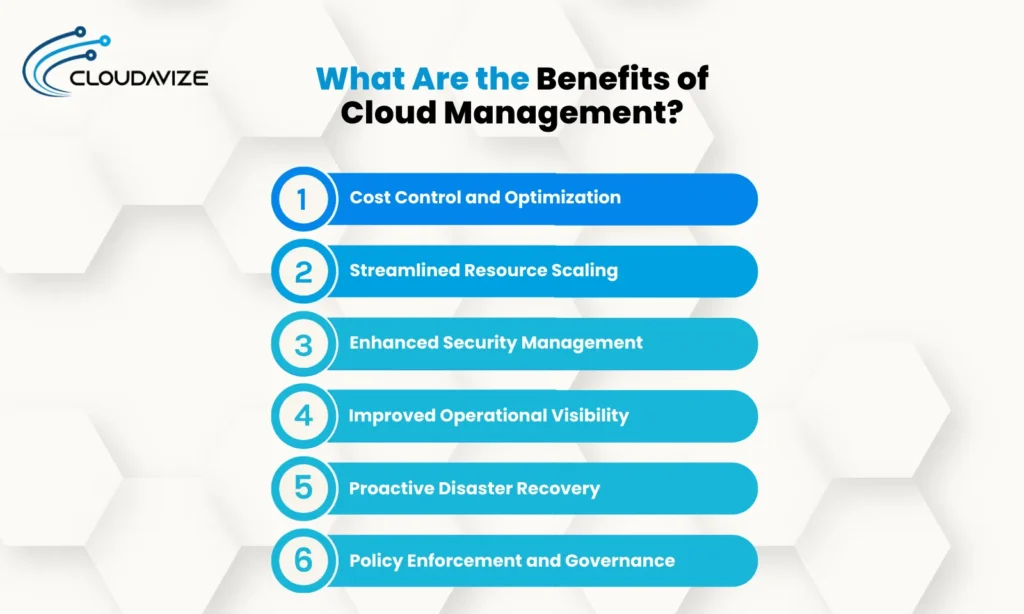
1. Cost Control and Optimization
Effective cost control and optimization in cloud management focus on reducing unnecessary expenses while maximizing resource efficiency. Businesses achieve this by implementing real-time cost monitoring, leveraging automated scaling, and utilizing predictive analytics. These tools help companies forecast usage spikes and adjust resources proactively, reducing expenses by up to 30% while maintaining performance. Reserved instances and automated workload adjustments prevent over-provisioning, ensuring that businesses only pay for what they use. With this precision, companies can optimize their cloud investments and avoid wasteful spending on idle infrastructure.
2. Streamlined Resource Scaling
Cloud management empowers businesses with automatic scaling, which intelligently adjusts resources based on demand. This ensures seamless performance during peak times and minimizes costs during low-usage periods. Industries like finance and e-commerce benefit from this scalability, which enhances reliability and prevents service disruptions. Additionally, using Amazon EC2 Spot instances can reduce costs by up to 90% for fault-tolerant workloads, further optimizing expenses. With dynamic scaling and cost-effective solutions, businesses achieve both performance and operational efficiency.
3. Enhanced Security Management
Security is a top priority in cloud environments, and cloud management plays a critical role in safeguarding sensitive data. With centralized security controls, automated threat detection, and compliance enforcement, businesses can secure their data and prevent cyber threats. Encryption, multi-factor authentication, and regular security audits ensure adherence to regulations like GDPR, HIPAA, and SOC 2. Cloud security offers significant advantages; 60% of C-suite executives cite security as the primary benefit of cloud adoption, as reported by Oracle. These robust protections enhance resilience, compliance, and overall data security.
4. Improved Operational Visibility
Cloud management provides businesses with real-time monitoring of system performance, resource utilization, and potential inefficiencies. Using AI-driven analytics and proactive alerts, businesses can detect anomalies early, optimize workloads, and reduce downtime. This continuous visibility allows IT teams to address issues before they affect operations, ensuring system stability and optimal resource allocation. By continuously analyzing performance metrics, businesses can make data-driven decisions, resulting in improved overall efficiency and reliability.
5. Proactive Disaster Recovery
Cloud management offers powerful tools for disaster recovery, including automated backups, failover mechanisms, and multi-region redundancy. These features enable quick recovery from system failures, cyberattacks, or data corruption. With defined Recovery Time Objectives (RTOs) and Recovery Point Objectives (RPOs), businesses minimize downtime and financial losses, ensuring business continuity. Cloud-based disaster recovery solutions improve resilience, with 37% of organizations using cloud infrastructure to reduce resolution time to 2.1 hours, according to Veeam’s Data Protection Trends Report, compared to 8 hours without cloud services.
6. Policy Enforcement and Governance
Cloud management enforces strong governance to maintain compliance and prevent security gaps. By regulating access controls, security configurations, and resource allocation, businesses can adhere to industry standards like ISO 27001 and SOC 2. Automated governance frameworks ensure consistency across cloud operations, providing a structured, secure environment. This comprehensive governance approach reduces the risk of security breaches and ensures organizations remain compliant with relevant regulations.
How Does Cloud Management Differ from Cloud Computing?
Cloud management ensures cloud services are efficiently utilized, secured, and cost-optimized through monitoring, automation, and policy enforcement, whereas cloud computing enables businesses to access IT infrastructure (servers, storage, networking) on-demand without maintaining physical data centers.
Key Differences Between Cloud Management and Cloud Computing
| Feature | Cloud Computing | Cloud Management |
| Definition | Delivery of cloud-based computing resources. | Supervise, optimize, and govern cloud resources. |
| Primary Function | Provides infrastructure, platforms, and software as services (IaaS, PaaS, SaaS). | Ensures cloud services are used efficiently, securely, and cost-effectively. |
| Focus Area | Storage, computing power, networking, and databases. | Resource allocation, security, cost control, and compliance. |
| User Responsibility | Businesses consume and deploy cloud services. | Businesses manage, optimize, and secure those services. |
| Key Technologies | AWS, Azure, Google Cloud, SaaS applications. | Cloud management platforms (CMPs), automation tools, cost monitoring solutions. |
What Are the Best Strategies for Cloud Management?
A well-defined cloud management Strategy focuses on cost control, security, automation, and resource optimization. Implementing cost monitoring, enforcing access controls, automating provisioning, and leveraging cloud-native tools help businesses maintain efficiency and security. Regular audits, disaster recovery planning, and continuous team training ensure long-term cloud reliability and performance.
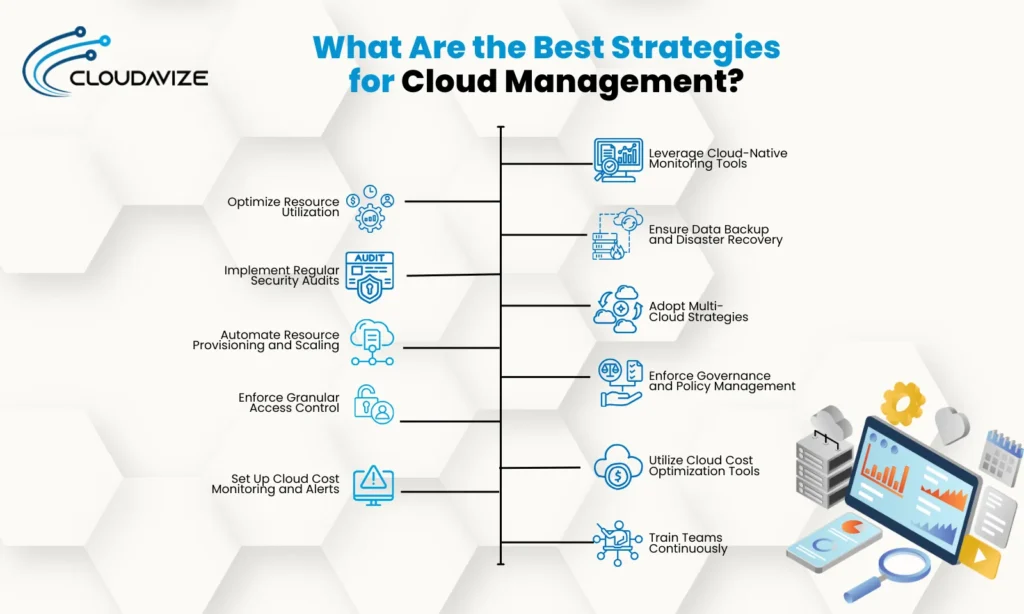
1. Set Up Cloud Cost Monitoring and Alerts
Uncontrolled cloud spending leads to budget overruns, impacting financial planning. Implementing cost tracking tools like AWS Cost Explorer or Azure Cost Management helps businesses monitor cloud usage in real-time. For example, an e-commerce company set up budget alerts at 80% of its allocated cloud spending. When usage neared the threshold, automated notifications prompted IT teams to analyze workloads, identifying and shutting down idle resources before exceeding the budget.
2. Enforce Granular Access Control
Unrestricted access to cloud resources increases security risks. Identity and Access Management (IAM) solutions, such as AWS IAM or Google Cloud IAM, enforce Role-Based Access Control (RBAC) to limit privileges. A healthcare provider, for instance, implemented IAM policies ensuring that only authorized personnel accessed patient data, significantly reducing the risk of unauthorized modifications and HIPAA compliance violations.
3. Automate Resource Provisioning and Scaling
Manually provisioning cloud resources results in inefficiencies and delays. Automation tools like AWS CloudFormation and Azure Automation ensure that virtual machines, databases, and networking components deploy instantly based on workload demands. A streaming service, for example, integrated auto-scaling, which automatically increased server capacity during peak hours and scaled down during off-peak periods, optimizing performance while reducing unnecessary costs.
4. Implement Regular Security Audits
Security threats evolve rapidly, requiring frequent security audits to detect vulnerabilities and misconfigurations. Tools like AWS Security Hub and Microsoft Defender for Cloud help automate compliance checks. A financial institution conducting quarterly security scans identified excessive permissions on cloud storage, leading to the implementation of stricter access policies that prevented potential data leaks.
5. Optimize Resource Utilization
Businesses often over-provision resources, leading to unnecessary expenses. Regular right-sizing of instances and auto-scaling prevent waste. A SaaS company reduced cloud costs by 30% by analyzing its workload patterns and migrating from high-cost on-demand instances to reserved instances, ensuring that only the required resources were allocated for continuous operations.
6. Leverage Cloud-Native Monitoring Tools
Monitoring cloud health and performance prevents downtime. Tools like AWS CloudWatch, Azure Monitor, and Google Cloud Operations Suite track CPU usage, memory consumption, and network latency. An online retail company used Google Cloud Operations Suite to detect slow API response times, identifying a backend processing bottleneck. By redistributing workloads, the company improved system responsiveness, ensuring a seamless shopping experience.
7. Ensure Data Backup and Disaster Recovery
Data loss disrupts operations, making automated backup solutions essential. AWS Backup and Azure Site Recovery ensure secure data storage and instant recovery. A legal firm implemented multi-region replication for case files, allowing immediate recovery when a server failure occurred, ensuring zero downtime and uninterrupted service for clients.
8. Adopt Multi-Cloud Strategies
A single cloud provider creates vendor lock-in risks. A multi-cloud strategy distributes workloads across AWS, Azure, and Google Cloud, ensuring high availability and flexibility. A fintech startup deployed transaction processing on AWS, analytics on Google Cloud, and disaster recovery on Azure, preventing system-wide failures while leveraging the best pricing from each provider.
9. Enforce Governance and Policy Management
Inconsistent policies lead to compliance failures. Cloud governance tools like AWS Organizations and Azure Policy standardize security, cost, and access management. A retail enterprise enforced automated tagging policies on all cloud resources, ensuring transparent cost allocation per department, reducing budget mismanagement.
10. Utilize Cloud Cost Optimization Tools
Cloud costs fluctuate based on usage. AWS Trusted Advisor and Azure Cost Management analyze spending trends and recommend cost-saving measures. A logistics company identified underutilized storage resources, switching to a lower-cost tier and reducing annual cloud expenses by 35%.
11. Train Teams Continuously
Cloud technology evolves rapidly, requiring ongoing training for IT teams. Certifications like AWS Certified Solutions Architect, Google Professional Cloud Architect, and Microsoft Azure Administrator Associate keep teams updated. A global software company mandated annual cloud certification renewals for its IT staff, ensuring expertise in cost-saving strategies, security best practices, and automation techniques.
What Tools and Platforms Are Used for Cloud Management?
Cloud management tools and platforms help businesses monitor, optimize, and secure their cloud environments. These solutions provide automation, cost tracking, security enforcement, and performance monitoring to streamline cloud operations.
Below are some of the most widely used cloud management tools and their primary use cases.
- AWS CloudFormation – Automates infrastructure provisioning using infrastructure-as-code (IaC).
- Azure Cost Management and Billing – Tracks cloud spending, sets budgets, and optimizes costs.
- Google Cloud Operations Suite – Provides real-time monitoring, logging, and diagnostics for cloud applications.
- VMware vRealize Suite – Manages multi-cloud operations, automates workloads, and optimizes resource usage.
- IBM Cloud Orchestrator – Automates hybrid cloud deployments and manages cloud governance.
- Red Hat CloudForms – Enforces security policies, monitors performance, and supports multi-cloud management.
- ServiceNow Cloud Management – Standardizes cloud workflows, policy enforcement, and governance.
- Terraform – Automates cloud resource provisioning and deployment with infrastructure-as-code (IaC).
- AWS Trusted Advisor – Provides recommendations for cost savings, performance improvements, and security best practices.
- Google Cloud Anthos – Enables seamless workload management across hybrid and multi-cloud environments.
- Cisco CloudCenter – Deploys and manages workloads across multiple cloud providers.
- NetApp Cloud Insights – Monitors cloud infrastructure, detects anomalies, and optimizes storage resources.
What Cloud Management Services do CloudAvize Provide?
CloudAvize offers comprehensive cloud management solutions to help businesses efficiently manage their cloud infrastructure while ensuring cost optimization, security, and high performance. From seamless cloud migration to ongoing performance monitoring, CloudAvize enables organizations to maximize the benefits of cloud computing with minimal disruptions and maximum efficiency.
A key focus of CloudAvize is cloud optimization and security. By analyzing resource usage, eliminating inefficiencies, and automating scaling, businesses can reduce unnecessary expenses and improve performance. CloudAvize also strengthens cloud security and compliance by implementing threat detection, identity management, and automated regulatory compliance, ensuring businesses remain protected against cyber threats while meeting industry standards such as GDPR, HIPAA, and ISO 27001.To ensure continuous availability and peak performance, CloudAvize provides 24/7 cloud monitoring and performance management. This includes real-time tracking, proactive issue resolution, and automated alerts to detect and fix performance bottlenecks before they impact operations. By leveraging AI-driven insights and workload balancing, CloudAvize helps businesses maintain a high-performing, secure, and cost-efficient cloud environment tailored to their operational needs.