
What is Managed Network Services?
Managed Network Services (MNS) is a service model in which a third-party managed service provider (MSP) assumes responsibility for the ongoing operation, monitoring, security, and support of a business’s network infrastructure. This service model includes activities such as network assessment and design, infrastructure implementation, continuous monitoring through a network operations center, incident response, and regular performance reporting.
Managed network services also combine core capabilities such as network monitoring and management, security, backup and disaster recovery, device management, maintenance, SD-WAN, and connectivity. These outsourced network services provide expertise, cost-efficiency, and 24/7 oversight for tasks such as security management, troubleshooting, updates, and performance optimization, typically governed by a service-level agreement (SLA).
For organizations of all sizes, particularly small and mid-sized businesses (SMBs), MNS helps maintain reliable network performance and availability while reducing operational overhead. With managed network services, businesses also benefit from predictable costs, improved security, better downtime, continuous support, and the ability to scale network operations without placing additional revenue.
How Managed Network Services Work for Modern Businesses?
Managed Network Services (MNS) for modern businesses operate through a structured workflow that includes network assessment, design, implementation, continuous monitoring, incident response, and performance reporting. Through this model, MNS relies on a managed service provider (MSP) to assume ongoing responsibility for planning, operating, and supporting the network across businesses of every scale, including small and medium-sized businesses (SMBs). This continuous operational approach ensures stable network performance and availability while reducing the day-to-day burden on internal IT teams.
5 key aspects of how managed network services work for modern businesses:
- Network Assessment and Design
The process begins with a thorough audit of the existing environment, during which MSPs evaluate current hardware, bandwidth usage, and security protocols to identify gaps or single points of failure. MSPs then create technical roadmaps and blueprints to optimize network performance and integrate modern solutions such as SD-WAN (Software-Defined Wide Area Network). This eliminates wasted spend on unnecessary hardware and ensures the network is built to handle future traffic demands, preventing costly mid-project pivots. - Infrastructure Implementation
Once the design is finalized, the MSP handles the physical and virtual deployment of the network, including configuring routers, switches, firewalls, and access points. The managed network provider executes the transition, often in phases to minimize downtime, ensuring all devices are integrated into a centralized management system. Professional implementation reduces the risk of configuration errors that lead to security vulnerabilities, ensuring a plug-and-play experience for employees from day one. - Continuous Monitoring
Unlike traditional IT support, MNS involves 24/7 continuous monitoring via a Network Operations Center (NOC). Automated tools constantly monitor and manage traffic patterns, latency, and hardware health to detect anomalies before they escalate into outages. This provides predictable uptime, as most issues are identified and resolved in the background without the business even being aware that a potential problem existed. - Incident Response
Managed service providers establish predefined incident response protocols aligned with Service Level Agreements (SLAs) to govern how network disruptions and security threats are handled. When an incident is detected, these protocols guide technicians to isolate the affected network segment, contain the issue, and restore services, including mitigation of threats such as DDoS attacks. This structured response reduces recovery time, limits financial impact from downtime, and supports business continuity during critical events. - Regular Performance Reporting
Transparency is an important aspect of managed network services, with MSPs delivering detailed analytical reports monthly or quarterly. These reports detail network performance, uptime percentages, security threats blocked, and bandwidth consumption trends. Such data-driven insights enable leadership to make informed decisions about future IT investments and to verify that the MSP is meeting the agreed-upon service standards.
What Is Included In Managed Network Services?
The core components of managed network services include network monitoring, management, security, backup, and maintenance. Together, these services form the foundation of a managed network service environment that supports consistent network availability, performance, security, and continuity across daily business operations.
6 major components included in managed network services:
- Network Monitoring and Management
Network monitoring and management deliver continuous visibility into network infrastructure by tracking routers, switches, firewalls, wireless networks, and connectivity links in real time. Centralized alerting and configuration oversight help identify issues such as performance degradation, device failures, and capacity constraints early. As part of ongoing operations, this proactive approach helps prevent disruptions before they affect users or business applications. - Network Security
A core component of managed network services is continuous security protection delivered through centrally managed policies, real-time monitoring, and enforced access controls across the network. Network security coverage includes the deployment and management of next-generation firewalls, intrusion detection systems (IDS), encrypted VPNs, and access control mechanisms. Embedded into daily operations, these measures form a managed network security perimeter that protects sensitive data and maintains consistent security as threats evolve. - Network Backup and Disaster Recovery
Backup and disaster recovery within managed network services ensure that network configurations and critical data are redundantly stored and easily restorable. This service includes backing up device configurations, maintaining documented recovery procedures, and validating restoration processes as part of ongoing operations. In the event of a hardware failure, configuration error, or cyberattack, businesses gain a defined path to business continuity, reducing recovery time, protecting against permanent data loss, and restoring network services to a known operational state. - Network Device Management
Network device management is delivered through centralized control and standardized policies that govern how network hardware and virtual components are deployed and maintained. This service includes provisioning, configuration, updates, and planned retirement of routers, switches, firewalls, and wireless devices. By enforcing consistent configuration standards, managed network services reduce configuration drift and support stable, predictable network operations over time. - Network Maintenance and Support
Ongoing network maintenance and technical support for managed network services are delivered through scheduled upkeep processes and responsive technical assistance that keep network services operating reliably. This includes firmware updates, performance tuning, fault remediation, and handling network-related service requests. By assigning these responsibilities to a managed service provider, businesses reduce reliance on internal IT teams and ensure consistent, predictable resolution of network issues. - SD-WAN and Connectivity Solutions
SD-WAN and connectivity solutions are delivered through centralized traffic management and policy-based routing across wide area networks. This service includes configuring software-defined wide area networking, managing internet and private links, and optimizing traffic paths for performance and reliability. Integrated into daily operations, managed connectivity improves application performance and strengthens network resilience across distributed environments.
What Are the Benefits of Managed Network Services for Businesses?
The benefits of managed network services include lower IT costs, improved network performance, enhanced security, and ongoing technical support for both SMBs and large enterprises. By shifting network operations to a structured, managed model, businesses gain more predictable outcomes and reduce operational friction across daily activities.
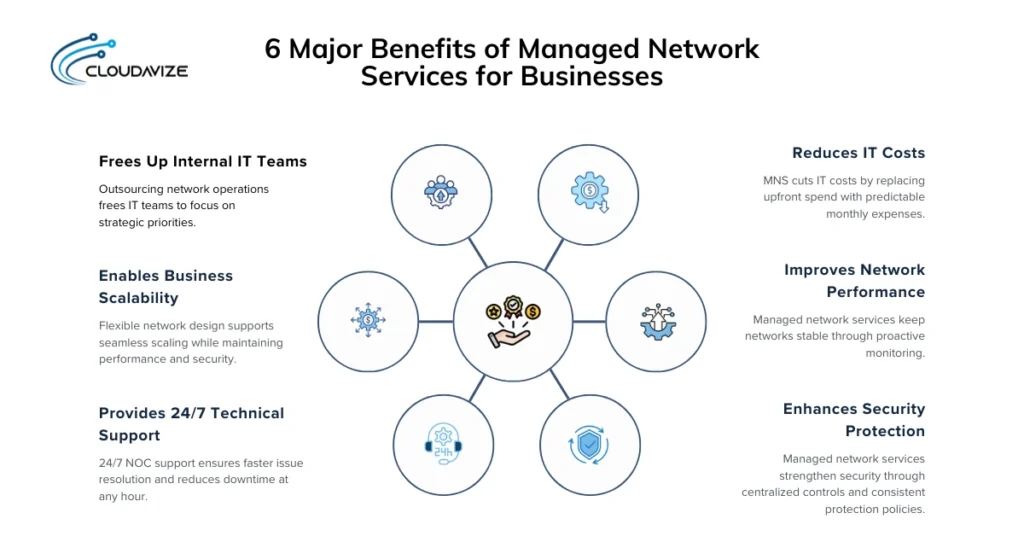
6 major benefits of managed network services for businesses:
- Reduces IT Costs:
By implementing MNS business can reduce IT costs by shifting capital expenditure (CapEx) to a predictable operating expense (OpEx) model. With this, businesses avoid the massive upfront costs of purchasing high-end hardware and the high salaries associated with specialized network engineers. Effectively, this creates a predictable monthly budget, allowing leadership to reallocate capital toward revenue-generating projects rather than maintenance. - Improves Network Performance:
Managed network services support improved performance through continuous monitoring, proactive issue detection, and standardized configuration management. Traffic patterns, latency, and device health are tracked in real time, allowing performance issues to be addressed before they disrupt users or applications. Stable network performance supports consistent access to business systems, reduces productivity loss, and maintains dependable application delivery. - Enhances Security Protection:
Compared to other security approaches, managed services improve security through centrally managed controls that operate as part of daily network operations. Managed Network Services applies consistent firewall policies, access controls, intrusion detection, and encrypted connectivity across the environment. This structured approach reduces exposure to unauthorized access and limits the operational impact of evolving security threats on business data and systems. - Provides 24/7 Technical Support:
Unlike an internal team that works fixed hours, a Network Operations Center (NOC) provides around-the-clock technical support to ensure that network issues are addressed regardless of time or location. Continuous availability of monitoring and response resources shortens resolution times and prevents extended downtime. For businesses, this support model improves service reliability and reduces operational risk during incidents outside standard business hours. - Enables Business Scalability:
Scalability is supported through flexible network designs and managed capacity planning that adapt to changing business requirements. Managed Network Services allow organizations to add locations, users, or applications without redesigning the entire network. This scalability supports growth initiatives while maintaining consistent network performance and security controls. - Frees Up Internal IT Teams:
By outsourcing network operations to MSPs, internal IT teams are relieved from routine monitoring, maintenance, and troubleshooting tasks. This shift allows in-house staff to focus on strategic initiatives such as system optimization, application improvement, and business process support. As a result, IT resources contribute more directly to organizational goals rather than ongoing operational maintenance.
What Are the Key Challenges for Businesses Using Managed Network Services?
Common challenges associated with managed network services include limited in-house expertise, legacy network technology, complex vendor dependencies, and reduced network visibility. These challenges are more pronounced for small and mid-sized businesses (SMBs), where lean IT teams and budget constraints can make oversight, coordination, and long-term network planning more difficult without proper governance structures in place.
4 key challenges for businesses using managed network services:
- Lack of In-House Network Expertise
A lack of in-house network expertise arises when businesses outsource network operations without retaining sufficient internal knowledge to oversee the managed service provider. Over time, internal teams may lose visibility into network architecture, configurations, and decision logic, increasing dependence on the provider for changes and strategic planning. Maintaining internal documentation, assigning an internal point of ownership for MSP coordination, and requiring regular reporting and knowledge-sharing sessions help preserve oversight and accountability. - Outdated Network Technology
Outdated network technology often exists when legacy hardware or legacy configurations are carried into a managed services model without modernization. Providers may be required to support aging infrastructure that limits performance, security capabilities, or scalability. This can negatively impact businesses by increasing operational risk, restricting the benefits of managed network services, and delaying adoption of newer connectivity or security improvements. For this, periodic technology assessments and phased upgrade planning with the provider help align the network environment with current performance, security, and growth requirements. - Complex Vendor Relationships
Many businesses use multiple providers for different needs, such as an ISP for connectivity, another for hardware, and a third for managed network security, creating gaps in the overall system. Without clear service boundaries and service level agreements, responsibility for performance issues may become fragmented, leading to complex issue resolution, longer response times, and making it harder for businesses to determine accountability during network incidents. To solve this, defining service ownership, consolidating accountability through unified SLAs, and establishing a single coordination point improve clarity and speed during network incidents. - Poor Network Visibility
Poor network visibility occurs when access to monitoring data, reporting, or communication from the managed service provider is limited or unclear. As a result, businesses may struggle to understand performance trends, security events, or the root causes of recurring issues. Limited visibility weakens governance and restricts informed decision-making. Standardized performance reporting, real-time dashboard access, and scheduled service reviews strengthen transparency and help align network operations with changing business requirements.
Managed Network Services Pricing Models
Managed network services pricing models include per-device, per-user, flat monthly rates, tiered service packages, and à la carte options. Each pricing model offers businesses flexibility based on network size, service scope, and operational needs, making them particularly suitable for SMBs with varying budgets and support requirements.
Key managed network services pricing models:
- Per-Device Pricing
In managed network services, a per-device pricing model involves a fixed monthly fee, typically ranging from $15 to $500 per device/month. This model covers devices such as servers, workstations, firewalls, and switches for monitoring, security, and maintenance. It works well for businesses with a predictable device count, allowing clear cost forecasting and proportional cost scaling as new devices are added. - Per-User Pricing
Per-user pricing for managed network services is a scalable and predictable model, typically ranging from $100 to $300+ per user per month. It covers all devices an employee uses, including laptops and mobile devices, under a single flat fee. For businesses especiall SMBs, this pricing model simplifies budgeting as organizations grow and often includes 24/7 help desk access, network management, and security services. - Flat Monthly Fee
A flat monthly fee for managed network services provides a fixed cost of $500 to $3,000 per month to manage the entire network environment. Pricing is influenced by network size, number of locations, service scope, and support coverage. This model is well-suited for businesses with stable infrastructure and clearly defined operational requirements. - Tiered Service Packages
Tiered Managed Network Services offer bundled support levels ranging from basic monitoring to comprehensive network and security coverage, priced at $50 to $250 per tier. Pricing increases as additional features such as enhanced security, 24/7 support, or advanced monitoring are included. Costs are determined by the selected tier, service depth, and performance or security expectations. - A La Carte
A la carte managed network services typically range from $50 to $300 per month per service, depending on scope and complexity. This pricing model allows businesses to select specific services such as firewall management, SD-WAN, remote monitoring and management (RMM), backup solutions, or specialized network support. It provides flexibility for targeted needs but can increase overall costs as service requirements expand.
How to Choose the Right Managed Network Services Provider for Your Business?
Choosing the right managed network services provider for your business starts with defining network requirements, then assessing technical expertise, reviewing SLA, verifying security capabilities, and evaluating scalability. Following these steps helps ensure the provider aligns with your business needs and can support reliable network operations over the long term.
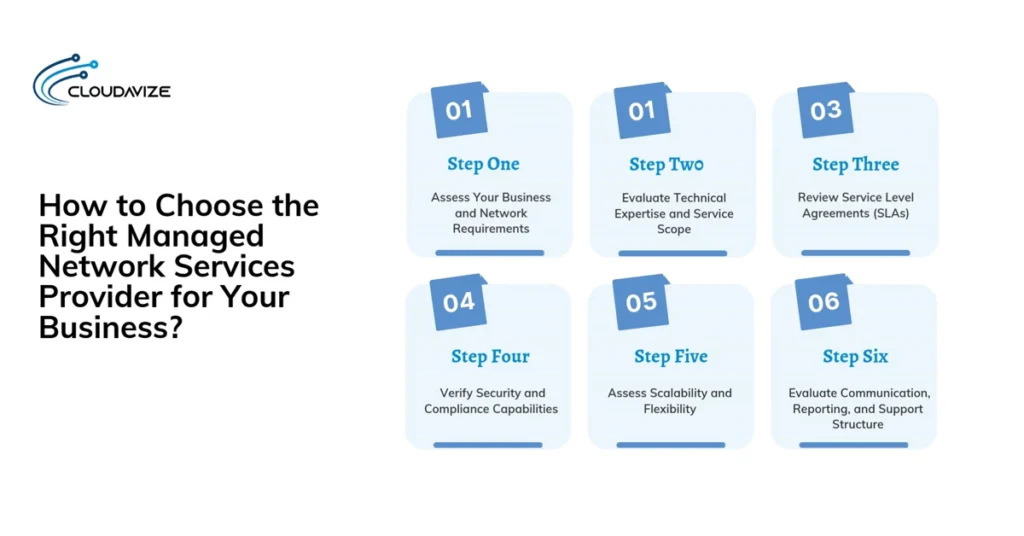
Step-by-step process to choose the right MNS provider for your business:
Step 1: Assess Your Business and Network Requirements
Start by identifying your current network size, number of users and locations, security requirements, compliance needs, and expected growth. This clarity helps determine whether a provider can support both present operations and future expansion without frequent redesign.
Step 2: Evaluate Technical Expertise and Service Scope
Review the provider’s experience in managing network infrastructure similar to yours, including monitoring, security, backup, SD-WAN, and connectivity services. Ensure their offerings align with the level of support your business requires rather than forcing unnecessary services.
Step 3: Review Service Level Agreements (SLAs)
Examine SLAs for response times, uptime commitments, escalation processes, and reporting frequency. Clearly defined SLAs establish accountability and set expectations for ongoing network operations and incident handling.
Step 4: Verify Security and Compliance Capabilities
Confirm that the provider follows standardized security practices, supports managed network security controls, and can align with any regulatory or industry-specific requirements relevant to your business.
Step 5: Assess Scalability and Flexibility
Ensure the provider can scale services as your business grows, whether by adding users, devices, locations, or advanced security capabilities. Flexibility in service delivery prevents operational constraints as needs evolve.
Step 6: Evaluate Communication, Reporting, and Support Structure
Strong communication, transparent reporting, and access to support resources are critical for maintaining visibility and governance. Providers should offer regular performance reporting and clear points of contact for ongoing management.
Ultimately, compatibility with your business operations, risk tolerance, and growth strategy is the key factor in selecting the right MNS provider. Working with experienced managed network services providers that understand local business environments can simplify this process and support long-term network reliability and performance.