
What Are Network Security Threats and Solutions?
Network security threats are malicious activities that compromise the confidentiality, integrity, or availability of computer networks and connected systems. Common threats include ransomware attacks, phishing campaigns, malware infections, DDoS attacks, man-in-the-middle (MitM) attacks, insider threats, and zero-day exploits. These attacks disrupt operations, expose sensitive information, cause financial losses, and create significant business risks. They may originate from external sources, such as cybercriminals, or from trusted insiders who misuse access privileges, intentionally or accidentally. Understanding how these threats operate is essential for implementing effective security solutions that reduce risk and protect critical assets.
Defending against these threats requires a layered security approach. Many small and medium-sized businesses (SMBs) rely on Managed Service Providers (MSPs) to implement and manage these solutions, since they may lack dedicated in-house cybersecurity teams. Effective protection includes next-generation firewalls (NGFW), intrusion detection and prevention systems (IDS/IPS), multi-factor authentication (MFA), network segmentation, SIEM platforms, vulnerability management, employee security awareness training, and real-time monitoring. Together, these measures help organizations strengthen security controls, improve threat detection, reduce attack surfaces, and maintain business continuity against evolving network security threats.
What are network security threats?
Network security threats are malicious activities designed to compromise the confidentiality, integrity, or availability of computer networks, connected systems, and sensitive data. These threats can come from external attackers, such as cybercriminals and nation-state groups, or internal users with authorized access. Attackers often target business networks to steal sensitive information, disrupt operations, deploy malicious software, or gain unauthorized access to critical systems and data.
Common network security threats include ransomware attacks, phishing campaigns, malware infections, DDoS attacks, and man-in-the-middle (MitM) attacks. For example, ransomware can encrypt business files and demand payment for recovery, while phishing emails trick employees into revealing login credentials or downloading malicious code. As cyber threats evolve, organizations must understand attack techniques to strengthen defenses, reduce vulnerabilities, and protect network infrastructure.
What are the 7 Most Common Network Security Threats?
Organizations face multiple network security threats, including ransomware, phishing, malware, DDoS attacks, man-in-the-middle (MitM) attacks, insider threats, and zero-day exploits, that disrupt operations, expose sensitive information, and damage business continuity. Understanding how these threats operate helps organizations strengthen security measures, reduce their attack surface, and improve overall network protection against evolving cyber threats.
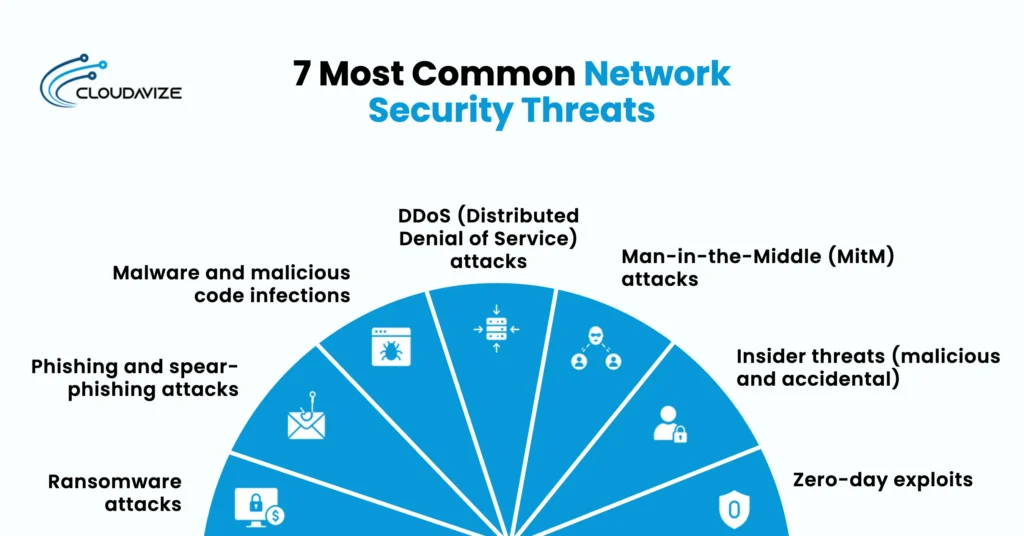
The 7 most common network security threats are:
Ransomware Attacks: Encrypt files and demand payment. Commonly spread via phishing emails or exploited vulnerabilities. Recovery is difficult without verified backups.
Phishing and Spear-Phishing Attacks: Exploit human trust rather than technical flaws. Spear-phishing is targeted to specific individuals.
Malware and Malicious Code Infections: Includes viruses, worms, and trojans. Can steal data, disrupt operations, or create backdoors.
DDoS Attacks: Overwhelm servers with traffic, disrupting services.
Man-in-the-Middle Attacks: Intercepts communications on unsecured networks.
Insider Threats: Malicious or accidental misuse of access by employees or contractors.
Zero-Day Exploits: Target unknown vulnerabilities before patches exist.
- Ransomware Attacks
Ransomware attacks encrypt files, applications, or entire systems and demand payment in exchange for restoring access. Attackers commonly spread ransomware through phishing emails, malicious downloads, or exploited vulnerabilities in outdated systems. These attacks can interrupt operations, compromise sensitive information, and create significant recovery challenges if organizations lack secure backups or effective incident response procedures. - Phishing and Spear-Phishing Attacks
Phishing attacks rely on deceptive emails or messages that imitate trusted sources to steal login credentials, financial details, or confidential business data. Spear-phishing takes a more targeted approach by customizing messages for a specific employee or organization. Because these attacks exploit human trust rather than technical weaknesses, they remain among the most effective methods for gaining unauthorized access to networks. - Malware and Malicious Code Infections
Malware refers to harmful software designed to infiltrate, damage, or control computer systems without authorization. Viruses, worms, trojans, and malicious scripts can spread through infected websites, downloads, or email attachments. Once installed, malicious code may steal data, disrupt network operations, create backdoors for attackers, or weaken overall network security by compromising connected devices and systems. - DDoS (Distributed Denial of Service) Attacks
In a DDoS attack, cybercriminals flood servers or network infrastructure with massive amounts of traffic, overwhelming systems and preventing legitimate access. Attackers often use botnets made up of compromised devices to generate this traffic. These attacks can slow services, disrupt operations, and render websites or applications completely unavailable to customers and employees. - Man-in-the-Middle (MitM) Attacks
Man-in-the-middle attacks occur when attackers secretly intercept communication between two users or systems. This commonly happens on unsecured networks or compromised public Wi-Fi connections. Once positioned between both parties, attackers can capture login credentials, financial information, or sensitive business data while remaining undetected during the communication process. - Insider Threats (Malicious and Accidental)
Not all network security threats come from external attackers. Insider threats involve employees, contractors, or business partners who misuse authorized access either intentionally or accidentally. A malicious insider may steal confidential information, while an accidental insider could expose systems by mishandling credentials or falling victim to phishing attacks, increasing the risk of data breaches and unauthorized access. - Zero-Day Exploits
Zero-day exploits target previously unknown vulnerabilities before software vendors release security patches or fixes. Because these flaws are undiscovered, organizations often have little protection against exploitation. Attackers use zero-day vulnerabilities to bypass security controls, gain unauthorized access, or deploy malicious software, making these exploits especially dangerous for businesses with outdated monitoring and patch management practices.
What Solutions Help Protect Against Network Security Threats?
Effective solutions for protecting against network security threats include next-generation firewalls (NGFW), intrusion detection and prevention systems (IDS/IPS), network segmentation, multi-factor authentication (MFA), SIEM systems, patch management, employee security awareness training, and real-time monitoring. SMBs frequently depend on MSPs to deliver and manage these advanced security tools and services.
7 common solutions that help businesses protect against network security threats are:
- Next-Generation Firewalls (NGFW) and Intrusion Detection/Prevention Systems (IDS/IPS)
Next-generation firewalls provide deeper traffic inspection than traditional firewalls by identifying malicious code, filtering suspicious activity, and enforcing advanced access controls. IDS/IPS solutions work alongside these systems by detecting and automatically blocking cyber threats, such as ransomware attacks, malware infections, and unauthorized intrusions, before they spread across the network infrastructure. - Network Segmentation and Micro-Segmentation
Network segmentation improves security by dividing networks into smaller, isolated sections, limiting how far attackers can move after gaining access. Micro-segmentation takes this further by applying security controls to individual workloads, devices, or applications. This layered approach reduces the attack surface, protects sensitive information, and helps contain malware or ransomware outbreaks before they impact entire systems. - Multi-Factor Authentication (MFA) and Identity-Based Access Controls
Multi-factor authentication adds an extra layer of protection by requiring users to verify their identity through multiple methods, such as passwords, mobile devices, or security tokens. Identity-based access controls restrict access based on user roles and permissions, helping organizations prevent unauthorized access, reduce the risk of credential theft, and strengthen overall network security management. - Security Information and Event Management (SIEM) Systems
SIEM systems collect and analyze security data from servers, firewalls, endpoints, and network devices in real time. By correlating logs and monitoring suspicious activity, SIEM platforms help security teams identify threats faster and respond to incidents more effectively. These systems also support compliance efforts through automated reporting and centralized visibility across the network environment. - Regular Patch Management and Vulnerability Scanning
Keeping systems updated is one of the most effective ways to reduce network security vulnerabilities. Patch management ensures software, operating systems, and applications receive security updates that address exploitable flaws. Vulnerability scanning identifies outdated software, exposed ports, weak configurations, and other weaknesses before attackers can use them to compromise systems or deploy malicious software. - Employee Security Awareness Training
Employees are often the first target of phishing attacks and social engineering campaigns. Security awareness training teaches staff how to recognize suspicious emails, unsafe links, and unauthorized access attempts before they lead to data breaches or malware infections. Ongoing training programs also help reduce human error and improve organizational readiness against evolving cyber threats. - Real-Time Network Traffic Monitoring and Anomaly Detection
Real-time monitoring tools continuously analyze network traffic for unusual patterns, suspicious connections, or abnormal behavior that may indicate cyberattacks. Anomaly detection systems use automation and machine learning to detect threats such as DDoS attacks, insider threats, and advanced malware early. Continuous monitoring improves threat detection and enables faster incident response across the organization.
What Types of Network Security Attacks Should Organizations Understand?
Organizations should understand active and passive attacks, external and internal attack vectors, social engineering schemes, technical exploits, and protocol-level attacks. Active attacks disrupt systems, while passive attacks secretly gather information. Threats may come from external cybercriminals or trusted insiders. Attackers also use phishing, ransomware, malware, and zero-day exploits to compromise networks, while DDoS attacks, packet sniffing, and ARP poisoning target communication protocols. Understanding these attack types helps organizations reduce vulnerabilities and strengthen network security.
The 5 types of network security attacks that an organization should be aware of are:
- Active vs. Passive Network Attacks
Active attacks directly interfere with systems by altering, disrupting, or damaging data and services, while passive attacks secretly monitor and collect information without detection or interference. Common active attack examples include ransomware, DDoS, and man-in-the-middle attacks, whereas passive attacks use techniques such as packet sniffing, traffic analysis, and eavesdropping to capture sensitive data, such as passwords and confidential communications, for use in future cyberattacks. - External vs. Internal Attack Vectors
External attack vectors originate outside an organization and commonly include phishing, malware, credential theft, or attacks targeting internet-facing services, while internal attack vectors involve individuals who already have authorized access, such as employees, contractors, or business partners. External threats aim to gain unauthorized access from outside, whereas internal threats can be deliberate, like stealing confidential data, or accidental, such as exposing credentials through negligence, making them often more difficult to detect and potentially more damaging before being discovered. - Social Engineering and Phishing-Based Attack Chains
Rather than exploiting technical flaws, social engineering attacks manipulate human behavior by targeting employee trust, urgency, and fear to bypass security controls. Attackers often use phishing emails, fake websites, fraudulent messages, or impersonation tactics to convince users to reveal credentials or install malicious software. Once access is obtained, attackers may escalate privileges, move laterally through the network, and launch additional attacks. Because these attack chains rely on trust and deception, they remain among the most successful methods for compromising organizational security. - Technical Exploits: Ransomware, Malware, and Zero-Day Attacks
Technical exploits target vulnerabilities in software, operating systems, and applications to gain unauthorized access, execute malicious code, or disrupt critical business operations. Ransomware encrypts critical data and demands payment for recovery, while malware can steal information, disrupt operations, or create hidden backdoors. Zero-day attacks are particularly dangerous because they exploit previously unknown vulnerabilities before developers release security patches. These attacks often bypass traditional defenses and can result in significant operational and financial damage. - Protocol-Level Attacks: DDoS, Packet Sniffing, and ARP Poisoning
Protocol-level attacks exploit weaknesses in the communication protocols that govern how devices authenticate, connect, and exchange data across a network. DDoS attacks overwhelm network resources with excessive traffic, causing service outages and performance degradation. Packet sniffing allows attackers to intercept and analyze unencrypted network traffic, potentially exposing login credentials or other sensitive information. ARP poisoning manipulates network routing information to redirect traffic through an attacker-controlled device, enabling data interception, unauthorized access, or further network compromise.
How Should Organizations Detect and Respond to Network Security Threats?
Organizations detect and respond to network security threats through continuous monitoring, SIEM platforms, and structured incident response plans that provide clear procedures for containing and resolving threats. Regular penetration testing and vulnerability assessments help uncover weaknesses before attackers can exploit them, reducing response times and minimizing the overall impact on business operations.
The 4 key practices for detecting and responding to network security threats are:
- Continuous Real-Time Network Monitoring and Log Management
Continuous real-time monitoring enables organizations to detect suspicious behavior, unauthorized access, and potential threats as they occur across the network. Security teams track network traffic, user activity, and system events to detect unusual patterns such as unauthorized access attempts, unexpected data transfers, or abnormal traffic spikes. Effective log management complements this process by collecting and analyzing security records across the network, providing valuable insights to support threat detection, incident investigations, and regulatory compliance. - SIEM and Threat Intelligence for Proactive Detection
SIEM systems and threat intelligence work together to give organizations the visibility and context needed to detect and respond to threats before significant damage occurs. Security Information and Event Management (SIEM) systems aggregate data from firewalls, servers, endpoints, and network devices to identify suspicious activity in real time. When combined with threat intelligence feeds that provide information on emerging malware, attacker tactics, and known vulnerabilities, organizations can prioritize high-risk alerts, improve response times, and detect threats before significant damage occurs. - Incident Response Planning and Playbooks
Incident response planning prepares organizations to contain, manage, and recover from security incidents quickly and with minimal operational disruption. Incident response planning establishes clear procedures, responsibilities, and communication channels before a security event occurs. Playbooks provide step-by-step guidance for handling specific threats, such as ransomware attacks, phishing incidents, or data breaches. Well-documented response processes help organizations contain threats faster, minimize disruption, and maintain business continuity during security incidents. - Penetration Testing and Regular Vulnerability Assessments
Penetration testing and vulnerability assessments proactively identify security weaknesses, misconfigurations, and exploitable gaps across systems and network infrastructure before attackers can exploit them. Penetration testing simulates real-world attack scenarios to evaluate how effectively security controls withstand attempted intrusions. Vulnerability assessments take a broader approach by scanning systems, applications, and network infrastructure for known security weaknesses, misconfigurations, and outdated software. Together, these practices uncover hidden risks, validate existing defenses, and support continuous improvement of network security programs.
What Factors Increase the Risk of Network Security Threats?
Factors that increase the risk of network security threats include human error, poor security training, legacy systems, unpatched technology, shadow IT, unmanaged devices, remote work vulnerabilities, third-party access, and misconfigured cloud and API exposures. These weaknesses reduce security visibility, create multiple entry points for attackers, and raise the likelihood of unauthorized access, data breaches, malware infections, and system exploitation.
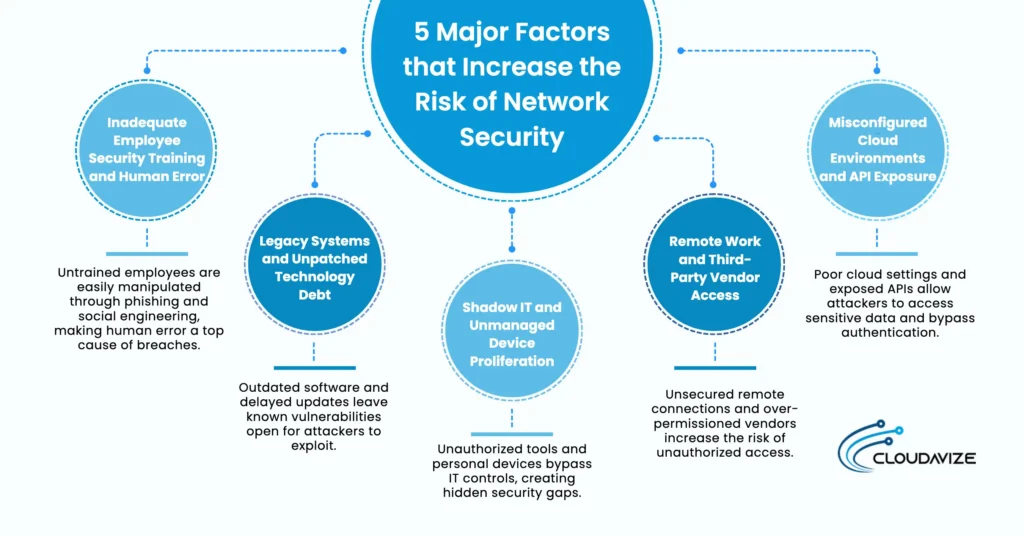
Below are the 5 major factors that increase the risk of network security:
- Inadequate Employee Security Training and Human Error
SMB environments often face a higher risk due to limited formal security training programs and incomplete implementation of MSP support. Employees may lack the knowledge to identify phishing emails, social engineering attempts, or other suspicious activity, increasing the likelihood of mistakes such as clicking on malicious links, using weak passwords, or mishandling credentials. Without structured guidance and ongoing awareness initiatives, these human errors can more easily lead to security breaches and unauthorized access to systems. - Legacy Systems and Unpatched Technology Debt
Organizations that rely on outdated systems and delayed software updates face significant cybersecurity risks. Legacy hardware and unsupported applications often contain known vulnerabilities that attackers can easily exploit. When security patches and technology upgrades are postponed, networks become exposed to threats such as malware, ransomware, and unauthorized access. Over time, this technology debt weakens overall security defenses and increases the likelihood of successful cyberattacks targeting unresolved system weaknesses. - Shadow IT and Unmanaged Device Proliferation
The growing use of shadow IT and unmanaged devices creates major security challenges, including unauthorized access, data breaches, malware infections, and reduced network visibility. Employees often use unauthorized cloud services, personal laptops, smartphones, or file-sharing applications to complete work tasks outside official IT oversight. Since these systems are not properly monitored or secured, they can introduce vulnerabilities, increase the risk of data exposure, and limit security teams’ ability to detect suspicious or malicious activity across the network. - Remote Work and Third-Party Vendor Access
The increase in remote work and third-party vendor access creates security risks, including unauthorized access, weak endpoint protection, data exposure, and compromised network connections. Employees working from unsecured networks or using poorly configured remote access tools may unintentionally expose organizational systems to attackers. In addition, third-party vendors with excessive permissions or insecure integrations can introduce vulnerabilities that cybercriminals exploit to access internal resources and sensitive business information. - Misconfigured Cloud Environments and API Exposure
Misconfigured cloud environments and exposed APIs pose security risks, including unauthorized access, data leakage, and weakened security controls. Incorrect cloud security settings, publicly accessible storage resources, or poorly secured API endpoints can give attackers opportunities to access sensitive information or bypass authentication. To reduce these risks, organizations should conduct regular configuration reviews, implement strong authentication, and adopt secure API management practices to better protect cloud infrastructure and data.
What Emerging Network Security Threats Should Organizations Watch?
Organizations should closely monitor Ransomware-as-a-Service (RaaS), AI-powered social engineering, supply chain attacks, and IoT/OT vulnerabilities, as these emerging threats use increasingly sophisticated methods to bypass traditional defenses. As attack techniques continue to evolve, businesses must strengthen security measures, improve threat detection capabilities, and monitor new attack surfaces to reduce risk and protect sensitive information from advanced cyber threats.
- Ransomware-as-a-Service (RaaS) and Double Extortion
Cybercriminals are increasingly commercializing ransomware through Ransomware-as-a-Service (RaaS) platforms, allowing less-skilled attackers to launch sophisticated attacks using ready-made tools. Double extortion tactics make these incidents even more damaging by combining data encryption with threats to publicly release stolen information. As a result, organizations face operational disruption, financial losses, and reputational damage from a single security breach. - AI-Powered Social Engineering and Deepfake Attacks
Artificial intelligence is making phishing and impersonation attacks more convincing than ever. Attackers can generate realistic emails, voice recordings, and deepfake videos that mimic executives, colleagues, or trusted partners to manipulate employees into revealing credentials or approving transactions. Because these attacks exploit human trust rather than technical vulnerabilities, they can bypass traditional security controls and become difficult to detect. - Supply Chain and Third-Party Software Attacks
Trusted vendors and software providers have become attractive targets for attackers seeking access to multiple organizations simultaneously. By compromising software updates, third-party applications, or supplier networks, attackers can distribute malicious code through legitimate channels. Incidents such as the SolarWinds breach demonstrate how a single compromised supplier can create widespread security risks across numerous organizations and industries. - IoT and OT Network Vulnerabilities
Connected devices and industrial systems continue to expand organizational attack surfaces. Many Internet of Things (IoT) devices and Operational Technology (OT) systems lack strong security controls, making them vulnerable to unauthorized access and exploitation. Compromised smart devices, industrial control systems, or SCADA environments can be used to disrupt operations, steal data, launch DDoS attacks, or provide entry points into critical network infrastructure.
How Should You Choose a Network Security Provider or Solution?
You should begin by evaluating your organization’s security requirements, including the types of cyber threats you face, the size and complexity of your network, and any compliance obligations. Once identified, assess providers based on their ability to protect against risks such as ransomware, phishing, insider attacks, and DDoS attacks. Managed Service Providers (MSPs) are useful for small and mid-sized businesses, offering managed security services without the need for in-house teams. Then compare technologies, services, and support to ensure proper alignment.
8 Key factors to consider include:
- Multi-factor authentication (MFA) for stronger user access security
- Access control and identity management systems
- Network segmentation to contain and limit security breaches
- SIEM (Security Information and Event Management) for centralized monitoring and analysis
- Regular vulnerability assessments and proactive risk detection
- Real-time threat detection and response capabilities
- Integration with existing IT infrastructure and tools
- Continuous monitoring, timely updates, and responsive technical support
What Should You Look for in a Network Security Solution?
You should look for a network security solution that provides comprehensive threat detection, real-time monitoring, layered security controls, and protection against emerging cyber threats. Essential features include firewalls, multi-factor authentication (MFA), access controls, and advanced monitoring tools that can identify suspicious activity before it escalates into a security incident. Solutions that receive regular updates and adapt to evolving attack methods are better equipped to defend against ransomware, phishing attacks, and cloud-related security vulnerabilities.
8 features to look for in a network security solution include:
- Comprehensive threat detection across networks and endpoints
- Real-time monitoring for immediate threat identification
- Layered security controls for multi-level protection
- Advanced firewalls to block unauthorized access
- Multi-factor authentication (MFA) for secure user verification
- Strong access control mechanisms to manage user permissions
- Advanced monitoring and analytics tools for suspicious activity detection
- Regular updates and patch management to address new threats
- Adaptive security capabilities against ransomware, phishing, and cloud risks
When Should You Consider Outsourcing Network Security?
You should consider outsourcing network security when your organization lacks the resources, expertise, or capacity to manage cyber threats effectively. Frequent security incidents, increasing ransomware attacks, limited in-house expertise, or the inability to maintain 24/7 monitoring are common signs that external support may be needed. In such cases, partnering with a network support provider or a specialized cybersecurity provider can be highly beneficial, as MSPs bring dedicated security expertise, advanced tools, and continuous monitoring capabilities that many in-house teams cannot maintain cost-effectively. This partnership can improve threat detection, strengthen security controls, and help maintain a more resilient security posture as threats continue to evolve.
7 Common Situations to Consider Outsourcing Network Security:
- Frequent or recurring security incidents
- Increasing ransomware or phishing attacks
- Lack of in-house cybersecurity expertise
- Inability to maintain 24/7 monitoring and response
- Limited resources to implement advanced security tools
- Difficulty keeping up with evolving cyber threats
- Need for cost-effective, enterprise-level security support