
Cloudavize is your trusted managed service provider for customized IT solutions and support services, designed to meet all your business needs, ensuring seamless operations, optimal performance, and sustainable growth.
Cloudavize is your trusted managed service provider for customized IT solutions and support services, designed to meet all your business needs, ensuring seamless operations, optimal performance, and sustainable growth.
Working Hours
| Monday : | 8 AM - 6 PM |
|---|---|
| Tuesday : | 8 AM - 6 PM |
| Wednesday: | 8 AM - 6 PM |
| Thursday : | 8 AM - 6 PM |
| Friday : | 8 AM - 6 PM |
| Saturday : | Closed |
| Sunday : | Closed |
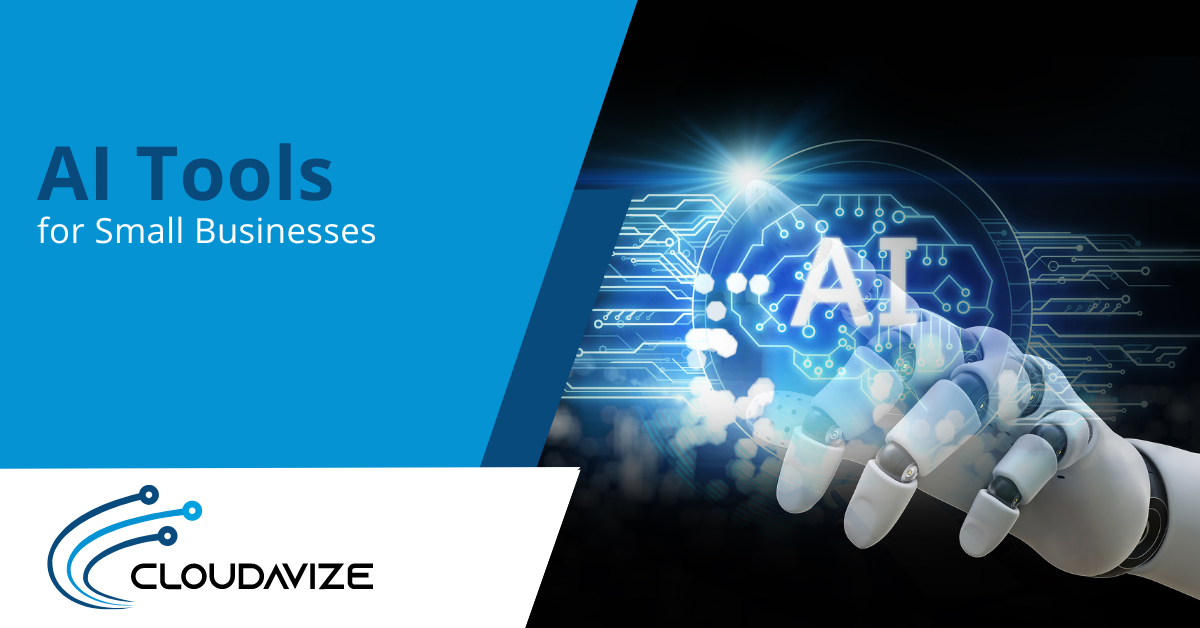
In today’s rapidly evolving digital landscape, small businesses face numerous challenges in staying competitive and efficient. One of the most transformative advancements in recent years has been the rise of artificial intelligence (AI).
AI tools, once considered the domain of large corporations with vast resources, are now accessible to small businesses, offering a plethora of opportunities to streamline operations, enhance customer experiences, and drive growth. In this comprehensive guide, we will explore the various AI tools available to small businesses, their benefits, and how to implement them effectively.
Artificial intelligence refers to the simulation of human intelligence in machines that are programmed to think and learn like humans. These systems can perform tasks such as problem-solving, decision-making, language understanding, and pattern recognition. AI encompasses various subfields, including machine learning, natural language processing, and robotics.
Small businesses often operate with limited resources, making efficiency and productivity crucial for survival and growth. AI tools can help small businesses automate repetitive tasks, gain insights from data, improve customer interactions, and make informed decisions. By leveraging AI, small businesses can compete more effectively with larger enterprises and adapt to changing market conditions.
Chatbots and virtual assistants are AI-powered tools that can handle customer inquiries, provide support, and guide users through various processes. These tools are available 24/7, ensuring that customers receive prompt assistance even outside of business hours. By automating customer service, small businesses can reduce response times, improve customer satisfaction, and free up human agents to focus on more complex issues.
AI tools can analyze customer data to create personalized marketing campaigns that resonate with individual preferences and behaviors. By delivering targeted content and offers, small businesses can increase engagement and conversion rates.
AI-driven data analytics tools can help small businesses make sense of vast amounts of data, uncovering trends, patterns, and insights that inform strategic decisions. These tools can analyze sales data, customer behavior, and market trends to identify opportunities for growth and areas for improvement.
For small businesses that deal with physical products, managing inventory efficiently is critical. AI tools can predict demand, optimize stock levels, and reduce the risk of overstocking or stockouts. By ensuring that the right products are available at the right time, small businesses can improve customer satisfaction and reduce carrying costs.
AI tools can automate various financial processes, such as bookkeeping, invoicing, and expense tracking. By reducing manual effort and minimizing errors, these tools can help small businesses maintain accurate financial records and improve cash flow management.
AI tools can assist small businesses in recruiting the right talent and managing employee performance. These tools can screen resumes, schedule interviews, and provide insights into employee engagement and productivity.
Before adopting AI tools, it’s essential to assess your business needs and identify areas where AI can provide the most value. Consider the specific challenges you face and the goals you want to achieve. This assessment will help you choose the right tools and prioritize their implementation.
With a clear understanding of your needs, research and compare different AI tools to find the ones that best fit your business. Look for tools that are user-friendly, scalable, and offer robust support and training resources. It’s also important to consider the cost and potential return on investment.
Successful implementation of AI tools requires seamless integration with your existing systems and workflows. Work with your IT team or a trusted technology partner to ensure that the tools are properly configured and integrated. Training your staff on how to use the tools effectively is also crucial for maximizing their benefits.
Once the AI tools are in place, continuously monitor their performance and impact on your business. Collect feedback from users and make adjustments as needed to optimize their effectiveness. Regularly review your AI strategy to ensure that it aligns with your evolving business goals.
One of the primary concerns with AI adoption is data privacy and security. Small businesses must ensure that they comply with relevant data protection regulations and implement robust security measures to safeguard sensitive information. Choose AI tools that prioritize data privacy and offer strong encryption and security features.
Introducing AI tools can lead to resistance from employees who may fear job displacement or struggle with new technologies. To address this, communicate the benefits of AI clearly and involve employees in the implementation process. Provide training and support to help them adapt to the changes and understand how AI can enhance their roles.
Ethical considerations are crucial when adopting AI tools. Small businesses must ensure that their AI systems are transparent, fair, and unbiased. Regularly audit AI algorithms to detect and mitigate any biases and ensure that the tools are used responsibly.
The future of AI in small businesses is promising, with several emerging trends set to shape the landscape. These include the rise of AI-powered voice assistants, increased use of AI in cybersecurity, and the integration of AI with the Internet of Things (IoT). Staying informed about these trends can help small businesses stay ahead of the curve and leverage new opportunities.
As AI technology continues to evolve, small businesses must remain agile and open to innovation. Regularly explore new AI tools and advancements to identify those that can provide a competitive edge. Embrace a culture of continuous learning and improvement to maximize the benefits of AI.
Artificial intelligence is no longer a futuristic concept; it is a powerful tool that small businesses can harness today to drive efficiency, innovation, and growth. By adopting AI tools for customer service, marketing, data analytics, inventory management, financial management, and human resources, small businesses can overcome challenges and thrive in a competitive market.
At Cloudavize, we are committed to helping small businesses navigate the complexities of AI adoption. Our team of experts is here to provide guidance, support, and tailored solutions to ensure that you harness the full potential of AI. Contact us today to learn more about how we can help your business succeed in the AI-driven world.

Owner
Cody is the Founder, Owner, and Lead IT Consultant at Cloudavize. Over the years, Cody has helped hundreds of small and midsize companies improve their IT. He is a constant learner and has obtained twelve IT certifications from partners including Microsoft, Cisco, AWS, and CompTIA. Cody's dedication to excellence and his extensive experience makes him a key leader in the IT industry.