20 Common Challenges Solved by IT Consulting
Businesses turn to IT consulting when technology challenges begin affecting security, operational efficiency, compliance, scalability, or long-term growth. Rather than addressing isolated technical issues, IT consultants evaluate the organization’s technology environment, identify underlying problems, and develop practical strategies aligned with business objectives. This guide explains the most common challenges IT consulting solves, including cybersecurity risks, data breach exposure, compliance gaps, outdated technology, cloud migration, fragmented systems, disaster recovery, weak IT strategy, vendor management, software waste, and other operational issues that impact business performance.
Throughout this guide, you will learn how IT consulting addresses each of these challenges using structured assessments, technology roadmaps, governance practices, and recognized industry frameworks such as the NIST Cybersecurity Framework (CSF), ISO/IEC 27001, COBIT, ITIL, and the CIS Critical Security Controls, where appropriate. These frameworks help consultants evaluate risks, strengthen governance, improve service management, prioritize security improvements, and recommend practical solutions that support informed technology decisions, operational resilience, and sustainable business growth.
20 common challenges solved by IT consulting are:
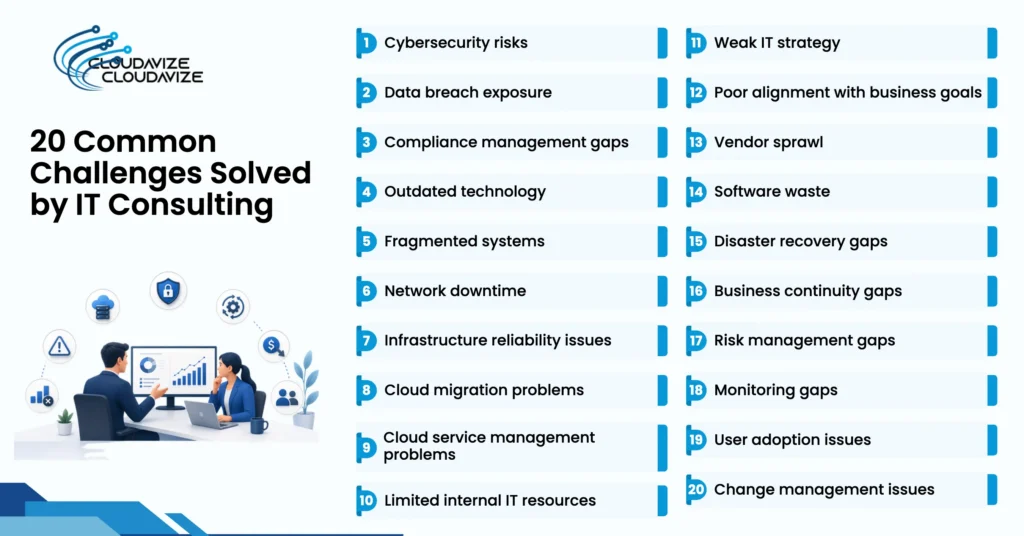
- Cybersecurity risks
Through a structured vulnerability assessment, IT consulting uncovers exactly where security gaps exist, from outdated protocols to weak authentication, before they escalate into unauthorized access or costly downtime. According to the IBM 2025 Security and Ponemon Institute Cost of a Data Breach Report, US organizations face an average breach cost of $10.22 million, with credential exploitation remaining a primary attack vector. A business often faces these heightened risks when security controls, software updates, user permissions, and internal policies do not keep pace with changing operational environments and evolving threat activity.
IT consulting helps the business reduce exposure by prioritizing identified weaknesses and applying controls that match each operational risk profile. Methods such as risk assessments, multi-factor authentication (MFA), role-based access control (RBAC), security policy reviews, patch management, and continuous threat monitoring create a resilient security program capable of defending critical digital assets. Many IT consultants structure these improvements around the NIST Cybersecurity Framework (CSF) for risk management and the CIS Controls for prioritizing practical security safeguards and implementation activities.
- Data breach exposure
Working with IT consulting to evaluate data protection practices against evolving business risks helps growing SMBs reduce data breach exposure before sensitive information is compromised. Misconfigured permissions, unsecured cloud storage, excessive user access, weak authentication, and inconsistent data handling increase the likelihood of unauthorized disclosure, financial losses, regulatory consequences, and declining customer confidence, making expert guidance increasingly valuable.
Protecting sensitive business information begins with understanding how data is collected, accessed, stored, and shared across the organization. IT consulting evaluates these processes before recommending data classification, identity governance, encryption strategies, permission audits, secure configuration reviews, and information handling standards that reduce breach risks and improve governance. These recommendations often align with the CIS Critical Security Controls, a prioritized set of cybersecurity safeguards that helps organizations reduce common attack vectors and strengthen data protection.
- Compliance management gaps
Without structured IT consulting, compliance management gaps leave growing SMBs struggling to consistently meet regulatory, contractual, and industry requirements. Inconsistent documentation, unclear responsibilities, outdated policies, incomplete access reviews, and poorly maintained records make audits harder while increasing operational risk, customer concerns, and costly remediation efforts during routine assessments or external reviews for business technology environments.
Maintaining regulatory compliance requires clear governance, documented processes, and ongoing oversight rather than reactive audit preparation. Through IT consulting, businesses strengthen compliance by conducting policy reviews, mapping controls to regulatory frameworks, standardizing documentation, assigning governance responsibilities, improving evidence collection, and performing periodic compliance assessments, resulting in greater accountability and transparent technology governance. Where appropriate, consultants also align governance and security programs with recognized frameworks such as ISO/IEC 27001 and the NIST Cybersecurity Framework, helping organizations establish repeatable security and compliance processes.
- Outdated technology
Long-term business growth becomes more difficult when outdated technology persists despite the need for strategic IT consulting and modernization. Aging hardware, unsupported software, legacy operating systems, and delayed equipment replacement reduce performance, create compatibility issues, increase maintenance costs, and prevent SMBs from adopting newer business technology that improves operational efficiency and responsiveness across departments.
Modernizing outdated technology begins with evaluating the current IT environment to determine which systems create operational inefficiencies, security vulnerabilities, or compatibility limitations. IT consulting uses infrastructure assessments, technology lifecycle planning, application compatibility reviews, hardware refresh strategies, and phased modernization roadmaps to prioritize upgrades that improve reliability, minimize business disruption, and support scalable growth.
- Fragmented systems
Fragmented business systems push growing SMBs toward IT consulting when disconnected applications slow decisions, duplicate work, and obscure reliable information. Independent software purchases, rapid expansion, department-specific tools, and weak integration planning create inconsistent workflows, repeated data entry, reporting delays, and operational friction that internal teams often cannot resolve without broader architectural guidance at scale.
IT consultants map applications, data flows, user needs, and process dependencies before recommending integration, consolidation, or platform replacement priorities. They evaluate APIs, identify redundant software tools, define data governance standards, and create a phased implementation roadmap that minimizes operational disruption. This consulting process improves information flow, reduces manual handoffs, clarifies system ownership, and gives leaders dependable data for strategic decisions.
- Network downtime
Unexpected network downtime leads growing businesses to seek IT consulting when recurring outages disrupt communication, interrupt access to critical applications, and delay customer service delivery. According to ITIC’s 2024 Hourly Cost of Downtime Report, based on an independent survey of more than 1,000 organizations worldwide, over 90% of mid-size and large enterprises estimated that one hour of downtime costs more than $300,000 on average, while 41% estimated hourly downtime between $1 million and more than $5 million. Aging network equipment, poor capacity planning, configuration inconsistencies, and single points of failure create operational bottlenecks that reactive troubleshooting rarely resolves permanently.
A thorough evaluation of network architecture, traffic patterns, and infrastructure performance helps businesses identify underlying weaknesses that contribute to recurring outages. IT consulting develops recommendations based on capacity planning, redundancy strategies, configuration reviews, network documentation, and performance baselines, enabling informed infrastructure decisions that improve network resilience, minimize downtime, and support consistent day-to-day operations.
- Infrastructure reliability issues
Consistent infrastructure performance depends on IT consulting that identifies reliability issues before unstable systems disrupt growing business operations. Aging servers, storage limitations, inconsistent configurations, insufficient capacity, and undocumented infrastructure changes often create recurring performance problems that reduce application availability, delay critical workflows, and increase pressure on internal IT teams managing expanding technology environments.
Evaluating the organization’s infrastructure provides the insight needed to identify reliability risks before they affect critical business operations. Based on this assessment, IT consulting prioritizes improvement initiatives, develops a modernization roadmap, and reviews system architecture, capacity trends, hardware lifecycles, configuration standards, and infrastructure dependencies, enabling business leaders to make informed technology investments that improve long-term stability. Consultants may also recommend ITIL service management practices to standardize incident, problem, and configuration management, helping improve infrastructure reliability over time.
- Cloud migration problems
Expanding cloud initiatives often require IT consulting as growing businesses migrate applications, data, and workloads while maintaining business continuity. Flexera’s 2025 State of the Cloud Report found that 84% of organizations consider managing cloud spend their top cloud challenge, while Kyndryl’s 2025 Cloud Readiness Report revealed that 70% of CEOs said their current cloud environments were built “by accident rather than by design.” Together, these findings highlight the need for strategic IT consulting to assess application dependencies, modernize legacy systems, establish governance, prioritize workloads, and optimize cloud costs before and throughout cloud migration projects.
Understanding the organization’s technology environment is the foundation of a successful cloud migration strategy. Following a detailed technical assessment, IT consulting identifies application dependencies, evaluates cloud readiness, develops a phased migration roadmap, recommends optimal cloud architectures (AWS/Azure/M365), establishes migration sequencing and risk mitigation strategies, and aligns stakeholder planning to deliver predictable migration outcomes while minimizing operational disruption.
- Cloud service management problems
As cloud environments expand, IT consulting becomes essential for businesses that struggle to maintain visibility, governance, and operational control across multiple cloud services. Unclear ownership, inconsistent configurations, uncontrolled resource growth, weak access management, and limited cost oversight often increase operational complexity, unnecessary spending, and administrative burdens that hinder long-term business technology performance.
IT consultants review cloud operations, evaluate governance practices, analyze resource utilization, and establish management frameworks aligned with business objectives. They recommend policies for account structure, identity governance, FinOps cost optimization, performance measurement, and operational accountability, helping organizations make informed cloud decisions, improve resource efficiency, and maintain scalable cloud environments.
- Limited internal IT resources
Growing SMBs frequently turn to IT consulting when limited internal IT resources make it difficult to support daily operations while planning future technology initiatives. Small IT teams often balance user support, infrastructure maintenance, cybersecurity responsibilities, vendor coordination, and strategic projects simultaneously, leaving little capacity to evaluate long-term technology decisions or address increasingly complex business requirements.
Understanding the limitations of internal IT resources enables businesses to make strategic decisions about where external expertise delivers the greatest value. A structured IT consulting engagement assesses workloads, identifies capability gaps, prioritizes technology initiatives, develops roadmap strategies, defines operational responsibilities, and documents critical processes, helping organizations strengthen internal IT functions without overextending existing teams.
- Weak IT strategy
Weak IT strategy is one of the most common reasons growing SMBs engage IT consulting because technology investments often expand without a clear plan that supports long-term business objectives. Disconnected purchasing decisions, reactive problem-solving, unclear technology priorities, and limited strategic oversight create inefficient systems, rising costs, duplicated investments, and missed opportunities, making it difficult for leadership to align technology initiatives with operational growth and changing business needs.
IT consultants evaluate the organization’s current technology environment, business objectives, operational challenges, and future growth plans before developing a strategic IT roadmap. By assessing infrastructure, software, cybersecurity, cloud adoption, budgeting, governance, and technology lifecycles, they prioritize initiatives based on business value, helping leadership make informed technology decisions, optimize IT investments, reduce unnecessary spending, and build a scalable strategy that supports long-term business success. Consultants frequently apply governance principles consistent with COBIT to align IT investments, performance measurement, governance, and business objectives.
- Poor alignment with business goals
Technology investments lose strategic value when IT consulting is absent, and business priorities evolve faster than technology planning. Independent purchasing decisions, disconnected departmental initiatives, unclear executive direction, and limited cross-functional collaboration often result in technology projects that consume budgets without improving operational efficiency, customer experience, or long-term business growth.
A comprehensive evaluation of organizational objectives, existing technology capabilities, business processes, and future priorities helps businesses identify where technology investments fail to support strategic goals. IT consulting develops strategic roadmaps, prioritizes technology investments, establishes governance frameworks, and defines key performance indicators (KPIs) that align IT initiatives with measurable business outcomes.
- Vendor sprawl
Vendor sprawl often drives growing businesses to seek IT consulting when too many technology providers create unnecessary complexity, inconsistent support, and rising operational costs. Independent software purchases, decentralized procurement, duplicate services, overlapping contracts, and limited governance reduce visibility into the technology ecosystem, making it difficult to manage vendors efficiently or optimize overall IT spending.
A detailed evaluation of existing vendor relationships reveals where overlapping services, inconsistent contracts, and fragmented procurement practices increase costs and complicate technology management. Based on these findings, IT consulting recommends vendor consolidation, evaluates provider performance, standardizes procurement processes, establishes vendor governance policies, and develops a strategic sourcing roadmap that helps businesses strengthen accountability, reduce complexity, and maximize investment value.
- Software waste
Unused and underutilized software often prompts growing businesses to seek IT consulting when technology investments fail to deliver expected operational value. According to Flexera’s State of ITAM and SaaS Management research, organizations waste between 28% and 32% of their total SaaS and software budgets on unused, underutilized, or unassigned software licenses. Decentralized purchasing increases subscription costs, complicates system management, and reduces total return on technology investments.
IT consultants perform software portfolio assessments, analyze application usage metrics, review licensing agreements, and identify opportunities to eliminate redundant tools. They recommend application rationalization, license optimization, governance policies, and standardized software selection processes, helping organizations reduce unnecessary technology spending, improve software adoption, and ensure future investments align with actual operational needs.
- Disaster recovery gaps
Effective disaster recovery requires IT consulting when growing businesses discover critical systems cannot be restored quickly after outages, ransomware, or infrastructure failures. Inadequate backup planning, undocumented recovery procedures, undefined recovery objectives, and infrequent testing create prolonged downtime, operational disruption, financial losses, customer dissatisfaction, and unnecessary business risk, prompting organizations to proactively seek structured recovery guidance.
Consultants assess existing backup capabilities, recovery dependencies, restoration procedures, and business continuity priorities before identifying gaps. They define Recovery Time Objectives (RTO) and Recovery Point Objectives (RPO), document Disaster Recovery (DR) plans, validate backups through simulation testing, and guide technical implementation. This consulting approach strengthens recovery readiness, minimizes downtime, and protects long-term operational resilience. Many consultants develop disaster recovery programs using guidance consistent with NIST SP 800-34, which focuses on contingency planning for information systems.
- Business continuity gaps
Maintaining business operations during unexpected disruptions often leads growing businesses to seek IT consulting when critical processes lack documented continuity plans. Rapid expansion, informal procedures, unclear responsibilities, and insufficient operational planning increase downtime, service interruptions, communication failures, financial losses, and customer disruption, exposing weaknesses that routine troubleshooting cannot resolve strategically over the long term alone.
The consulting process focuses on understanding how operational disruptions affect essential business functions before recommending continuity improvements. After evaluating business priorities and operational dependencies, consultants create continuity strategies, document critical workflows, establish emergency communication procedures, and define governance for ongoing continuity planning. Periodic testing and plan updates help businesses sustain operations through unexpected external events.
- Risk management gaps
Technology risks become increasingly difficult to manage without IT consulting as growing businesses adopt new systems, expand digital operations, and face evolving regulatory and operational demands. Limited risk visibility, inconsistent governance, undocumented processes, and reactive decision-making allow critical vulnerabilities to accumulate, increasing the likelihood of service disruptions, compliance issues, financial losses, and technology investments that expose the business to unnecessary long-term risk.
A structured IT consulting engagement evaluates the current technology environment, identifies and prioritizes business and technical risks, reviews existing controls, and assesses their effectiveness against organizational objectives. Consultants develop risk registers, mitigation strategies, governance frameworks, and implementation roadmaps, enabling business leaders to make informed technology decisions and strengthen long-term operational resilience. Many consulting engagements also reference the NIST Cybersecurity Framework for risk identification and COBIT for governance, helping organizations align technology risks with broader business objectives.
- Monitoring gaps
Limited monitoring visibility often leads growing businesses to seek IT consulting when performance issues, infrastructure failures, or system anomalies remain undetected until they disrupt operations. Inadequate monitoring tools, inconsistent alerting, fragmented visibility, undefined baselines, and limited log analysis delay issue identification, increasing downtime, troubleshooting effort, operational risk, and service reliability concerns across critical business systems.
Greater operational visibility starts with understanding where existing monitoring processes fail to provide timely, actionable insights. Through a structured IT consulting engagement, businesses evaluate infrastructure monitoring, alert quality, log management, and reporting capabilities before implementing monitoring baselines, centralized dashboards, governance standards, and automated log analysis that accelerate issue detection and strengthen operational oversight while supporting the Detect function of the NIST Cybersecurity Framework.
- User adoption issues
Low user adoption after introducing new systems is one of the most common reasons growing businesses seek IT consulting support, often occurring when employees lack adequate training, clear workflows, or early involvement in the transition process. Without structured change management and consistent communication, employees are more likely to resist change and underutilize new technologies. Gartner’s 2025 HR research found that only 32% of business leaders achieved healthy employee change adoption, while McKinsey research shows about 70% of digital transformations fail to meet their stated objectives.
Addressing user adoption begins with understanding how employees interact with technology and where workflow challenges limit day-to-day usage. Through structured IT consulting, businesses assess user readiness, gather stakeholder feedback, and develop adoption strategies that include role-based training, onboarding programs, communication plans, knowledge transfer, and measurable adoption metrics to encourage long-term platform utilization and business value.
- Change management issues
Poorly managed technology changes often prompt growing businesses to seek IT consulting when new initiatives create confusion, resistance, or operational disruption instead of expected improvements. Limited planning, inconsistent communication, unclear stakeholder responsibilities, inadequate documentation, and rushed rollouts reduce employee engagement, delay implementation, increase project risks, and prevent organizations from achieving intended business outcomes from technology investments.
A structured assessment of organizational readiness, stakeholder expectations, communication processes, and existing change practices helps businesses identify obstacles that could delay technology initiatives. Based on these findings, IT consulting develops a formal change management strategy, establishes governance workflows, defines approval gates, creates rollout plans, documents responsibilities, and conducts post-implementation reviews that minimize operational disruption and support predictable transformation outcomes. Where organizations follow formal IT service management practices, consultants often align technology changes with ITIL to improve governance, change control, and service reliability.
What Startup Challenges Are Solved by IT Consulting?
Startup challenges solved by IT consulting include budget constraints, resource limits, product-market fit, project delays, scalability limits, and tech talent gaps. Through strategic planning, architecture guidance, cloud optimization, and specialized technical expertise, IT consultants help startups prioritize technology investments, accelerate product development, build scalable infrastructure, bridge temporary skill shortages, and make informed technology decisions that support sustainable business growth.
Below are the startup challenges solved by IT consulting:
- Budget constraints
IT consulting helps startups prioritize high-impact technology investments, avoid over-engineered platforms, and leverage cost-effective cloud architectures. Consultants evaluate business goals, recommend scalable technology stacks, optimize infrastructure spending, and create phased implementation roadmaps that maximize limited budgets while preserving flexibility for future growth and evolving business requirements.
- Resource limits
External advisors augment lean startup teams, providing specialized architecture, security, and cloud skills without the overhead of full-time executive hires. They fill critical knowledge gaps, support technical decision-making, mentor internal teams, and help founders execute complex initiatives without significantly increasing long-term payroll commitments.
- Product-market fit
Technical advisory ensures that underlying application infrastructure scales rapidly in response to unexpected market traction and user demand. Consultants align technology architecture with product objectives, improve platform flexibility, and reduce technical bottlenecks, allowing startups to adapt quickly as customer feedback and market requirements evolve.
- Project delays
Structured technology roadmaps prevent common architecture rework, accelerating product launch timelines and development milestones. Consultants identify project risks early, establish realistic implementation priorities, improve cross-functional coordination, and streamline technical planning to keep development efforts aligned with business objectives and delivery schedules.
- Scalability limits
IT consultants design cloud-native, modular systems that accommodate fast user growth without requiring full infrastructure redesigns. They assess future capacity requirements, eliminate architectural bottlenecks, recommend scalable platforms, and develop long-term infrastructure strategies that support sustainable expansion while maintaining reliable application performance.
- Tech talent gaps
Consulting bridges temporary leadership and engineering gaps, guiding technical strategy while founders recruit permanent internal staff. Experienced advisors establish development standards, evaluate technology decisions, mentor technical teams, and provide strategic oversight that helps startups maintain project momentum without delaying business growth.
What Small Business Challenges Are Solved by IT Consulting?
For small businesses, IT consulting addresses high IT costs, limited IT budgets, small internal teams, and reactive IT management. Through strategic technology assessments and planning, consultants optimize IT spending, strengthen internal capabilities, replace reactive support with proactive strategies, and help businesses improve operational efficiency, reliability, and long-term growth.
The most common small business challenges solved by IT consulting include:
- High IT costs
Unexpected IT repair expenses place significant financial pressure on small businesses, making IT consulting valuable for controlling long-term technology costs. Consultants assess existing infrastructure, identify recurring cost drivers, recommend preventive improvements, and develop technology strategies that reduce unexpected expenses while improving system reliability and return on IT investments.
- Limited IT budgets
Limited technology budgets often require small businesses to make every IT investment count, making strategic consulting especially valuable. Consultants prioritize business-critical initiatives, eliminate unnecessary spending, evaluate cost-effective solutions, and create phased technology roadmaps that maximize value while supporting sustainable growth within available financial resources.
- Small internal teams
Lean internal teams frequently leave small businesses without the specialized expertise needed for complex technology initiatives. IT consultants supplement internal capabilities, improve workload prioritization, provide technical guidance for strategic projects, and enable employees to focus on core business operations without compromising technology performance or productivity.
- Reactive IT management
Relying on reactive troubleshooting prevents many small businesses from addressing technology issues before they affect daily operations. IT consultants evaluate the existing environment, identify recurring problems, develop proactive maintenance and monitoring strategies, and recommend infrastructure improvements that reduce disruptions, improve reliability, and strengthen long-term operational efficiency.
What Mid-Sized Business Challenges Are Solved by IT Consulting?
Challenges such as scaling bottlenecks, legacy systems, technical debt, IT leadership gaps, licensing waste, AI readiness gaps, data governance gaps, and knowledge transfer gaps are solved through IT consulting for mid-sized businesses. By providing strategic assessments, modernization planning, governance frameworks, and executive technology guidance, consultants help organizations build scalable IT environments, optimize technology investments, strengthen operational efficiency, and support sustainable business growth.
IT consulting helps mid-sized businesses overcome the following technology challenges:
- Scaling bottlenecks
As mid-sized businesses expand, scaling bottlenecks often emerge when existing IT infrastructure cannot keep pace with growing operational demands. By evaluating current capacity, network architecture, and cloud infrastructure, consultants develop modular expansion strategies that support additional locations, higher workloads, and sustainable business growth without requiring major
- Legacy systems
Many mid-sized businesses continue relying on legacy systems that limit agility, integration, and long-term scalability. Following a comprehensive application assessment, consultants create phased modernization roadmaps, prioritize critical upgrades, and recommend API-driven integrations that improve flexibility while minimizing operational disruption throughout the transition process.
- Technical debt
Years of short-term technology decisions often leave mid-sized businesses burdened with technical debt that slows innovation. Rather than replacing systems immediately, consultants identify accumulated technical issues, rank remediation priorities, and establish structured improvement plans that strengthen application stability, simplify maintenance, and reduce long-term operational complexity.
- IT leadership gaps
Growing mid-sized businesses often require strategic technology leadership before investing in a full-time executive IT team. Through Virtual CIO (vCIO) services, consultants provide executive technology planning, budgeting guidance, governance recommendations, and board-level reporting that align technology initiatives with long-term business objectives.
- Licensing waste
Software licensing waste becomes increasingly common as mid-sized businesses adopt more applications across multiple departments. After reviewing enterprise software portfolios and licensing agreements, consultants eliminate redundant subscriptions, optimize license allocation, establish procurement governance, and improve software utilization to reduce unnecessary operational expenses.
- AI readiness gaps
Preparing for artificial intelligence requires many mid-sized businesses to strengthen their technology and data foundations before deployment. Instead of focusing solely on AI tools, consultants improve data quality, establish governance policies, define access controls, and prepare infrastructure that enables secure, scalable, and responsible AI adoption.
- Data governance gaps
Expanding operations often make consistent data governance a growing challenge for mid-sized businesses. Through governance assessments and policy development, consultants establish data classification standards, access controls, ownership responsibilities, and handling procedures that improve compliance, strengthen security, and support reliable business decision-making.
- Knowledge transfer gaps
Staff growth and employee turnover can leave mid-sized businesses vulnerable to the loss of critical technical knowledge. To preserve institutional expertise, consultants document systems, standardize operational procedures, create knowledge repositories, and develop repeatable playbooks that simplify onboarding, improve consistency, and strengthen long-term operational continuity.
How Do IT Challenges Affect Businesses?
IT challenges affect businesses through slower team productivity, unplanned IT costs, poor customer experience, delayed growth plans, and increased pressure on internal teams. Left unresolved, these issues reduce operational efficiency, increase financial risk, limit business scalability, and strain employees. IT consulting helps identify underlying technology gaps, improve system performance, and create long-term strategies that strengthen business resilience and sustainable growth.
Common business impacts of unresolved IT challenges include:
- Slower team productivity
System slowdowns, network outages, and fragmented software force employees to waste hours on manual workarounds and repetitive data entry. Over time, IT consulting helps eliminate these inefficiencies by optimizing workflows, improving system performance, and reducing unnecessary manual tasks that limit operational productivity.
- Unplanned IT costs
Emergency hardware replacements, reactive cybersecurity remediation, and cloud budget overruns disrupt financial planning. IT consultants identify underlying cost drivers, prioritize preventive improvements, and develop long-term technology strategies that reduce unexpected expenses and improve budget predictability.
- Poor customer experience
Slow customer portals, service disruptions, and data delays undermine client trust and lead to account churn. Through infrastructure assessments and technology optimization, IT consultants improve service reliability, application performance, and system availability to support a more consistent customer experience.
- Delayed growth plans
When IT infrastructure cannot scale, business expansion into new markets, locations, or product lines is delayed. IT consultants develop scalable technology roadmaps and modern infrastructure strategies that enable businesses to expand confidently without major operational constraints.
- More pressure on internal teams
Persistent technical issues cause frustration and burnout among staff and internal support personnel, increasing voluntary employee turnover. By addressing recurring technology challenges and improving operational processes, IT consultants reduce daily support burdens and allow internal teams to focus on higher-value business initiatives.
How Should Businesses Choose an IT Consulting Firm?
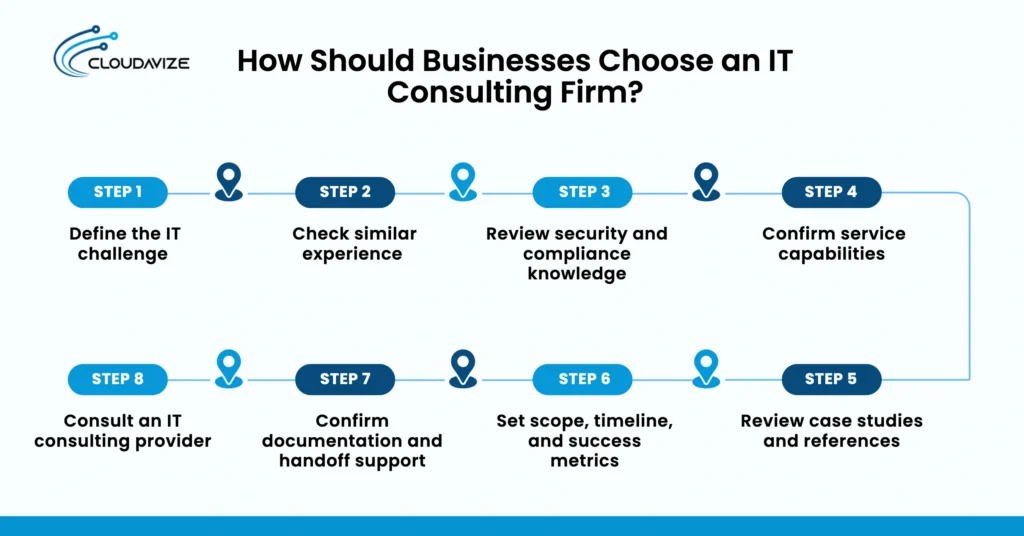
Businesses should choose an IT consulting firm by defining the IT challenge, checking similar experience, reviewing security expertise, confirming service capabilities, evaluating case studies, setting project scope, confirming documentation, and scheduling a consultation. These steps help businesses select a consulting partner with the right expertise, align technology initiatives with business goals, reduce implementation risks, and achieve measurable long-term value from technology investments.
Follow these steps when selecting an IT consulting firm:
- Step 1: Define the IT challenge
Clearly identify the technology challenges your business needs to solve before engaging an IT consulting firm. Document specific issues such as cybersecurity risks, cloud migration, recurring downtime, legacy systems, or scalability limitations so the consultant can recommend solutions aligned with your business objectives.
- Step 2: Check similar experience
Evaluate whether the IT consulting firm has successfully completed projects similar to yours. Look for experience within your industry, business size, and technology environment to ensure the consultant understands your operational challenges and can deliver practical, proven recommendations.
- Step 3: Review security and compliance knowledge
Verify that the consultant has expertise in the security and regulatory requirements relevant to your business. Confirm experience with frameworks such as HIPAA, SOC 2, CMMC, or other applicable standards, along with current cybersecurity best practices and risk management strategies.
- Step 4: Confirm service capabilities
Ensure the IT consulting firm provides the services your project requires from planning through execution. Review whether they offer strategic consulting, technology assessments, architecture design, implementation guidance, governance, and ongoing managed services if long-term support is needed.
- Step 5: Review case studies and references
Request case studies, client references, and measurable project outcomes before making a decision. Review documented results, business improvements, and return on investment, and speak with previous clients whenever possible to validate the firm’s experience and delivery capabilities.
- Step 6: Set scope, timeline, and success metrics
Define the project scope, implementation timeline, budget, and key performance indicators before work begins. Establishing clear deliverables, milestones, responsibilities, and measurable success criteria helps keep the consulting engagement aligned with business expectations.
- Step 7: Confirm documentation and handoff support
Before the engagement ends, confirm that the consultant will deliver complete technical documentation and a structured handoff. This should include system documentation, architectural diagrams, configuration details, standard operating procedures, and knowledge transfer sessions that enable your internal team to confidently manage and maintain the IT environment.
- Step 8: Consult an IT consulting provider
Schedule a discovery session with your shortlisted IT consulting provider to discuss business objectives, technology challenges, and future growth plans. Use this consultation to evaluate technical expertise, communication style, strategic approach, and overall fit before selecting a long-term technology partner.