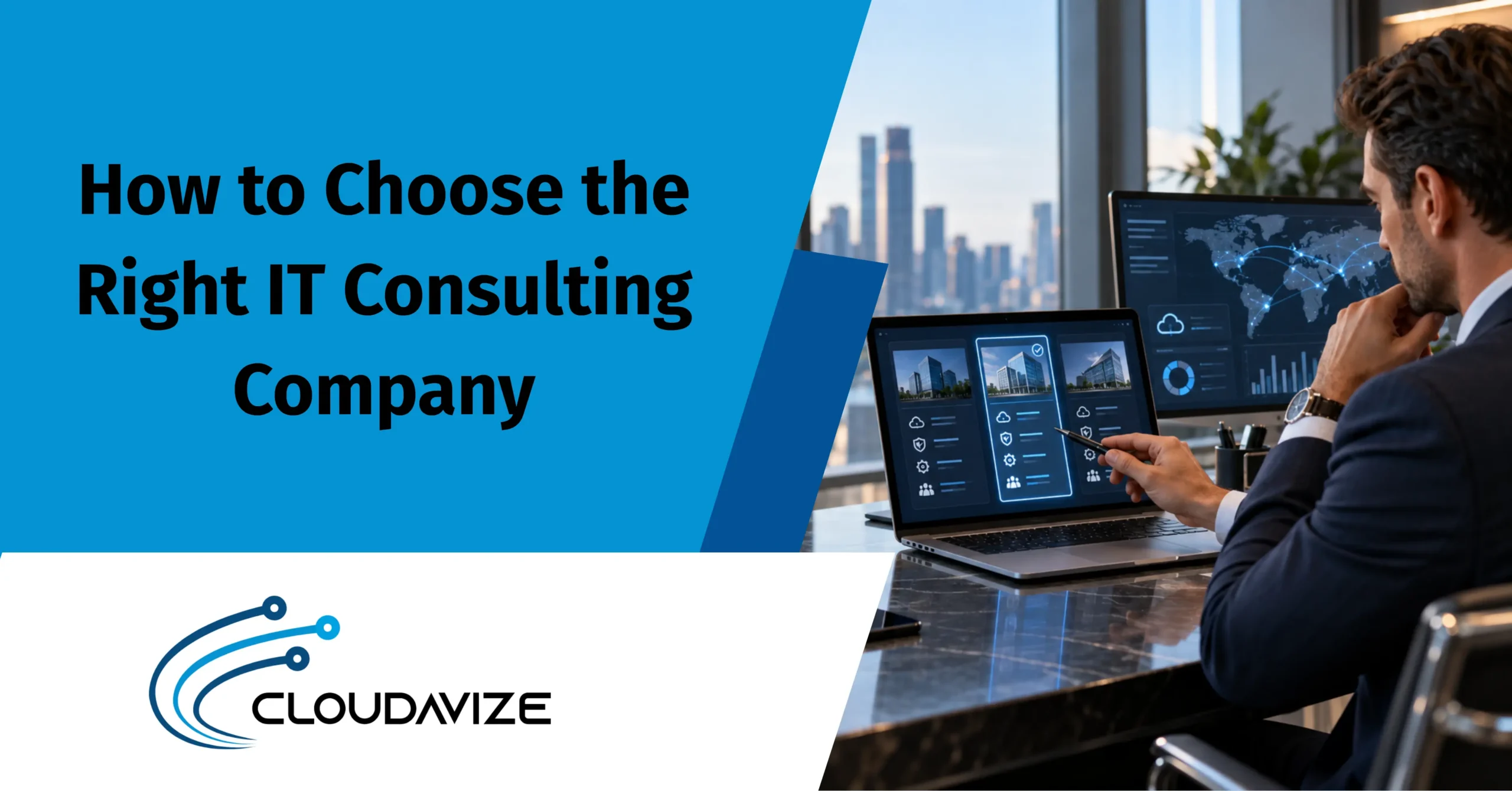
How to Choose the Right IT Consulting Company
To choose the right IT consulting company, start by defining your IT needs, goals, and project requirements, then determine the IT consulting services and engagement model you need. Research and shortlist suitable companies, evaluate each provider’s technical and industry expertise, and assess the proposed consulting team’s experience and capability. Next, review project delivery, communication, and support, verify case studies and client results, compare proposals, pricing, scope, and expected business value, review security and contract terms, and compare qualified providers before making your selection.
For small and mid-sized businesses, the right IT consulting company should understand your business goals, current technology stack, legacy systems, cloud infrastructure, cybersecurity requirements, and digital transformation priorities. Assess whether its expertise covers platforms your business uses, such as AWS, Microsoft Azure, Google Cloud Platform (GCP), Salesforce, ServiceNow, or SAP. SMBs should also determine whether proposed technology solutions can scale with business growth and produce measurable outcomes, such as lower IT costs, stronger security, improved system performance, or better ROI. If your small business needs continuous monitoring, maintenance, cybersecurity, or user support, an MSP can provide managed IT services after the consulting engagement.
Follow these steps to choose the right IT consulting company:
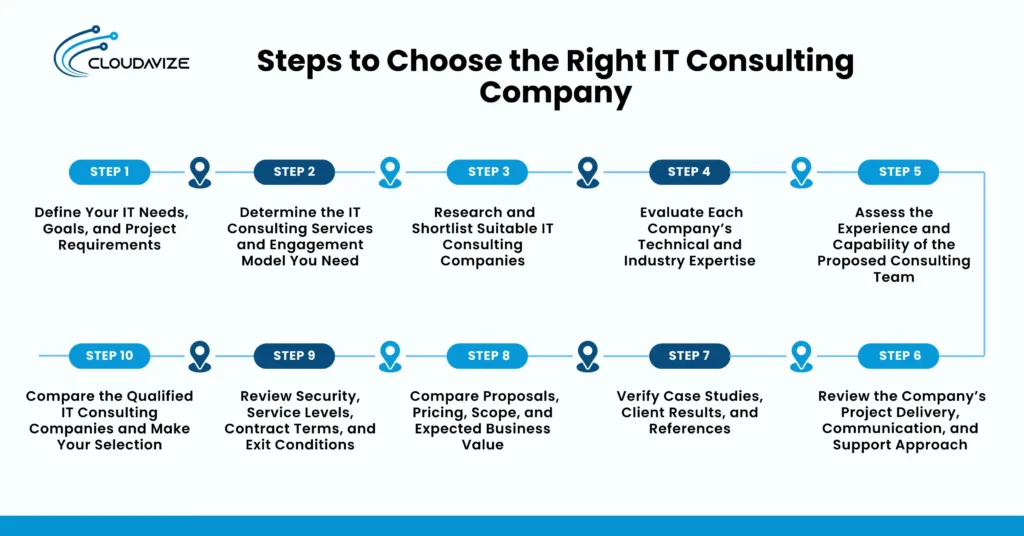
- Step 1: Define Your IT Needs, Goals, and Project Requirements
Start by documenting the exact business problems the consulting engagement must solve and assess your current IT setup. For small and mid-sized businesses, common needs may include legacy system modernization, cloud migration, network reliability, cybersecurity gaps, ERP or CRM implementation, regulatory compliance, business continuity, scalability, or broader digital transformation. Define both short- and long-term business goals so the required IT consulting services address specific operational and technical pain points.
Document the project scope, deliverables, exclusions, budget, timeline, dependencies, security and data requirements, risk tolerance, and available internal resources. Assign stakeholders, technical contacts, approval authority, and decision responsibilities before contacting consulting firms. Establish baseline metrics, KPIs, expected ROI, and other success criteria to measure project outcomes. Use this requirement profile as the baseline for provider discussions so each IT consulting company responds to the same business needs, technical requirements, and project expectations.
- Step 2: Determine the IT Consulting Services and Engagement Model You Need
Match your project requirements to the IT consulting services needed to achieve your business goals. These may include technology strategy, cloud migration, infrastructure modernization, cybersecurity, IT audits, DevOps, AI/ML, data analytics, business intelligence, ERP or CRM implementation, disaster recovery, systems integration, or digital transformation. Select services according to your current technology environment, capability gaps, project scope, and expected outcomes.
Next, choose an engagement model based on how you want the work managed and delivered. Options include project-based consulting, fixed-price or time and materials (T&M) engagements, retainers, staff augmentation, dedicated teams, strategic advisory, fractional CTO or vCIO services, and ongoing managed services. Staff augmentation can supplement internal technical capacity, while an MSP can manage ongoing infrastructure, monitoring, cybersecurity, and support. For SMBs, compare provider capacity, delivery responsibility, pricing structure, service flexibility, and onsite or remote requirements before selecting a model.
- Step 3: Research and Shortlist Suitable IT Consulting Companies
Create a shortlist after establishing minimum qualification requirements. Find IT consulting companies through business referrals, Clutch, G2, Google Reviews, industry associations, and vendor partner directories such as Microsoft Partner, AWS Partner Network, and Google Cloud Partner listings. Check each provider’s services, industry experience, company size, minimum project size, location, time-zone coverage, and onsite availability. Small businesses should also look for providers with experience supporting clients with similar IT environments, internal resources, and project requirements.
Apply the same screening criteria to every candidate, including service capability, security credentials, availability, staffing capacity, industry knowledge, and location requirements. A trusted IT consultant will clearly disclose technology partnerships, reseller relationships, referral arrangements, and subcontractors that could affect recommendations or project delivery. If you are considering an MSP for ongoing services, confirm that its managed service capabilities match the systems and support requirements defined for the engagement.
- Step 4: Evaluate Each Company’s Technical and Industry Expertise
Check whether each provider has experience directly related to your project, industry, and technology stack. For cloud projects, look for relevant AWS Certified, Microsoft Azure, or Google Cloud credentials and partner status. Depending on the engagement, expertise may also include Salesforce, ServiceNow, SAP, DevOps, PMP, ITIL, or CISSP. For regulated or security-sensitive environments, assess experience with applicable requirements and frameworks such as HIPAA, PCI DSS, CMMC, SOC 2, ISO/IEC 27001, or the NIST Cybersecurity Framework.
Cybersecurity capability deserves particular scrutiny. The 2025 ISC2 Cybersecurity Workforce Study surveyed 16,029 cybersecurity professionals and decision-makers and found that 59% reported critical or significant cybersecurity skills needs. Organizations responded partly through external resources, with 20% outsourcing work and 19% bringing in third-party service providers (ISC2, 2025). Verify that the specific technical and security expertise presented during sales will be available during your engagement, including assigned consultants, specialist roles, availability, and backup resources.
- Step 5: Assess the Experience and Capability of the Proposed Consulting Team
Review the consultants who will actually perform the work, not only the company’s overall credentials. Request the names, roles, CVs or resumes, seniority, relevant certifications, technical skills, and availability of proposed team members, such as the solution architect, project manager, cloud engineer, cybersecurity specialist, or technical lead. Confirm whether they are employees, contractors, or subcontractors and whether delivery involves onshore, nearshore, or offshore resources. Check time-zone overlap and communication availability where distributed teams are involved.
Assess whether the proposed team understands your systems, users, security requirements, and expected outcomes. Ask about staff turnover, backup resources, team scalability, and the process for replacing unavailable consultants without disrupting delivery. Review evidence from comparable engagements involving the proposed consultants. For SMBs that depend on external technical expertise, confirm that the provider can maintain the required seniority mix, specialist coverage, and staffing capacity throughout the engagement.
- Step 6: Review the Company’s Project Delivery, Communication, and Support Approach
Ask each provider to explain how it will move the project from discovery and planning through implementation, testing, and measurable results. Identify which delivery or project management methodologies it uses, such as Agile, Scrum, DevOps, ITIL, or PMBOK, where relevant to the engagement. Examine project governance, stakeholder responsibilities, QA and testing, risk management, change management, milestones, KPIs, acceptance criteria, and reporting. Confirm how progress and dependencies will be tracked through project dashboards or collaboration tools such as Jira, Microsoft Teams, or Slack.
Define communication and support expectations, including meeting frequency, escalation paths, documentation, training, knowledge transfer, and post-implementation hypercare. For an MSP engagement, assess SLAs for response time, resolution time, system availability, escalation procedures, monitoring, and 24/7 support where required. For small businesses with limited internal IT staff, clear ownership, knowledge transfer, and ongoing support responsibilities can help maintain service continuity after implementation.
- Step 7: Verify Case Studies, Client Results, and References
Past project evidence can show whether an IT consulting company has delivered results in environments similar to yours. Examine its project portfolio, relevant case studies, independent reviews on platforms such as Clutch, G2, and Google Reviews, and verified client interviews where available. Look for before-and-after KPIs covering outcomes such as uptime, cost savings, productivity improvement, user adoption, ROI, SLA performance, on-time delivery, and budget variance. Check the baseline and measurement method behind quantitative claims rather than relying on client logos or general testimonials.
Speak with relevant client references about delivery quality, communication, technical performance, and project results. Ask how the provider handled delays, staffing changes, scope changes, budget pressure, technical problems, and user adoption. Compare these accounts with case-study claims and documented performance records to determine whether the provider has produced consistent, measurable results across comparable engagements.
- Step 8: Compare Proposals, Pricing, Scope, and Expected Business Value
Give every finalist the same requirements, assumptions, deliverables, deadlines, and statement of work (SOW) structure. Examine whether each proposal defines scope, exclusions, dependencies, staffing, payment milestones, client responsibilities, and risk allocation. Pricing models may include hourly or time and materials (T&M), fixed-price, retainer, project-based, managed-service subscription, milestone-based, or outcome-based arrangements. Assess each model based on budget predictability, delivery risk, and expected business outcomes rather than the headline rate alone.
Calculate total cost of ownership (TCO), including consulting fees, software licensing, infrastructure costs, third-party services, travel, maintenance, support, and budget contingency. Separate one-time implementation costs from recurring MSP fees and document change requests or change-order pricing. For SMBs, compare total costs with expected ROI and measurable business value while confirming that payment terms and ongoing service expenses fit the defined technology budget.
- Step 9: Review Security, Service Levels, Contract Terms, and Exit Conditions
Before signing, document security, service, and contractual responsibilities through the Master Services Agreement (MSA), Statement of Work (SOW), NDA, and applicable DPA or HIPAA Business Associate Agreement (BAA). Define SLAs, RTO and RPO targets, data ownership, source-code ownership, data portability, termination assistance, and access revocation. Assess relevant controls and standards, such as SOC 2 Type II, ISO 27001, NIST CSF, PCI DSS, or CMMC, based on the engagement. Security requirements should address MFA, least-privilege access, encryption, incident notification, subcontractors, and cyber liability or errors-and-omissions insurance.
Verizon’s 2025 Data Breach Investigations Report analyzed more than 22,000 security incidents, including 12,195 confirmed breaches. Third-party involvement appeared in 30% of breaches, twice the previous year’s share. Credential abuse accounted for 22% of initial breach access, while vulnerability exploitation accounted for 20% and increased 34% year over year (Verizon, 2025). These findings support examining third-party access, credential controls, vulnerability management, and incident response before finalizing an IT consulting agreement.
- Step 10: Compare the Qualified IT Consulting Companies and Make Your Selection
Use a weighted scorecard or vendor evaluation matrix to assess every finalist against the same criteria and evidence requirements. Include business understanding, technology-stack alignment, industry experience, proposed team capability, security posture, service focus, past performance, total cost, and expected business value. Factor in company size, scalability, location, time-zone compatibility, cultural fit, and vendor concentration where these could affect delivery. Assign weights based on your business priorities so the final assessment reflects project requirements rather than sales presentations or personal impressions.
Document each provider’s strengths, risks, trade-offs, unresolved questions, and required conditions before procurement approval. For complex or high-risk projects, consider a paid discovery engagement or limited pilot to validate technical capability, communication, and working compatibility before a larger commitment. Record the selection rationale, decision authority, contract conditions, and project-start requirements before onboarding the chosen IT consulting company.
What Red Flags Should You Watch for When Choosing an IT Consulting Company?
When choosing an IT consulting company, watch for vague answers, unrealistic guarantees, high-pressure tactics, unclear fees, weak evidence of experience, premature product recommendations, undisclosed vendor relationships, and little interest in business outcomes. Treat each warning sign as a reason to investigate further, not to assume the provider is trustworthy. Ask direct questions, request supporting evidence, and document material commitments. Resolve concerns about capability, security, cost, accountability, and project alignment before selecting an IT consulting company.
Before hiring an IT consulting company, check the following red flags:
- Vague answers or unwillingness to make written commitments
Dependable IT consulting providers and technology services consultancies readily document their proposed scope of work, deliverables, and operational boundaries. If an IT services firm offers evasive verbal assurances instead of concrete, legally binding contractual terms, take it as a major warning. Reputable tech advisory firms set distinct, measurable milestones so both parties stay aligned throughout the project life cycle. Refusing written accountability often indicates a lack of internal capability, poor organization, or an intentional effort to dodge liability when project deliverables fall short.
- Unrealistic guarantees or timelines
IT transformation inherently carries operational risk, unforeseen technical hurdles, and unexpected implementation challenges. An information technology consultancy promising instant transformations, zero risk, or unusually short implementation schedules without supporting evidence may be setting unrealistic project expectations. High-quality IT service providers offer realistic estimations based on thorough risk assessments and historical project data. They openly communicate potential obstacles rather than making empty promises to secure your signature, keeping project schedules grounded in realistic operational expectations.
- Pressure to make a quick decision
Professional technology advisors respect your need to perform due diligence, review contractual terms, and evaluate financial commitments. Aggressive sales tactics, artificial deadlines, or limited-time discounts can limit the time you have to evaluate an IT consultancy’s capabilities, references, pricing, and contract terms. Rushing the decision-making process prevents your team from thoroughly reviewing technical capabilities, checking client references, or reading the fine print. Genuine IT consulting experts build partnership trust through transparent communication rather than high-pressure sales strategies.
- Unclear pricing or unexpected fees
Transparent pricing builds trust and makes project budgets easier to manage. Small businesses should watch for vague estimates, hidden administrative fees, unclear hourly rates, or undefined scope-change charges that can increase total costs. Reliable IT consulting firms provide clear fee structures that explain expected services, additional expenses, and billing terms before work begins. This transparency helps small businesses compare providers, forecast technology spending more accurately, and avoid unexpected consulting or support charges that could disrupt a defined budget.
- Weak evidence of relevant experience
Look for proven technical expertise supported by verifiable case studies, vendor certifications, and direct client references in your specific domain. If a tech advisor offers generic testimonials or refuses to connect you with previous clients, their practical capabilities remain unproven. Industry dynamics and compliance standards vary wildly, making specialized domain experience critical to project execution. Without solid evidence of past successes, your organization risks becoming an expensive testing ground for an inexperienced computing consultancy learning on the job.
- Product recommendations before understanding your needs
Effective technology services consulting begins with a deep, objective analysis of your current technical infrastructure and specific business goals. An IT consulting firm that recommends specific software or hardware before assessing your requirements may propose technology without fully understanding your operational needs. Quality tech consultants listen first, analyze existing bottlenecks second, and only then recommend tailored solutions. Pushing one-size-fits-all products without proper context typically leads to misaligned technology investments, wasted budget, and severe system integration failures.
- Undisclosed vendor incentives or subcontractors
Ethical IT consultancies disclose all partner referral commissions, hardware reseller incentives, and third-party labor arrangements upfront. Undisclosed financial ties to software vendors can create potential conflicts of interest and make it difficult to determine whether recommendations are based solely on your technical and business requirements. Furthermore, silently offloading your project to offshore subcontractors risks overall quality and data security. Clear disclosure of vendor partnerships and team composition helps you identify commercial relationships, delivery dependencies, and potential conflicts before the engagement begins.
Little interest in business outcomes
Information technology investments should directly drive measurable business value, such as increased operational efficiency, reduced overhead, or enhanced revenue growth. If an IT service provider focuses exclusively on technical specifications while ignoring your broader strategic objectives, key performance indicators, and return on investment, alignment is broken. True tech consulting partners align digital initiatives directly with organizational strategy. Limited interest in business outcomes can lead to technical recommendations that do not align with operational priorities, measurable targets, or expected business value.
What Should You Check Before Hiring an IT Consulting Company? hbh
Before hiring an IT consulting company, check its qualifications, relevant experience, proposed consulting team, delivery approach, client results, pricing, security practices, contract terms, and alignment with your business needs. Request supporting documents and evidence for material claims, including certifications, client references, pricing schedules, security documentation, and contractual commitments. These checks help identify financial, operational, security, and contractual concerns before you sign an agreement.
The key areas to check before hiring an IT consulting company include:
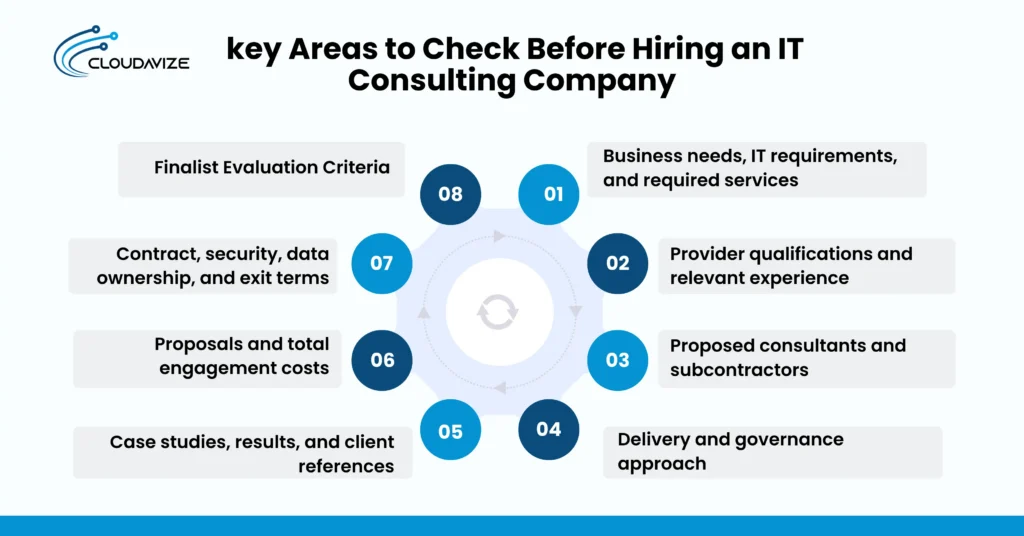
- Business needs, IT requirements, and required services
Confirm that your business problems, technical requirements, project scope, and required IT services are clearly documented. For SMBs, specify deliverables, exclusions, budget limits, timelines, security standards, compliance requirements, and internal resource dependencies. Check that the provider’s discovery findings, proposal, or RFP response reflects these requirements accurately. This documentation gives each prospective technology partner the same baseline and helps small and mid-sized businesses compare proposals consistently.
- Provider qualifications and relevant experience
Check the provider’s technical expertise, industry experience, technology certifications, and relevant partner status. Request evidence of credentials that apply to your project, such as AWS, Microsoft Azure, Google Cloud, cybersecurity, or other platform certifications. For security-sensitive projects, examine applicable evidence such as SOC 2 reports or ISO/IEC 27001 certification. SMBs should also confirm experience with businesses that have comparable technology environments, security requirements, internal resources, and project scope.
- Proposed consultants and subcontractors
Request profiles, relevant certifications, roles, responsibilities, and project experience for the consultants assigned to your engagement. Confirm their availability and identify whether employees, contractors, external specialists, or subcontractors will perform the work. Ask for subcontractor disclosure where applicable and document who remains accountable for delivery, security, and project decisions. Also check the provider’s replacement procedure if a named consultant becomes unavailable.
- Delivery and governance approach
Ask for documentation explaining how the provider manages discovery, project planning, risk, testing, quality assurance, change control, reporting, and project governance. Check performance baselines, KPIs, milestones, acceptance criteria, decision authority, and the escalation matrix. For support or managed services, examine the SLA for response times, resolution targets, availability commitments, and support responsibilities. Training, knowledge transfer, and post-launch support should also have defined ownership.
- Case studies, results, and client references
Request case studies, sample or redacted deliverables, measurable project results, and references from comparable engagements. Check independent feedback on sources such as Clutch, G2, or Google Reviews where relevant. Ask references about timeline performance, budget control, communication, technical problems, scope changes, and user adoption. Compare this feedback with the provider’s stated results and supporting KPIs to confirm whether its experience matches your requirements.
- Proposals and total engagement costs
Check whether each proposal follows the same scope, assumptions, deliverables, and pricing requirements. Review fixed-price, hourly, time-and-materials, milestone-based, retainer, or recurring service fees based on the proposed engagement model. Calculate total costs across consulting, software licensing, infrastructure, third-party services, travel, after-hours support, and maintenance. The pricing schedule should also define payment milestones and the change-order procedure for work outside the agreed scope.
- Contract, security, data ownership, and exit terms
Examine the Master Services Agreement (MSA), Statement of Work (SOW), SLA, confidentiality provisions, security requirements, liability terms, and applicable insurance certificates. Confirm ownership of business data, custom code, configurations, documentation, and other project assets. Check incident notification requirements, data-return procedures, termination clauses, access revocation, transition assistance, and knowledge transfer. Clear exit terms can reduce operational dependency and make a future provider transition easier.
- Finalist Evaluation Criteria
Apply the same weighted evaluation criteria to every qualified IT consulting company. Score factors such as relevant experience, team capability, technical fit, delivery approach, security posture, past performance, total cost of ownership, and contractual risk using consistent definitions and supporting evidence. Record unresolved questions, material risks, and required conditions for each finalist. Document the final selection rationale and approval authority so stakeholders have a clear record of the decision.
What Will Happen After You Hire an IT Consulting Company?
After you hire an IT consulting company, the engagement progresses through onboarding, IT assessment, technology planning, implementation, and performance review. Consultants establish project responsibilities, evaluate existing systems and risks, identify technical gaps, develop a prioritized technology roadmap, and implement approved changes. After deployment, we measure performance against defined business and technical outcomes. The exact timeline varies based on project scope, system complexity, dependencies, required services, and available resources.
The engagement progresses through these five phases:
- Phase 1: Onboarding and Project Kickoff (First Week)
The consulting company will set up administrative protocols, secure required system access, and align project leadership during the first week. Consultants reconfirm your business objectives, project scope, timelines, decision hierarchies, communication channels, and status meeting cadences while acquiring role-based credentials.
- Phase 2: Discovery and IT Assessment (Weeks 1–3)
During weeks 1 through 3, the IT consultants will audit your existing technical infrastructure, software applications, cloud platforms, networks, and workflows. Structured stakeholder interviews identify operational bottlenecks, security risks, and legacy software dependencies to establish baseline metrics for future project success.
- Phase 3: Recommendations and Technology Roadmap (Weeks 3–5)
Between weeks 3 and 5, the consulting firm will present its assessment findings and deliver a prioritized technology roadmap. This comprehensive strategy details critical system risks, high-impact improvement opportunities, specific project milestones, required resources, target completion dates, and budget estimates.
- Phase 4: Implementation, Integration, and Adoption (Timeline Varies)
During implementation, the consultants will execute the approved roadmap through technical configurations, software deployments, cloud migrations, and security hardening. Quality assurance, performance benchmarking, role-based user training, and hands-on change management support ensure operational stability across your organization.
- Phase 5: Performance Review and Ongoing Support (Post-Launch/Ongoing)
After launch, the IT consulting partner will evaluate post-deployment system performance against initial baselines and target business outcomes. Recurring governance reviews track system performance, remaining support issues, and changing technology requirements. For ongoing IT needs, SMBs may transition to an MSP model, where managed IT services provide continuous monitoring, maintenance, security, and technical support without requiring equivalent in-house capabilities.