
Cloudavize is your trusted managed service provider for customized IT solutions and support services, designed to meet all your business needs, ensuring seamless operations, optimal performance, and sustainable growth.
Cloudavize is your trusted managed service provider for customized IT solutions and support services, designed to meet all your business needs, ensuring seamless operations, optimal performance, and sustainable growth.
IT infrastructure forms the backbone of an organization’s technological environment, combining hardware, software, networking, storage, and cloud components that enable business operations and data management. It ensures efficient system performance, secure data handling, and compliance with standards like HIPAA and GDPR. A well-designed infrastructure reduces downtime, supports recovery, and provides a stable base for reliable IT services.
Modern IT infrastructure now includes cloud computing, virtualization, and Infrastructure as Code (IaC) to improve scalability and efficiency. These technologies help automate processes, manage resources dynamically, and reduce capital expenses costs. Hybrid and multi-cloud models, using platforms like AWS, Azure, and Google Cloud, integrate on-premises and cloud systems to enhance flexibility, performance, and resilience across operations.
Optimizing IT infrastructure involves automation, continuous monitoring, and strong cybersecurity practices such as zero-trust frameworks. Regular audits, timely updates, and AI-driven analytics improve performance and reduce risks. By integrating AI, DevOps, and data analytics, organizations can strengthen agility, increase productivity, and ensure their infrastructure continues to support long-term innovation and sustainable growth.
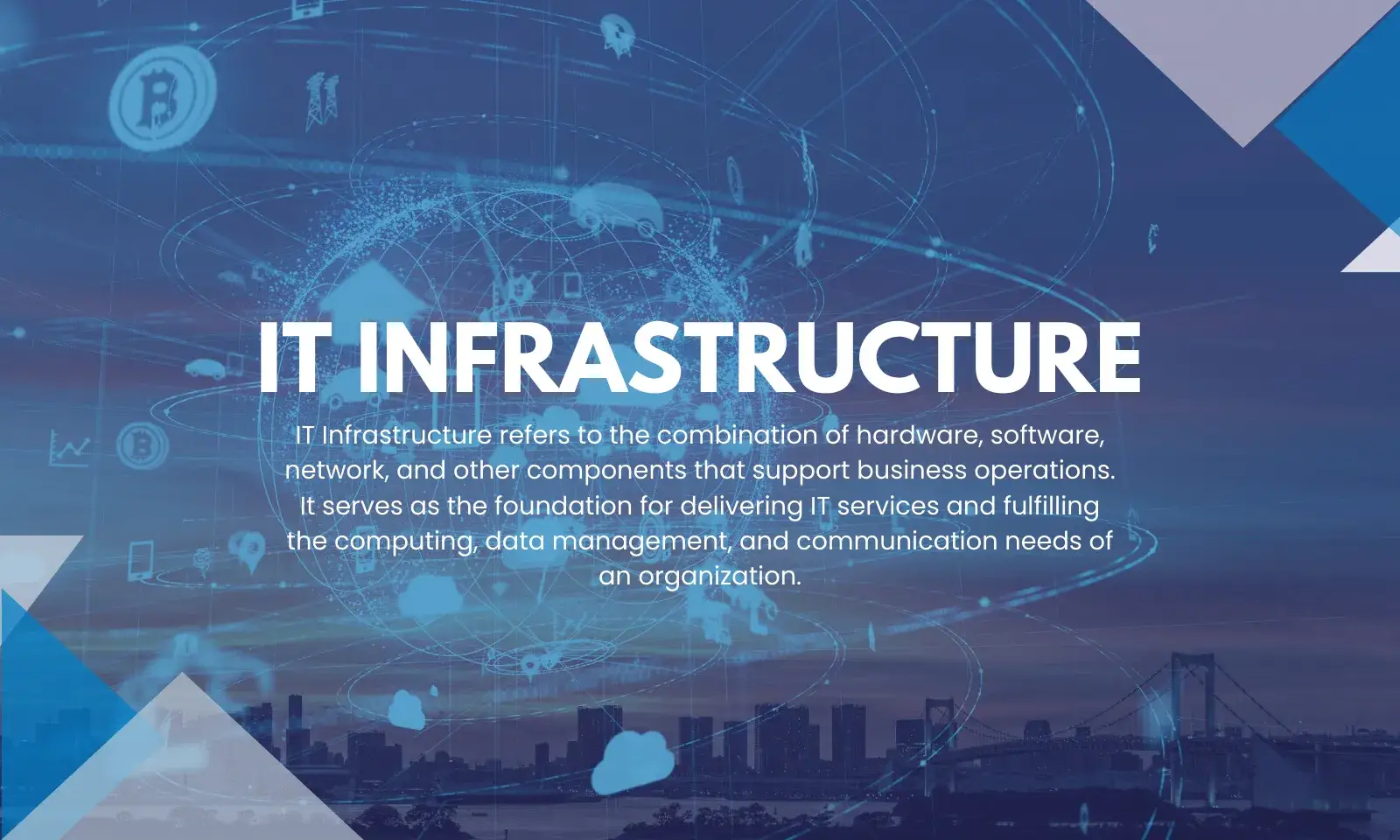
IT Infrastructure refers to the combination of hardware, software, network, and other components that support business operations. It serves as the foundation for delivering IT services and fulfilling the computing, data management, and communication needs of an organization.
A well-architected IT infrastructure is essential for business continuity, security, and efficiency. By powering daily operations, it ensures mission-critical applications run smoothly, minimizes downtime, and enables disaster recovery through backups and failover mechanisms. It integrates security measures like firewalls, encryption, and access control to protect data from cyber threats and adhere to industry-specific regulations like HIPAA and GDPR.
IT infrastructure provides network connectivity, cloud tools, and remote access solutions to enhance communication and collaboration. This allows distributed teams to operate seamlessly across different locations and scale operations without major disruptions.
Likewise, by facilitating automation, cloud computing, virtualization, and Infrastructure as Code (IaC), IT infrastructure enables businesses to scale resources without investing in physical hardware. It helps to improve performance while maintaining cost-effectiveness.
Also, modern IT infrastructure integrates futuristic technologies like AI, big data, and DevOps, which drive digital transformation and innovation. Businesses can leverage these modern techniques to improve productivity, operational agility, and competitiveness and build a strong base for long-term growth and technological advancements.
Types of IT infrastructure include traditional, cloud, and hybrid IT infrastructure. Businesses can choose one of these types based on their operational needs, data management, budget, and scalability requirements.
Each model has unique benefits and challenges, so IT managers must evaluate them based on business needs, cost efficiency, and long-term IT strategy.
| Feature | Traditional | Cloud | Hybrid |
| Deployment | Fully on-premises | Fully cloud-based | Combination of on-premises and cloud |
| Cost | High upfront costs | Pas-as-you-go | Balanced cost model |
| Scalability | Limited by hardware | Highly scalable | Scalable with controlled costs |
| Performance | Predictable, hardware-limited | Dependent on the cloud provider | Optimized for workload distributions |
| Use Cases | Legacy applications, high-security industries | Startups, scalable applications | Enterprises handling large-scale operations |
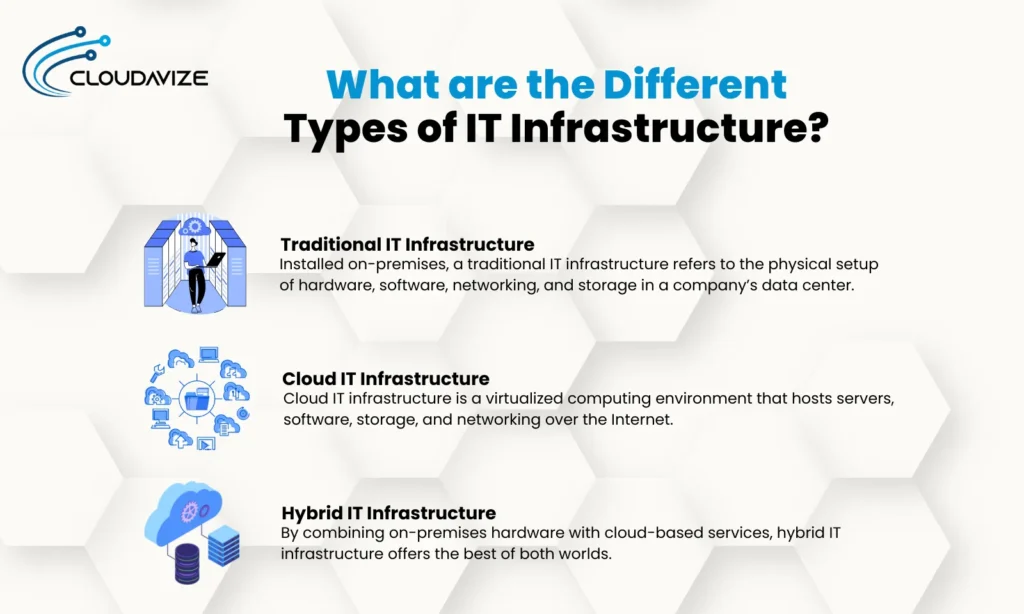
Installed on-premises, a traditional IT infrastructure refers to the physical setup of hardware, software, networking, and storage in a company’s data center.
Owned and managed by companies, this model requires high capital expenditure (CapEx) for physical servers, networking equipment, storage devices, and cybersecurity solutions. It also requires an in-house IT team to manage operations, troubleshoot issues, and ensure infrastructure security. As frequent hardware upgrades are required to meet growing demands with traditional IT infrastructure, they limit the scalability options and require new infrastructure investments.
Because it allows for full control over security, compliance, and system configurations, highly regulated industries like finance, government, and defense prefer the traditional method. This method also favors companies that prioritize data security and customization to safeguard sensitive data and meet regulatory requirements.
Cloud IT infrastructure is a virtualized computing environment that hosts servers, software, storage, and networking over the Internet. It is a fully hosted, on-demand computing model available on cloud platforms like AS, Microsoft Azure, and Google Cloud as Infrastructure as Service (IaaS), Platform as a Service (PaaS), and Software as a Service (SaaS) solutions.
Unlike traditional infrastructure, cloud computing eliminates the need for on-premises hardware, allowing businesses to scale resources according to their needs. Its low upfront costs, fast deployment, and global accessibility features make it ideal for startups and e-commerce businesses. Cloud computing also handles server maintenance, automated updates, and built-in disaster recovery, reducing IT overhead while improving overall IT resilience.
However, since cloud IT infrastructure stores critical information on third-party servers, data security concerns pose a challenge. Another major concern is vendor lock-in, which prevents businesses from migrating from one provider to another.
By combining on-premises hardware with cloud-based services, hybrid IT infrastructure offers the best of both worlds. This model leverages cloud platforms for scalability, flexibility, collaboration, and disaster recovery while storing sensitive data on private servers.
A hybrid model allows companies the flexibility and scalability to handle big data processing, support remote work, and expand globally without relying heavily on a single provider. It also offers multi-cloud operability without the restriction of vendor lock-in. This model provides cost optimization by allowing businesses to use on-site resources for predictable workloads while expanding business with cloud services only when necessary.
However, integrating a hybrid model is complex. IT teams should create a perfect balance between on- and cloud platforms to achieve seamless connectivity, robust security, data synchronization, and resource allocation. To maintain performance and security, businesses must also invest in hybrid cloud networking solutions like VPNs, direct connections, and API integrations.
Key components of IT infrastructure encompass various hardware, software, networking, data storage, cloud security, virtualization, and helpdesk management. These components work together to support an organization’s operations and technology needs.
Likewise, these components are interdependent. For example, servers rely on networking to communicate and securely store data.
Understanding the inter-dependency and role of these crucial components of IT infrastructure is essential for IT managers and system administrators to devise a comprehensive IT strategy.
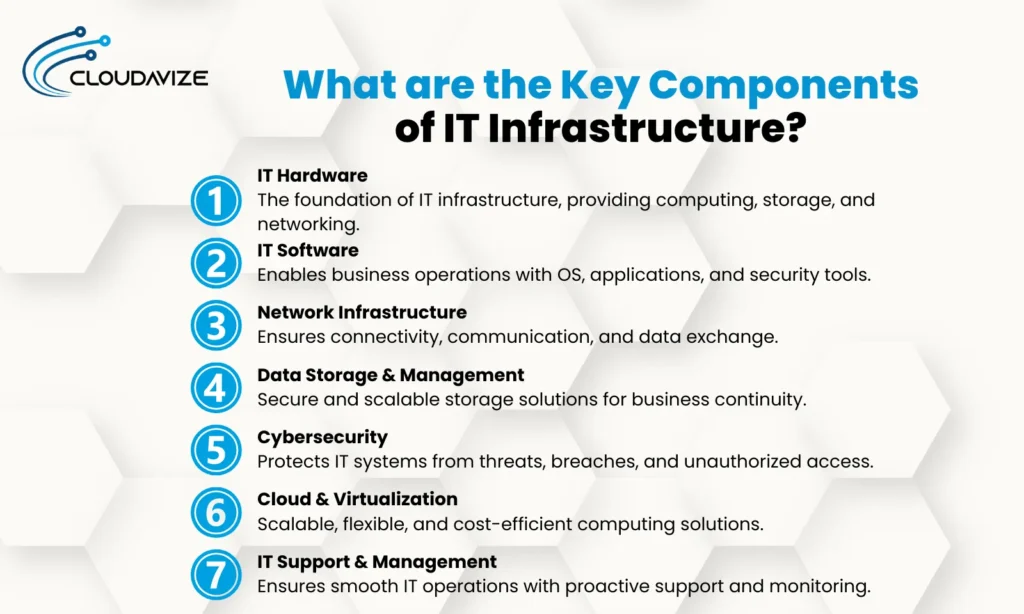
Hardware is the foundation of IT infrastructure. It provides the computing power, storage, and networking capabilities necessary for smooth business operations.
The software enables businesses to run applications, manage databases, and ensure cybersecurity within their IT infrastructure.
A robust network infrastructure ensures connectivity, communication, and data exchange across an organization’s digital ecosystem.
Organizations need efficient data storage solutions that provide secure, accessible, and redundant data management options.
Effective cybersecurity solutions are crucial for protecting IT infrastructure from cyber threats, unauthorized access, and data breaches.
By implementing cloud and virtualization technologies, organizations get flexible, scalable, and cost-efficient computing solutions.
A well-managed IT support service is essential for achieving smooth IT operations, minimal downtime, and proactive security measures.
The different IT infrastructure domains include the User, Workstation, LAN, LAN/WAN, System/Application Storage, and Remote Access Domain. These domains work together to ensure seamless business operations, security, and connectivity. Each domain plays a distinct role in managing users, devices, networks, applications, and remote across.
Understanding the different IT infrastructure domains helps organizations optimize security, streamline workflows, and enhance overall system performance.
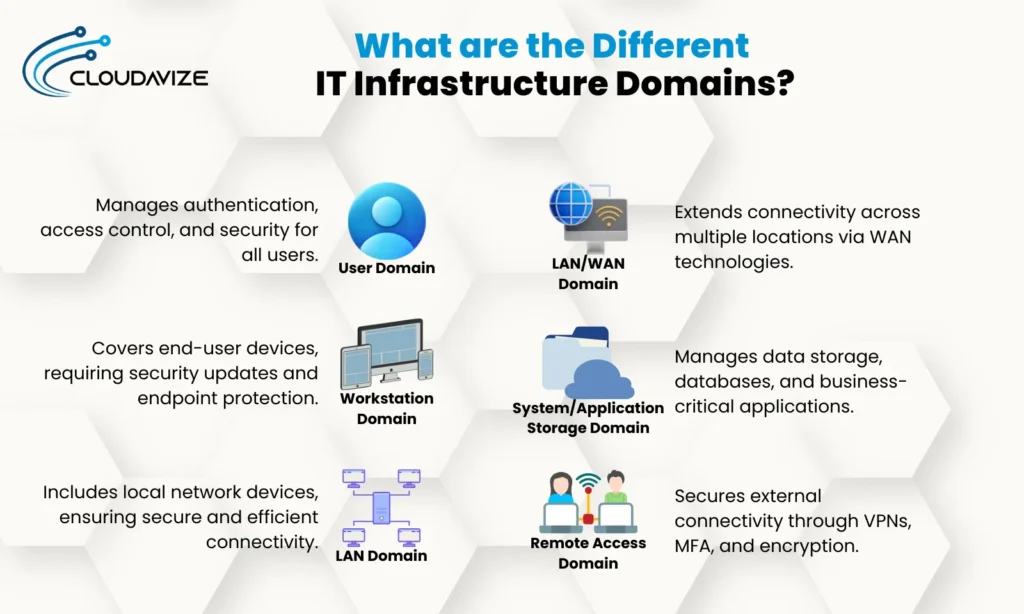
The user domain includes all users (employees, customers, and contractors) who can access an organization’s IT infrastructure. It is responsible for authentication, access control, and security enforcement, ensuring that users only access authorized systems, applications, and data. Effective management of user domains via MFA, RBAC, and endpoint security measures helps prevent insider threats and potential security breaches.
The workstation domain includes desktops, laptops, and other end-user devices used for daily operations. As users rely on workstations to access enterprise applications, databases, and cloud services, the workstation domain becomes crucial for productivity, communication, and business operations. Maintaining security and performance in this domain requires regular software updates, patch management, and endpoint protection to safeguard against malware, phishing, and system vulnerabilities.
The LAN Domain consists of network devices and systems within a specific location, such as an office, data center, or corporate facility. It includes switches, routers, firewalls, and wireless access points, which require proper management to prevent network congestion, data loss, or security vulnerabilities. Effective LAN management involves network segmentation, firewall protection, and continuous monitoring to ensure high-speed communication and data transmission across workstations, servers, printers, and other connected devices.
The LAN/WAN domain extends the network beyond LAN by integrating WAN to connect multiple locations for enterprise-wide connectivity. Organizations utilize leased lines, MLPS, SD-WANSs, and VPNs for efficient and secure data transfer and cloud access between corporate offices, cloud services, and remote teams. They must minimize latency, bandwidth usage, and security risks to maintain network efficiency and cybersecurity.
The system/application storage domain includes all data storage solutions, databases, and application servers responsible for managing business-critical data and applications. Organizations use SAN (Storage Area Networks), NAS (Network-Attached Storage), RAID configurations, and cloud platforms like AWS, Azure, and Google Cloud to ensure data integrity, accessibility, and redundancy for business operations. Implementing backup solutions, disaster recovery plans, and encryption helps protect sensitive data from corruption, loss, and cyber threats.
The remote access domain includes VPNs, RDP, ZTNA, and cloud-based authentication services to ensure secure connectivity to IT systems from external locations, such as their home offices or branch offices. Organizations implement multi-factor authentication (MFA), endpoint security, and encrypted communication channels to prevent unauthorized access and cyber threats while ensuring seamless remote productivity.
IT infrastructure is architected and deployed through a structured process that includes planning, designing, procuring, implementing, and managing IT resources to meet business needs. The process starts with a thorough analysis of business objectives and operational requirements and ends with monitoring and management, which keep the infrastructure secure, efficient, and aligned with evolving business needs.
The crucial steps that determine the architecture and deployment of IT infrastructure are as follows.
To effectively manage and maintain IT infrastructure, the focus should be on continuous monitoring, regular updates, automation, proactive security enforcement, and strategic resource allocation to prevent disruptions and optimize performance. Businesses should leverage AI-driven analytics, cloud management platforms, and automated backup solutions to enhance data integrity, security, scalability, business continuity, and long-term efficiency.
Key strategies that help to manage and maintain IT infrastructure effectively include
Automating IT infrastructure requires using Infrastructure as Code (IaC), configuration management tools, AI-driven operations, and automated security enforcement. Businesses use automation tools (Ansible, Terraform, Puppet), AI and machine learning (AIOps), network management, backups, and security enforcements to reduce manual efforts, enhance efficiency, minimize downtime, and improve overall system resilience.
Here are the key approaches to IT infrastructure automation
Businesses can optimize their IT infrastructure by implementing automation, migrating to the cloud, conducting regular system audits, implementing virtualization, and right-sizing IT resources. Other practices include deploying hybrid and multi-cloud strategies, utilizing zero-trust frameworks, and integrating DevOps and CI/CD pipelines for scalability, agility, and resilience in a rapidly growing digital space.
The top 9 ways businesses can optimize their infrastructure are
The cost considerations for IT infrastructure include a balance between capital expenditure (CapEx) and operational expenditure (OpEx), an evaluation of the cost of on-premises vs. cloud infrastructure, and factors such as hardware, licensing, maintenance, and security. Organizations should implement the right optimization strategies to maximize performance, security, and ROI while maintaining a flexible IT environment.
On-premises infrastructure requires high upfront investment (CapEx), while cloud infrastructure operates on a pay-as-you-go model (OpEx), reducing initial costs.
Traditional IT setups demand higher maintenance costs, security investments, and hardware upgrades, whereas cloud management services offer scalability, automated updates, and lower maintenance costs.
Businesses must account for software licenses, subscription fees, security updates, and ongoing IT support, which vary based on vendor agreements and infrastructure type.
Whether on-premises or cloud-based, organizations must invest in firewalls, intrusion detection systems (IDS), compliance frameworks, and data encryption to protect enterprise assets.
Techniques like server consolidation, virtualization, and optimized cloud pricing models help reduce resource waste and improve efficiency.
The IT infrastructure field offers career opportunities for professionals in application, cloud computing, cybersecurity, databases, IT management, networking, and system administration. These roles involve deploying, securing, optimizing, and maintaining critical IT environments, ensuring seamless business operations, data security, and scalability.
Businesses should consider outsourcing IT infrastructure when they need to reduce operational costs, access specialized experts, and scale IT resources without investing in on-premises infrastructure. Outsourcing is also beneficial for SMBs that want to simplify management, lack in-house IT capabilities, require continuous monitoring, experience talent scarcity, or long for investment in core business functions instead of managing IT operations.
Below are the key scenarios where businesses should seek a third-party vendor to outsource IT infrastructure
Real-world examples of IT infrastructure highlight successful cloud migrations, hybrid cloud implementations, and key lessons learned from past challenges. Many organizations leverage Managed Service Providers (MSPs) to streamline these transitions, ensuring scalability, security, and operational efficiency. Below are case studies showcasing how businesses have optimized their IT infrastructure.
Phillips 66, a global energy company, successfully transferred over 300 terabytes of data in less than a month, reducing storage costs by 80%. This migration not only streamlined operations but also provided a scalable and secure environment for its enterprise applications.
The Y2K incident, or Millennium Bug, exposed the need for proactive IT management. Fearing system failures in 2000, governments and businesses invested £300 billion globally to prevent disruptions. Their efforts avoided major failures, highlighting the importance of risk assessment and regular system updates.
Accenture embarked on a three-year journey to transition its IT infrastructure to a hybrid cloud model. By integrating private and public cloud solutions, from 2015 to 2018, the company realized over US$20 million in savings, with an additional US$2 million saved in 2020, while hosting all business-critical systems in the cloud.
In 2017, Evernote migrated over 3 petabytes of data, including 5 billion notes and 5 billion attachments, to the Google Cloud Platform in 70 days to improve performance, security, and scalability. The move reduced infrastructure management, allowing Evernote to focus on customers while enhancing uptime, encryption, and faster feature deployment.
Capital One migrated to AWS over eight years and closed eight on-premises data centers to improve scalability, security, and efficiency. This transition enabled instant infrastructure provisioning, a 70% reduction in disaster recovery times, and 50% fewer transaction errors while enhancing customer-focused innovation.
The future of IT infrastructure will be shaped by automation, AI-driven security, edge computing, blockchain, and cloud management advancements. In the upcoming years, businesses will increase their dependency on hybrid and multi-cloud environments and leverage AI-powered cloud management to enhance efficiency, scalability, and cost optimization.
Emerging technologies like AI, quantum computing, and 5G are revolutionizing IT infrastructure operations. AI-driven automation for real-time system monitoring, predictive analytics, and security allows businesses to reduce downtime and proactively fix vulnerabilities. Quantum computing will change data encryption and complex calculations, and 5G will drive fast, low-latency communication to enable IoT, cloud, and edge processing.
Over the next decade, IT infrastructure will become more software-defined, cloud-native, and self-healing. As businesses focus on sustainability and compliance, we will see more investment in energy-efficient data centers, zero-trust frameworks, and AI-powered IT operations. These advancements will pave the path for a more intelligent, scalable, and secure IT ecosystem where automation, cloud, and AI-driven security work together to meet the future.