
12 Common Types of Cybersecurity
A data breach costs U.S. businesses an average of $10.22 million, and most go undetected for 241 days before they are fully contained (IBM Cost of a Data Breach Report 2025). By the time a breach is discovered, attackers have typically moved laterally across systems, compromised credentials, and extracted sensitive data, and the visible damage is rarely the full extent of it.
Organizations faced an average of 1,968 cyberattacks per week in 2025, an 18% year-over-year increase driven by AI-automated phishing, polymorphic malware, and an expanding attack surface across cloud, mobile, IoT, and remote work infrastructure (Check Point 2026 Cyber Security Report). No single security control can cover all of these threat surfaces.
Cybersecurity addresses this by securing every surface attackers target, from networks and cloud environments to endpoints, mobile devices, and AI systems, so organizations can detect, contain, and respond to threats before the damage becomes irreversible. Each type of cybersecurity focuses on a specific threat surface while working in coordination with the others to protect sensitive information, prevent malware and ransomware, manage user access, and defend emerging technologies like AI.
The 12 most common types of cybersecurity every organization should know are listed below.
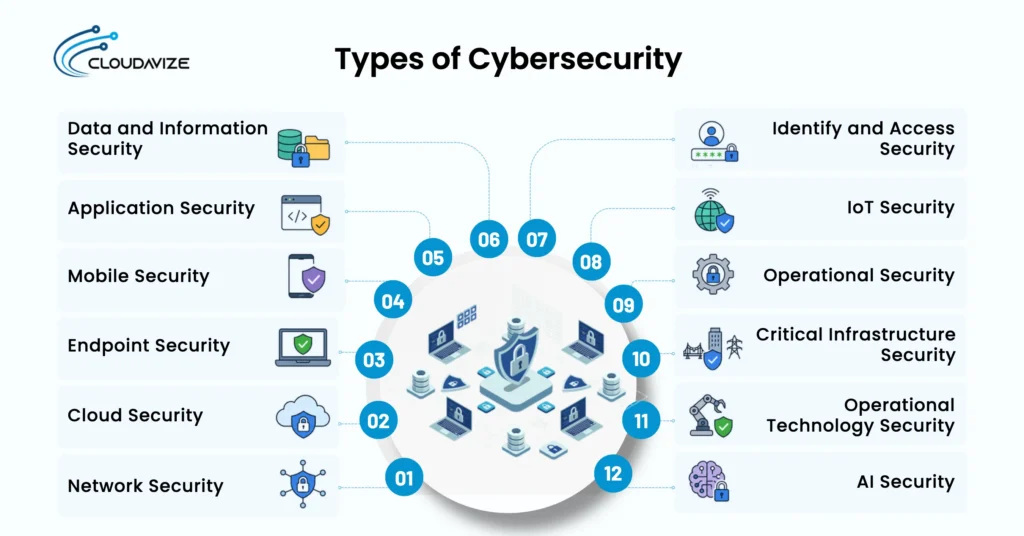
- Network Security
- Cloud Security
- Endpoint Security
- Mobile Security
- Application Security
- Data and Information Security
- Identity and Access Security
- IoT Security
- Operational Security
- Critical Infrastructure Security
- Operational Technology Security
- AI Security
Quick Comparison: 12 Types of Cybersecurity
| Cybersecurity Type | What It Protects | Primary Threats | Common Security Controls |
| Network Security | Business networks and traffic | Unauthorized access, malware, DDoS | Firewalls, IDS/IPS, VPNs, ZTNA, NAC |
| Cloud Security | Cloud applications, data, and infrastructure | Misconfigurations, credential theft, ransomware | IAM, MFA, CSPM, CASB, CWPP |
| Endpoint Security | Laptops, desktops, servers, and workstations | Malware, ransomware, compromised devices | EDR, XDR, antivirus, patch management |
| Mobile Security | Smartphones and tablets | Malicious apps, spyware, device theft | MDM, MFA, encryption, MTD |
| Application Security | Web, desktop, and mobile applications | SQL injection, XSS, insecure APIs | SSDLC, SAST, DAST, WAF, penetration testing |
| Data & Information Security | Sensitive business and customer data | Data breaches, unauthorized access, data leakage | Encryption, DLP, RBAC, backups |
| Identity & Access Security | User accounts and system access | Credential theft, insider threats, account takeover | MFA, SSO, PAM, RBAC, ITDR |
| IoT Security | Connected devices and sensors | Botnets, insecure firmware, unauthorized access | Device inventory, segmentation, firmware updates |
| Operational Security | Daily business processes and operations | Human error, social engineering, insider misuse | Security policies, monitoring, incident response |
| Critical Infrastructure Security | Essential services (energy, healthcare, water, transportation) | Nation-state attacks, ransomware, SCADA attacks | Network segmentation, monitoring, compliance |
| Operational Technology (OT) Security | Industrial control systems and manufacturing equipment | ICS attacks, ransomware, operational disruption | OT monitoring, segmentation, industrial threat detection |
| AI Security | AI models, machine learning systems, and training data | Prompt injection, model theft, data poisoning | AI governance, model testing, access controls |
- Network Security
Network security is a type of cybersecurity that protects the integrity, confidentiality, and availability of business networks from unauthorized access and cyberattacks. It combines hardware, software, policies, and processes to secure internet connections, internal and wireless networks, and traffic flows using a defense-in-depth approach where multiple layers work together to reduce risk.
The 2024 Salt Typhoon campaign demonstrated the cost of network-level failures. Chinese state-backed hackers infiltrated AT&T, Verizon, and T-Mobile, accessing call metadata, geolocation data, and audio recordings undetected for months. In early 2025, UNC3886 exploited a Juniper Networks zero-day to install multiple ‘TINYSHELL’ backdoor variants on enterprise routers, monitoring traffic and pivoting across networks without triggering alerts. Defending against these threats requires multiple layers of network protection working together.
Key components of network security include:
- Firewalls: Filter incoming and outgoing traffic based on security rules to block unauthorized access.
- VPNs and Encryption: Create encrypted connections between users, devices, and business networks to secure data in transit.
- Zero Trust Network Access (ZTNA): Verifies the identity and authorization of every user and device before granting access, regardless of network location.
- Intrusion Detection and Prevention Systems (IDS/IPS): Monitor network traffic to detect and automatically block suspicious or malicious activity.
- Network Detection and Response (NDR): Uses behavioral analytics and machine learning to identify threats that bypass traditional perimeter controls.
- SIEM (Security Information and Event Management): Aggregates log data from firewalls, IDS/IPS, and endpoints into a single view for faster threat detection.
- SOAR (Security Orchestration, Automation, and Response): Automates alert triage, threat enrichment, and incident response workflows to reduce response time.
- Network Access Control (NAC): Enforces security policies on connecting devices, verifying compliance before granting access.
- Cloud Security
Cloud security protects cloud-based applications, data, workloads, and infrastructure from unauthorized access, cyberattacks, and data breaches. As businesses rely on cloud platforms to store sensitive information and run critical applications, strong cloud security helps maintain data confidentiality, ensure service availability, and reduce the risk of cloud-related security incidents.
In the 2024 Snowflake breach, attackers used infostealer-harvested credentials to access customer tenants that lacked MFA. Over 165 organizations were compromised, including AT&T, Ticketmaster, and Santander, exposing data on 500+ million individuals. Snowflake’s own infrastructure was never breached; the failure was purely credential-based access without multi-factor authentication.
Cloud environments face a range of threats that exploit misconfigurations, weak credentials, and shared responsibility gaps. Common cloud security threats include:
- Malware: Infects cloud workloads, virtual machines, or storage to steal data or disrupt services.
- Phishing: Targets cloud account credentials through fraudulent emails or websites, giving attackers access to cloud platforms.
- Ransomware: Encrypts cloud-hosted files or synchronized data and demands payment to restore access.
- Insider Threats: Employees, contractors, or third parties who intentionally or accidentally misuse cloud access, exposing confidential data.
- DDoS Attacks: Overwhelm cloud-hosted applications with malicious traffic, disrupting availability.
Mitigating these threats requires cloud-native security controls designed for multi-tenant and hybrid environments. Key cloud security controls include Cloud Security Posture Management (CSPM) for detecting misconfigurations, Cloud Access Security Brokers (CASB) for enforcing security policies across SaaS applications, Cloud Workload Protection Platforms (CWPP) for securing workloads across multi-cloud environments, and Identity and Access Management (IAM) with enforced MFA for controlling who can access cloud resources.
- Endpoint Security
Endpoint security protects individual devices, such as laptops, desktops, smartphones, tablets, and workstations, that connect to a business network. Because these devices often serve as entry points for cyberattacks, endpoint security prevents unauthorized access, malware infections, and data breaches before they spread across the network.
The 2024 Change Healthcare ransomware attack started at a single endpoint. Attackers used stolen credentials to access a remote desktop portal that lacked multi-factor authentication, then moved laterally through the network for nine days before deploying ALPHV/BlackCat ransomware. The breach affected 192.7 million individuals, disrupted pharmacy and claims processing nationwide, and cost UnitedHealth Group over $2.457 billion. Preventing endpoint-level compromises requires security tools that go beyond traditional antivirus.
Modern endpoint security relies on technologies that extend beyond traditional antivirus:
- Endpoint Protection Platform (EPP): Scans files, detects known threats, and blocks malware or ransomware before it infects the device.
- Endpoint Detection and Response (EDR): Continuously monitors endpoint activity, detects suspicious behavior, and provides tools for incident response and threat hunting.
- Extended Detection and Response (XDR): Correlates threat data across endpoints, networks, cloud workloads, and email into a unified detection and response layer.
- Automated Patch Management: Identifies and applies security updates across all endpoints to close known vulnerabilities before attackers exploit them.
- Device Encryption: Protects data stored on endpoints from unauthorized access if devices are lost, stolen, or physically compromised.
- Mobile Security
Mobile security protects smartphones, tablets, and other portable devices from cyber threats, unauthorized access, and data loss. As employees increasingly use mobile devices to access business applications, cloud services, and corporate networks, securing these devices is essential for protecting sensitive information and maintaining business productivity.
In early 2025, Meta confirmed a zero-click attack on WhatsApp targeting around 100 journalists and civil society members using Paragon Solutions’ Graphite spyware, which accessed devices without user interaction to read encrypted messages, monitor calls, and track locations. Separately, Lookout’s 2024 report found mobile devices increasingly serve as initial compromise points, with Chinese APT groups deploying BadBazaar spyware through messaging apps like Telegram for surveillance.
Protecting mobile devices across a distributed workforce requires controls that cover device management, authentication, and threat detection. Key mobile security practices include:
- Mobile Device Management (MDM): Centrally manages devices, enforces security policies, and enables remote lock or wipe of lost or stolen devices.
- OS and App Updates: Patches known vulnerabilities by keeping iOS, Android, and installed applications current.
- Device Encryption: Encrypts stored data to prevent unauthorized access to sensitive business information if a device is compromised.
- App Permission Controls: Restricts access to cameras, microphones, location, contacts, and files to only trusted, verified applications.
- VPN for Public Networks: Protects data from interception when connecting to unsecured public Wi-Fi.
- Strong Authentication: Combines multi-factor authentication (MFA), biometric verification, and strong passwords to secure access to business applications and cloud services.
- Mobile Threat Defense (MTD): Detects mobile-specific threats such as malicious apps, network attacks, and OS-level exploits in real time.
- Application Security
Application security is a cybersecurity practice that protects software applications from vulnerabilities, unauthorized access, and cyberattacks throughout the software development lifecycle (SDLC). Since web, mobile, desktop, and cloud applications process sensitive business and customer data, securing them is essential to prevent data breaches, maintain application availability, and protect organizational assets.
Cl0p exploited a SQL injection zero-day in Progress Software’s MOVEit file transfer tool, compromising 2,700+ organizations and exposing 95+ million individuals, with $15B+ in collective remediation costs. Over 80% of victims were hit through third-party vendors, not direct MOVEit usage. The attack established managed file transfer software as a high-value attack surface and validated Cl0p’s mass exploitation model.
Applications face persistent threats that exploit coding flaws, weak authentication, and insecure integrations. Common application security threats include:
- SQL Injection (SQLi): Attackers insert malicious queries into application inputs to access, modify, or delete sensitive database information.
- Cross-Site Scripting (XSS): Malicious scripts injected into web pages steal user credentials, session cookies, or other sensitive data.
- Insecure APIs: Poorly protected application programming interfaces expose sensitive information or allow unauthorized access to application functions.
- Broken Authentication and Access Control: Weak authentication or misconfigured permissions enable attackers to access user accounts and protected resources.
Reducing application-level risk requires security practices embedded throughout the development lifecycle. Key application security practices include: - Secure Software Development Lifecycle (SSDLC): Integrates security into every stage, from planning and development to testing, deployment, and maintenance.
- Static and Dynamic Security Testing (SAST/DAST): Analyzes source code and tests running applications to identify vulnerabilities before release.
- Software Composition Analysis (SCA): Scans third-party libraries and open-source components for known vulnerabilities and outdated dependencies.
- Web Application Firewalls (WAF): Filters and monitors HTTP traffic between web applications and the internet, blocking common exploits like SQLi and XSS.
- Penetration Testing: Simulates real-world cyberattacks to identify exploitable weaknesses before malicious actors can reach them.
- Data and Information Security
Data and information security protects sensitive business data from unauthorized access, disclosure, alteration, or destruction throughout its lifecycle. It safeguards structured and unstructured information stored on servers, endpoints, cloud platforms, databases, and backup systems.
The 2024 National Public Data breach exposed 2.9 billion records, including SSNs, names, addresses, and phone numbers, all stored in plain unencrypted text. The data broker even published backend database passwords in a publicly accessible file. The resulting lawsuits forced a Chapter 11 bankruptcy filing, making it a case study in the consequences of absent basic security controls like encryption and access management. Preventing data exposure at this scale requires controls that protect information across its full lifecycle.
Key data and information security measures include:
- Data Encryption: Encrypts data at rest and in transit, ensuring only authorized users with correct decryption keys can access sensitive information.
- Access Controls: Uses role-based access control (RBAC), least-privilege principles, and multi-factor authentication (MFA) to limit data access to authorized users.
- Data Classification: Categorizes information by sensitivity level, such as public, internal, confidential, or restricted, so organizations apply appropriate controls to each tier.
- Data Loss Prevention (DLP): Monitors and prevents unauthorized sharing, transfer, or leakage of sensitive information across email, cloud services, endpoints, and removable media.
- Backup and Recovery: Maintains secure, tested backups to protect against ransomware, accidental deletion, and hardware failure.
- Database Activity Monitoring (DAM): Tracks and audits database queries and access patterns in real time to detect unauthorized activity or policy violations.
- Identity and Access Security
Identity and access security determines who can reach business systems, applications, networks, and sensitive data, and under what conditions. It verifies user identities before granting access and ensures employees, contractors, and third parties can only reach resources required for their roles. Effective identity and access security reduces the risk of unauthorized access, credential theft, insider threats, and account compromise.
The 2024 Midnight Blizzard attack began when Russian state-sponsored attackers password-sprayed a legacy Microsoft test account lacking MFA, then exploited a legacy OAuth application to access senior leadership, cybersecurity, and legal team mailboxes. The breach went undetected for over a month. By March, attackers had also accessed source code repositories, increasing attack volume tenfold. Preventing identity-based attacks requires controls that verify, restrict, and monitor access at every level.
Key identity and access security controls include:
- Multi-Factor Authentication (MFA): Requires two or more verification factors, such as a password, biometric scan, or one-time code, before granting access.
- Role-Based Access Control (RBAC): Grants access based on job responsibilities, ensuring employees receive only the permissions necessary for their work.
- Single Sign-On (SSO): Allows users to securely access multiple business applications with a single set of credentials, simplifying authentication management.
- Least Privilege Access: Limits permissions to the minimum level required, reducing the impact of compromised accounts and insider misuse.
- Privileged Access Management (PAM): Secures, monitors, and audits access to critical systems by administrators and high-privilege users.
- Identity Threat Detection and Response (ITDR): Monitors identity infrastructure for credential misuse, privilege escalation, and account takeover attempts in real time.
- IoT Security
IoT security protects Internet of Things devices, connected systems, and the data they exchange from unauthorized access, cyberattacks, and operational disruption. With over 19.8 billion IoT devices online in 2025 and one in three breaches now involving an IoT device (Verizon 2024 DBIR), securing them is essential for maintaining operational continuity and protecting sensitive information.
Healthcare saw 181 confirmed ransomware attacks in 2024, affecting 25.6 million records with average demands of $5.7 million. Another 42 attacks on non-direct-care organizations compromised 115+ million records. IoT-connected medical devices remain key entry points due to outdated firmware and poor segmentation. Broader IoT malware surged 124% year over year, with botnets like Aisuru compromising 700,000 devices for DDoS attacks exceeding 29 Tbps. Securing IoT environments requires controls that account for device diversity, limited processing power, and expanded network exposure.
Key IoT security controls include:
- Network Segmentation: Isolates IoT devices from corporate IT systems, preventing compromised devices from becoming lateral entry points.
- Firmware and Patch Management: Identifies connected devices and applies security updates to close known vulnerabilities in IoT firmware and software.
- Strong Authentication: Replaces default credentials with unique passwords and enforces MFA for device management access.
- Encryption: Protects data collected, processed, and transmitted by IoT devices from interception or tampering.
- Continuous Monitoring: Tracks IoT device behavior and network traffic to detect anomalies, unauthorized connections, or signs of compromise.
- IoT Device Discovery and Inventory: Maintains a real-time catalog of all connected devices to eliminate shadow IoT and ensure security coverage across the full device population.
- Operational Security
Operational security focuses on an organization’s day-to-day operations by controlling how critical systems, data, and business processes are accessed, handled, and monitored. It reduces operational risks through security policies, user permissions, continuous monitoring, and secure operational practices.
The 2023 MGM Resorts attack demonstrated how a single social engineering call can shut down a $34 billion company. Scattered Spider impersonated an employee using LinkedIn data to obtain credentials from MGM’s help desk, then deployed ALPHV/BlackCat ransomware across 100+ ESXi hypervisors, disabling slot machines, room keys, and reservation systems across 29 properties for ten days. The breach cost MGM ~$100 million and triggered multiple class-action lawsuits. Preventing operational failures like these requires disciplined controls across people, processes, and systems.
Key areas of operational security include:
- Access Management: Controls who can access business systems, applications, and sensitive information using least-privilege access and approval workflows.
- Data Handling: Establishes procedures for securely collecting, storing, sharing, and disposing of business and customer data to prevent unauthorized disclosure.
- System Monitoring: Continuously monitors networks, endpoints, and user activity to detect suspicious behavior and respond to incidents quickly.
- Change Management: Verifies and approves system updates, software changes, and configuration modifications before implementation to reduce operational risks.
- Incident Response: Defines procedures for identifying, containing, investigating, and recovering from cybersecurity incidents to minimize business disruption.
- Employee Security Awareness: Trains employees and help desk staff to recognize phishing, social engineering, vishing, and other operational security threats, and to follow verification procedures before granting access or resetting credentials.
- Critical Infrastructure Security
Critical infrastructure security protects essential systems like energy, water, healthcare, transportation, and telecommunications from cyberattacks, sabotage, and operational disruption. These sectors are increasingly interconnected through industrial control systems, SCADA networks, and IoT devices, expanding the attack surface. Compromise of these sectors can cascade into public safety risks, economic disruption, and widespread service failures.
In 2021, DarkSide ransomware entered Colonial Pipeline through a compromised VPN password on an inactive account lacking MFA, forcing a six-day shutdown of 5,500 miles of pipeline supplying 45% of East Coast fuel. The disruption triggered a presidential emergency and regional fuel shortages. Colonial paid $4.4 million in ransom, and the attack remains the most significant publicly disclosed cyberattack on U.S. critical infrastructure.
Critical infrastructure faces a range of targeted threats that exploit both digital and physical vulnerabilities. Common risks to critical infrastructure include:
- Targeted Cyberattacks: Nation-state actors, cybercriminals, and hacktivist groups attempting to disrupt essential services or access critical systems.
- Ransomware: Encryption of operational systems or critical data that interrupts essential services and delays recovery.
- ICS/SCADA Attacks: Exploitation of vulnerabilities in industrial control systems and supervisory control and data acquisition environments to disrupt physical operations.
- Supply Chain Attacks: Compromised vendors, software, or service providers introducing security risks into critical infrastructure operations.
Defending critical infrastructure requires controls tailored to the operational and regulatory demands of essential services. Key critical infrastructure security controls include: - Network Segmentation: Isolates operational systems from corporate IT networks to limit the spread of cyber threats.
- Continuous Monitoring: Detects suspicious activity across critical systems for rapid threat detection and response.
- Access Controls: Restricts access to critical assets using RBAC, least privilege, and MFA.
- Incident Response and Recovery Planning: Establishes procedures to contain incidents, restore operations, and maintain essential services during security events.
- Sector-Specific Compliance: Aligns security programs with frameworks such as NIST CSF, NERC CIP (energy), and TSA Security Directives (pipelines and transportation).
- Operational Technology Security
Operational technology (OT) security protects the hardware, software, and communication systems used to monitor and control industrial operations. It secures manufacturing equipment, industrial control systems (ICS), supervisory control and data acquisition (SCADA) systems, programmable logic controllers (PLCs), and other connected machinery.
Attacks on OT environments are accelerating. In 2024, sites suffering physical operational impairment from cyberattacks rose 146% to 1,015 (Waterfall Security 2024 Threat Report). U.S. water utilities became primary targets, with hackers remotely disabling SCADA-controlled pumps in Muleshoe, Texas, and HMI screens in Aliquippa, Pennsylvania. CISA’s 2025 assessment found 400+ water SCADA interfaces exposed to the internet, many with default credentials. Ransomware attacks on industrial operators increased 46% from Q4 2024 to Q1 2025 (2025 Honeywell Cyber Threat Report). Protecting OT environments requires industrial-specific controls that account for legacy systems, safety constraints, and continuous uptime requirements.
Key operational technology security measures include:
- Network Segmentation: Separates OT networks from corporate IT systems to prevent cyber threats from reaching industrial environments.
- Real-Time Monitoring: Continuously monitors industrial systems and network traffic to detect abnormal activity, equipment failures, or potential cyberattacks.
- Access Controls: Restricts access to OT systems using role-based permissions, least privilege, and MFA.
- Asset Inventory and Patch Management: Identifies all connected OT devices and applies security updates where operationally appropriate to mitigate known vulnerabilities.
- Incident Response Planning: Establishes procedures to detect, contain, and recover from cyber incidents while minimizing disruption to industrial processes.
- OT-Specific Threat Detection: Deploys industrial-grade monitoring tools such as Dragos, Claroty, or Nozomi Networks that understand OT protocols (Modbus, DNP3, OPC) and can detect anomalies traditional IT security tools miss.
- AI Security
AI security protects artificial intelligence systems, machine learning models, algorithms, and their data from cyber threats, manipulation, and unauthorized access. IBM’s 2025 Cost of a Data Breach Report found that 13% of organizations experienced breaches involving AI models or applications, while 97% lacked proper AI access controls.
The threat landscape for AI systems is expanding rapidly. Between January and March 2026, over 1,184 malicious AI agent skills were distributed through ClawHub, installing stealer malware on developer machines. OWASP ranks prompt injection as the #1 LLM vulnerability for two consecutive years, and the 2025 International AI Safety Report found attackers succeed roughly half the time at bypassing safeguards within ten attempts.
AI systems face a growing range of threats that target training data, model behavior, and deployment pipelines. Common risks to AI systems include:
- Data Poisoning: Attackers manipulate training data to influence model behavior, causing inaccurate predictions or biased outcomes. Research shows as few as 250 malicious documents can alter model behavior.
- Adversarial Attacks: Carefully crafted inputs deceive AI models into incorrect decisions without changing the underlying system.
- Model Theft: Unauthorized extraction or copying of proprietary AI models, algorithms, or intellectual property.
- Prompt Injection: Attackers exploit AI inputs to bypass safeguards, reveal sensitive data, or control model behavior, now targeting RAG pipelines, AI agents, and MCP tool integrations.
- Shadow AI: Employees deploy unsanctioned AI tools without security review, creating unmonitored access points to business data.
Mitigating these risks requires security practices designed specifically for AI development and deployment. Key AI security practices include:- Data Validation: Verifies quality, integrity, and authenticity of training and input data, including provenance tracking for all datasets.
- Access Controls: Restricts access to AI models, datasets, and development environments using RBAC and MFA.
- Continuous Monitoring: Tracks AI system activity, model performance, and behavioral drift to detect threats or degradation.
- Model Testing and Red Teaming: Evaluates models for vulnerabilities, bias, and resilience through adversarial testing and penetration exercises.
- AI Governance: Establishes policies for deployment approval, data usage, output validation, and compliance with emerging regulations such as the EU AI Act.
How Does Cybersecurity Protect Start-Up Businesses From Cyberattacks?
Cybersecurity protects start-ups by securing cloud and SaaS environments, enforcing identity and access controls, protecting endpoints, training employees against social engineering, and encrypting and backing up critical data before the business scales. Start-ups are especially vulnerable due to small teams, shared devices, and heavy SaaS reliance. CISA, SBA, and FCC guidance recommends baseline controls even for early-stage businesses to protect customer data and avoid incidents that shut down operations before gaining traction.
Key cybersecurity priorities for start-ups include:
- Cloud Security: Secure SaaS applications, cloud storage, and collaboration platforms with enforced MFA, access controls, and proper configuration since cloud tools are typically a start-up’s primary infrastructure.
- Identity and Access Management: Implement strong passwords, MFA, and role-based access from day one to prevent credential-based attacks across shared accounts and third-party tools.
- Endpoint Security: Protect employee laptops and personal devices with antivirus, EDR, and automated patching, especially in BYOD environments where company and personal use overlap.
- Employee Security Awareness: Train small teams to recognize phishing, social engineering, and unsafe downloads, where a single compromised employee can expose the entire business.
- Data Encryption and Backup: Encrypt sensitive customer and business data and maintain regular backups to recover from ransomware or accidental data loss without paying a ransom.
How Does Cybersecurity Protect Small Businesses From Cyberattacks?
Cybersecurity protects small businesses by securing networks, managing endpoints, enforcing access policies, encrypting regulated data, maintaining backup and recovery, and delivering ongoing security awareness training. Small businesses typically have established networks, multiple locations, customer databases, and payment systems that expand the attack surface. The Verizon 2025 DBIR found SMBs experienced four times more breaches than large organizations, with ransomware in 88% of cases, while IBM reports average breach costs for firms under 500 employees at $3.31 million. FCC, CISA, and FFTC guidance recommends layered controls matching operational complexity and compliance obligations.
Key cybersecurity priorities for small businesses include:
- Network Security: Protect internet connections, internal networks, and Wi-Fi with firewalls, intrusion prevention, and network monitoring to control access across office and remote environments.
- Endpoint Security and Device Management: Secure all company-owned and employee devices with EDR, automated patching, and centralized device management to maintain visibility across a distributed workforce.
- Identity and Access Management: Enforce MFA, RBAC, and least-privilege access across business applications, especially as employee count grows and turnover introduces access management risks.
- Cloud and Data Encryption: Encrypt customer payment data, financial records, and business-critical information to meet PCI DSS, HIPAA, or other regulatory requirements that apply as the customer base expands.
- Backup and Disaster Recovery: Maintain automated, tested backups with documented recovery procedures to restore systems quickly after ransomware, hardware failures, or accidental data loss.
- Employee Security Awareness Training: Deliver ongoing training, not just onboarding sessions, to help employees recognize evolving threats like business email compromise, invoice fraud, and social engineering.
How Does Cybersecurity Protect Midsize Businesses From Cyberattacks?
Cybersecurity protects midsize businesses by centralizing security operations, securing endpoints and servers, enforcing identity governance, managing encryption and compliance, maintaining formal incident response plans, and assessing vendor and third-party risk across regulatory frameworks. Midsize businesses manage larger networks, more endpoints, multi-jurisdictional regulatory exposure, and higher-value data that attracts targeted attacks. CISA and FCC recommend a layered approach with centralized visibility and formal incident response capabilities to reduce cyber risks at this scale.
Key cybersecurity priorities for midsize businesses include:
- Security Operations and Monitoring: Deploy SIEM or managed detection and response (MDR) to aggregate logs from endpoints, networks, cloud environments, and identity systems into a centralized view for continuous threat detection and faster incident response.
- Endpoint and Server Security: Protect laptops, desktops, mobile devices, and on-premises or cloud servers with EDR, automated patch management, and device compliance policies enforced across the organization.
- Access Controls and Identity Governance: Manage user lifecycles, enforce MFA, implement privileged access management (PAM), and conduct regular access reviews to prevent credential sprawl and insider threats across a growing workforce.
- Encryption, Compliance, and Data Protection: Implement encryption, DLP, and data classification policies aligned with regulatory requirements such as GDPR, HIPAA, PCI DSS, or SOC 2, and maintain audit readiness through documented controls and regular assessments.
- Incident Response Planning: Maintain a formal, tested incident response plan with defined roles, communication procedures, and recovery time objectives to minimize business disruption during a security event.
- Vendor and Third-Party Risk Management: Assess the security posture of vendors, SaaS providers, and supply chain partners that access business systems or handle sensitive data, since third-party compromise is a leading attack vector for midsize organizations.
How Do Different Types of Cybersecurity Work Together?
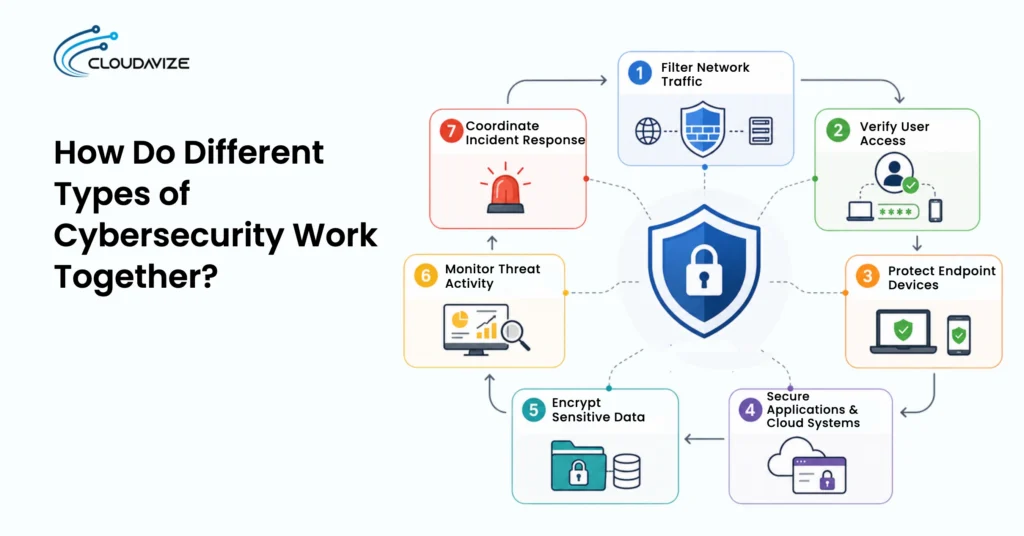
Different types of cybersecurity operate as interconnected layers in a defense-in-depth model, where each layer reinforces the others to eliminate single points of failure. Overlapping controls filter network traffic, verify user access, protect endpoint devices, secure applications and cloud systems, encrypt sensitive data, monitor threat activity, and coordinate incident response. Together, these layers reduce the attack surface, limit unauthorized access, improve threat detection, and strengthen business continuity against evolving cyber threats.
Here’s how different types of Cybersecurity work together:
- Filter Network Traffic
Network security filters traffic using firewalls and intrusion detection systems (IDS), cloud security extends these controls to virtual environments, and IoT security monitors traffic from connected devices. Shared security rules block malicious traffic across on-premises and cloud networks. - Verify User Access
Identity and access management (IAM) authenticates users, endpoint security verifies device health before granting access, and mobile security enforces MDM policies. Together, these controls support a Zero Trust approach by continuously validating users and devices before allowing access to business resources. - Protect Endpoint Devices
Endpoint security uses EDR to monitor devices, mobile security protects smartphones and tablets, IoT security secures connected devices, and network security isolates compromised endpoints to prevent threats from spreading laterally. - Secure Applications and Cloud Systems
Application security reduces software vulnerabilities through secure coding, testing, and patch management, while cloud security protects hosted applications using encryption, identity controls, and secure configurations. Together, they prevent attackers from exploiting applications to reach sensitive data. - Encrypt Sensitive Data
Data and information security encrypts data at rest, network security encrypts data in transit, and cloud security protects data stored in hosted environments. Consistent encryption across all environments keeps information secure even if one security layer is bypassed. - Monitor Threat Activity
Operational security establishes monitoring procedures, while network security, endpoint security, and cloud security continuously generate traffic logs, device alerts, and cloud events. A SIEM platform correlates these signals into a unified view for faster threat detection and investigation. - Coordinate Incident Response
When a security incident occurs, monitoring systems detect the threat, network security isolates malicious traffic, endpoint security quarantines affected devices, IAM revokes compromised credentials, data security protects backups, and operational security executes the incident response plan to restore normal operations.
What Should Businesses Consider When Planning Cybersecurity?
Businesses should plan cybersecurity by identifying critical business needs, compliance requirements, and cyber threats to implement appropriate security measures, reduce risks, and strengthen overall business resilience. According to guidance from the SBA, FTC, FCC, and CISA, an effective cybersecurity strategy starts with knowing what needs protection, who can access it, and how the organization will respond to a security incident.
These 7 factors should be considered when planning business cybersecurity:
- Business Needs
Identifying which systems, data, applications, and operations are most critical to organizational objectives is the first step before selecting cybersecurity controls. A company that relies heavily on remote work needs stronger endpoint and VPN security, while a business processing high volumes of customer transactions should prioritize application and data security. Aligning cybersecurity investments with actual business priorities prevents overspending on low-risk areas and underprotecting high-value assets. - Compliance Requirements
Understanding which legal, regulatory, and industry standards apply to the business is essential, as these define required security controls, documentation, and incident reporting procedures. Non-compliance carries financial penalties, legal liability, and reputational damage. Common frameworks include GDPR for personal data protection, HIPAA for healthcare information, PCI DSS for payment card security, and SOC 2 for service organization controls. - Data Sensitivity
Not all business data carries the same risk, and classifying it by sensitivity level determines which protections apply. Financial records, customer PII, intellectual property, employee records, and health information all carry different risk profiles and regulatory obligations. Data that would cause significant financial, legal, or reputational harm if exposed requires stronger controls, including encryption, access restrictions, monitoring, and defined retention and disposal policies. - Cloud Use
Every cloud platform a business depends on introduces security risks that require evaluation, including Microsoft 365, Google Workspace, Azure, and AWS. Misconfigurations, excessive permissions, and unsecured third-party integrations are the leading causes of cloud breaches. Essential controls to consider include CSPM for detecting misconfigurations, IAM for managing access, CASB for enforcing security policies across SaaS applications, CWPP for workload protection, and DLP with encryption for data in cloud environments. - Application Risks
Businesses should assess any web, mobile, or internal application that processes sensitive data or connects to their system for security vulnerabilities. According to OWASP Top 10, the most exploited application vulnerabilities include injection attacks, broken authentication, security misconfiguration, and cross-site scripting. Applications built without secure development practices or left unpatched after deployment create persistent entry points for attackers. - Access Controls
Defining who can access which systems, under what conditions, and with what level of privilege is one of the most impactful cybersecurity decisions a business can make. Overly broad access permissions are a leading factor in insider threats and credential-based breaches. Technical access models to evaluate include DAC, MAC, RBAC, and ABAC, each governing access based on different authorization rules. Access should be reviewed regularly, especially during employee role changes, onboarding, and offboarding. - Attack Surface
Mapping and continuously reducing all possible entry points attackers can exploit is an ongoing process, not a one-time assessment. Every new tool, integration, or user account expands the attack surface across endpoints, applications, network interfaces, cloud services, email systems, and connected devices. Regular assessments, removal of unnecessary services, timely software updates, and strict access controls help limit exposure and lower the probability of a successful breach.
When Should Businesses Consider Managed Cybersecurity Services?
Businesses should consider managed cybersecurity services when they lack in-house expertise, support remote or hybrid teams, handle sensitive data, or face compliance requirements across multiple frameworks. Internal IT teams often lack the bandwidth to maintain 24/7 monitoring, manage security tooling across endpoints, cloud, and networks, and respond to incidents fast enough to limit damage.
Partnering with a managed service provider bridges the gap between internal capabilities and modern threat demands. Core managed cybersecurity services include continuous monitoring through MDR and SIEM, endpoint and cloud security management, identity and access controls, managed firewall and network defense, and security awareness training, providing 24/7 protection and faster incident response without the cost of a full in-house security operations team.